The salt air off the coast of New South Wales has a way of erasing the noise of the world. When you stand where the whitewash hits the sand, the political shouting matches in Canberra feel a thousand miles away. The ocean demands a specific kind of presence. It forces you to look at the horizon, to watch the shifting shadows beneath the swells, to respect the boundary between human territory and the wild.
But lately, that boundary has a new sound. It is a high-pitched, mechanical whine, slicing through the rhythm of the crashing waves.
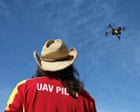
Up there, cutting through the sea breeze, a drone hovers. It is part of a newly expanded, year-round patrol network designed to scan the clear blue waters for apex predators. To the families packing up their towels and umbrellas, that mechanical hum is the sound of modern reassurance. It is proof that someone, or something, is watching over them.
Yet just an hour inland, sitting at a kitchen table covered in neatly stacked manila folders, someone else is dealing with a completely different kind of shadow.
The Watchers in the Air
Consider a Saturday morning at Bondi or Byron Bay. The sand is already burning hot by 10:00 AM. Swimmers plunge into the breakers, completely oblivious to the sophisticated lens tracking them from sixty meters above.
For years, shark-spotting drones were a seasonal fixture of the Australian summer, a temporary shield deployed when the beaches were packed to capacity. Now, the government has decided that the eye in the sky will never blink. The patrols are going year-round.
The logic is simple enough. Climate patterns are shifting. Water temperatures are fluctuating unpredictably, drawing marine life into new territories at unusual times of the year. People are surfing through the dead of winter, clad in thick neoprene, trusting that the ocean remains the same playground it has always been.
But the introduction of permanent surveillance alters the psychological relationship we have with the wild. When you look up and see a carbon-fiber bird tracking your every move, the illusion of coastal escape thins out. We are trading a sliver of our coastal freedom for a massive injection of predictability. The data flows from the drone to a pilot on the beach, then to an app on a smartphone, turning the raw, untamed Pacific into a managed space.
We want to believe we can eliminate risk entirely. We want to believe that if we throw enough technology at the horizon, we can ensure that nothing bad ever happens to the people we love.
If only the same could be said for the systems we build on land.
The Financial Shadow
While the drones keep watch over the shoreline, a much colder storm has been brewing in the halls of Parliament. Treasurer Jim Chalmers recently found himself pinned to the wall over an entirely different safety net—one that has failed completely for thousands of ordinary people.
It is known colloquially as the widow tax.
To understand the weight of this policy, you have to leave the beach behind and look at what happens when a life partner steps out of the frame. Imagine a woman named Margaret. This is a composite scenario, but her reality is mirrored in countless households across the country. Margaret and her husband spent thirty years contributing to the economy, paying their taxes, and building a modest nest egg. They believed in the contract. They believed that if they played by the rules, the system would hold them up when they grew old.
Then, the unexpected happens. A sudden illness, a quiet room, and a lifetime of partnership evaporates.
In the wake of that grief, the state steps in. Under current pension and superannuation rules, the death of a spouse often triggers a brutal recalculation of government support. Instead of allowing the surviving partner to maintain the modest financial security they built together, the system slashes benefits, reclassifies income thresholds, and levies taxes that treat the grieving spouse as an entirely separate, wealthier entity than they actually are.
The logic behind the policy is rooted in dry, bureaucratic arithmetic. The state reasons that one person costs less to support than two.
But a house does not suddenly become half as expensive to heat when a husband dies. The council rates do not drop by fifty percent. The grocery bill shrinks slightly, but the cost of maintaining a life remains stubbornly fixed.
When challenged on this reality, politicians often retreat into the language of fiscal responsibility and structural constraints. They talk about budgets, deficits, and long-term economic sustainability. They point to charts and spreadsheets to justify why a grieving person must now give up a larger portion of their dwindling resources.
The Illusion of the Net
There is a striking irony in these two simultaneous national conversations. On one hand, we are spending millions of dollars to put advanced technology into the sky to protect people from a threat that is statistically incredibly rare. On the other hand, we are actively clawing back financial security from people facing a tragedy that is absolutely inevitable for millions of couples.
Both issues are fundamentally about how a society chooses to protect its citizens.
A drone over a beach is a highly visible, comforting symbol of governance. It looks active. It looks modern. It allows a premier or a minister to stand in front of a microphone and say, "We are keeping you safe."
A line item in a tax code, however, is invisible. It operates in the quiet corners of suburban homes, tucked away in letters from Centrelink or the Australian Taxation Office. It does not make for a dramatic evening news broadcast unless someone stands up in a public forum and demands answers from a treasurer who would rather talk about inflation targets.
When Chalmers was grilled on the matter, the tension was palpable. The questions weren't about abstract economic theories; they were about the human friction caused by a system that feels fundamentally unfair. It is the friction of a widow realizing that the country she spent her life building views her vulnerability as a budgetary line item to be optimized.
The Shifting Tide
We live in an era that worships data and oversight. We trust the algorithm to spot the dark shape moving through the water, and we trust the treasury model to balance the nation's books. But models are bloodless. They don't understand the panic of a sudden current, nor do they understand the quiet despair of looking at a bank balance that no longer matches the cost of living alone.
The year-round drone patrols will continue to hum above the surfers at sunrise. The technology will get sharper, the response times faster, and the beaches will be declared safer than ever before.
But true safety isn't just about surviving the day at the beach. It is about what happens when you come home, put the towel away, and face the long, cold reality of the years ahead. Until the structures we build on land match the vigilance of the machines we put in the air, the safety net we boast about will remain dangerously incomplete.