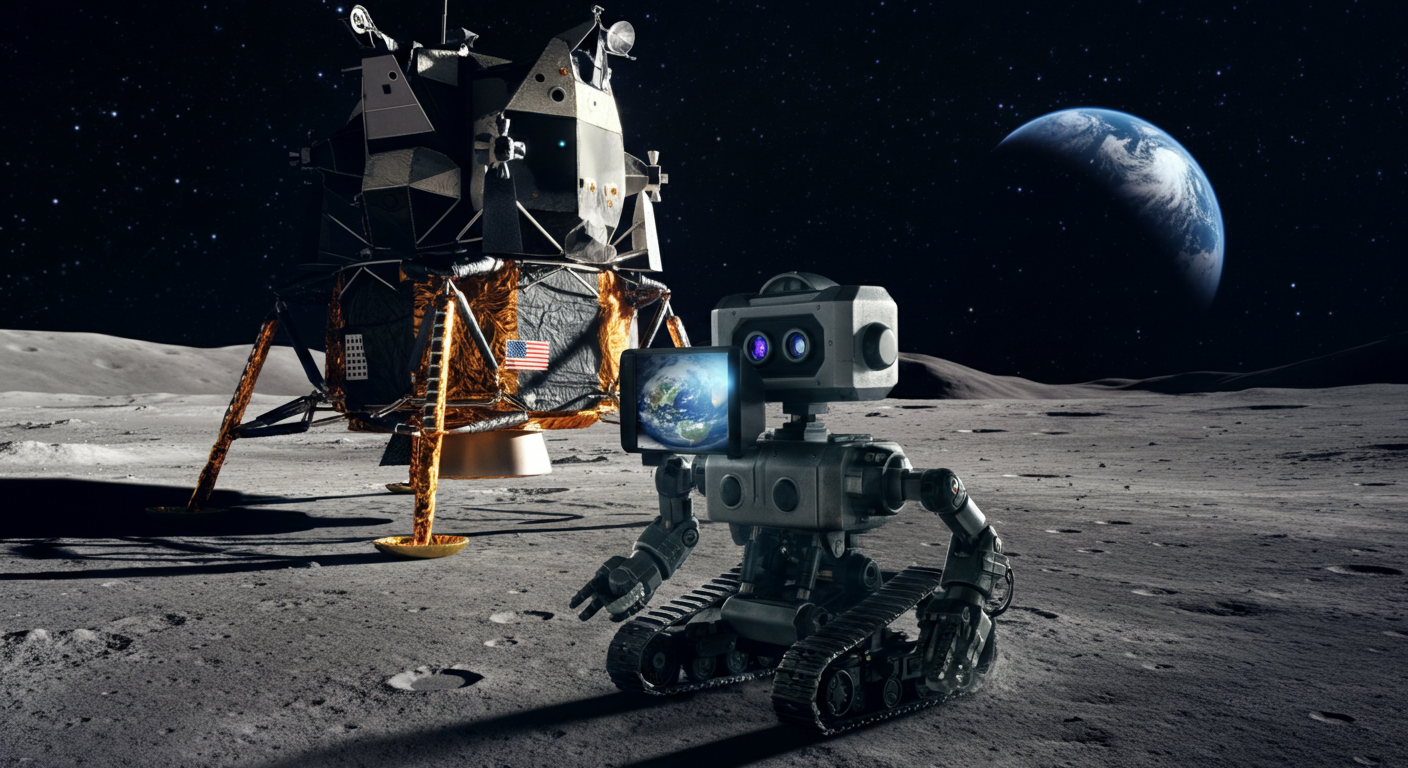
Giant, multi-billion-dollar rovers get all the press, but they have a massive vulnerability. If a multi-ton machine stuck in a crater flips over or snaps an axle, the entire mission dies instantly. Every pound sent into space requires a ridiculous amount of fuel, meaning massive exploration vehicles are becoming a financial and logistical nightmare.
When Japan Aerospace Exploration Agency (JAXA) successfully executed its Smart Lander for Investigating Moon (SLIM) mission, the biggest breakthrough wasn't just the precision "pinpoint" landing. It was a tiny, 250-gram mechanical ball named SORA-Q.
Roughly the size of an orange or a baseball, this miniature machine proved that shape-shifting swarm robotics are no longer a sci-fi trope. They are a viable, cheap, and incredibly resilient strategy for navigating hostile planetary surfaces.
The Toy Design That Solved Space Travel's Toughest Problem
Every ounce matters when you're escaping Earth's gravity. To build the world's smallest and lightest lunar rover, JAXA skipped traditional aerospace contractors and partnered with a surprising ally: Takara-TOMY, the toy company famous for co-creating Transformers.
They also brought in Sony for compact image-processing technology and Doshisha University for mechanical insights.
The engineering issue was clear. Traditional rovers require heavy suspensions, independent motors, and bulky wheels that take up precious cargo space inside a lander. SORA-Q bypassed this entirely by launching as a solid, sleek sphere wrapped in a honeycomb aluminum-alloy shell.
This spherical state protected the delicate internal electronics from the brutal g-forces of launch and the violent impact of deployment.
Once it was dropped onto the lunar regolith (the fine, powdery dust covering the Moon), the magic happened. The sphere split cleanly down the middle. The two hemispherical outer shells popped outward to act as eccentric wheels.
A tiny stabilizer tail extended from the rear to prevent the body from spinning out of control, and a central camera flipped upward to scan the horizon.
Instead of heavy gears, the robot crawls across the ground by rotating its outer shells in an asymmetrical, undulating motion inspired by sea turtles and frogs. It is a highly efficient way to navigate loose, slippery sand without getting bogged down.
Saving a Faceplanting Spacecraft
The real-world test came when SLIM reached the Moon near the Shioli crater. The landing was historically accurate but physically chaotic. One of the lander’s main engines suffered a failure right before touchdown, causing the spacecraft to tumble and land completely upside down, resting flat on its nose.
With its solar panels facing the wrong way, engineers back on Earth were blind. They didn't know the orientation of the lander or exactly why power levels were dropping.
Fortunately, just seconds before impact, SLIM successfully ejected its miniature payload. SORA-Q, officially designated as Lunar Excursion Vehicle-2 (LEV-2), rolled onto the dirt, transformed into its wheeled mode, and immediately began operating autonomously.
It didn't rely on real-time commands from Earth. The mini-rover used its onboard cameras and processing software to find the stricken lander, drive around it, and snap a clear, color photo showing the upside-down spacecraft resting on its nose.
SORA-Q transmitted this data wirelessly to its companion hopper, LEV-1, which then beamed the images back to Earth. That single, dramatic photo gave JAXA engineers the precise telemetry they needed to adjust their plans and eventually revive the lander when the sun hit the panels weeks later.
Why Scale Matters for the Next Moon Rush
SORA-Q was never built to drill for ice, travel miles across the lunar plains, or analyze minerals. It was a proof of concept. The success of this tiny shape-shifter shows why the aerospace industry is moving away from single, massive rovers and heading toward micro-robot swarms.
- Extreme Temperature Survival: The tiny robot endured a brutal thermal environment, operating successfully in temperatures that swing from 250 degrees Fahrenheit in direct sunlight down to minus 208 degrees during the pitch-black lunar night.
- Cost and Redundancy: Sending one massive rover costs hundreds of millions. If it fails, the mission is over. Sending a swarm of fifty 250-gram transforming robots costs a fraction of the price. If five of them fall into a crevice, you still have forty-five active explorers on the ground.
- Unprecedented Access: Giant wheeled vehicles cannot risk entering steep, unstable craters or narrow lava tubes where they might get trapped permanently. Small, tumbling spheres can roll down slopes, squeeze through tight openings, and map underground environments that are completely inaccessible to traditional machinery.
Deploying the Micro-Swarm Strategy
If you are developing remote sensor setups, building automated hardware, or managing data collection in rugged environments, the lesson from JAXA is clear: prioritize modularity and redundancy over sheer scale.
Instead of designing one complex system that must handle every single variable perfectly, break the problem down into miniature, hyper-focused units.
The next step for space agencies and private lunar firms isn't building a bigger wheel; it is manufacturing these tiny, shape-shifting scouts by the dozen to map out landing zones before human boots ever touch the ground.