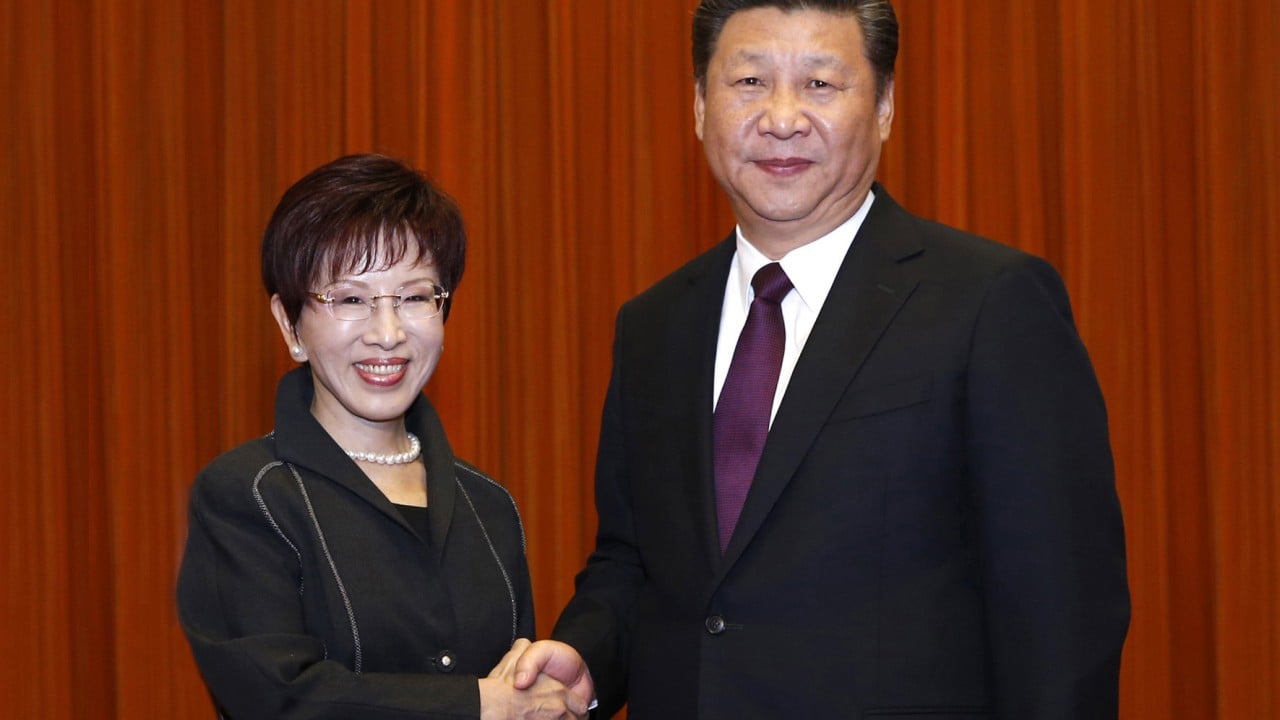
Hung Hsiu-chu knows what it feels like when the air in a room turns thin. She has spent decades in the high-stakes theater of cross-strait politics, but recently, the atmosphere has changed. It isn’t the heat of an active fire. It is something far more chilling. It is the "cold peace"—a state of being where two sides stop talking, start bracing, and wait for the other to blink.
The former chairwoman of the Kuomintang (KMT) recently stood before a crowd and didn't just talk about policy. She talked about survival. She spoke of a bridge that is rotting from lack of use. When the machinery of diplomacy grinds to a halt, the silence that follows isn't peaceful. It is the silence of a fuse burning in a vacuum.
The Breakfast Table Border
Consider a hypothetical family in New Taipei City. Let’s call the daughter Mei. Mei is twenty-four, works in graphic design, and spends her weekends hiking the lush trails of Yangmingshan. To Mei, the "Taiwan Question" is a background hum, like the sound of a refrigerator you’ve stopped noticing. But for her grandfather, who remembers the frantic energy of the 1990s and the tentative handshakes of the 2000s, that hum sounds like a warning.
He remembers when the "Three Links" opened up. He remembers when a flight from Taipei to Shanghai wasn't a political statement, but a business trip. Today, Mei looks at her phone and sees headlines about military drills and severed communication lines. The distance between the two shores hasn't changed in miles, but in the minds of the people living there, the Strait has become an ocean.
Hung Hsiu-chu’s recent pleas are directed at this widening gap. She argues that the current "cold peace" is a fragile mask. Underneath it, trust has evaporated. When trust dies, everything becomes a threat. A fishing boat off course is no longer an accident; it’s a provocation. A trade adjustment isn’t economics; it’s warfare.
This isn't just about politicians in suits. It’s about the "invisible stakes." It’s about whether Mei’s future involves a flourishing career in a connected Asia or a frantic scramble for a basement shelter.
The Architecture of Mistrust
The tragedy of the current stalemate is that it feels inevitable to those caught within it. The ruling Democratic Progressive Party (DPP) maintains a stance of sovereignty that resonates with a younger generation’s identity. Meanwhile, Beijing watches through a lens of historical grievance and strategic necessity. Between them lies a void where dialogue used to live.
Hung’s message is unpopular in many circles. It is difficult to talk about "rebuilding trust" when the rhetoric on both sides is dialed to a scream. But she insists that the alternative is a slow-motion slide into a catastrophe no one actually wants.
Trust isn't built on grand declarations. It is built on the mundane. It is built on student exchanges, on joint police efforts to stop human trafficking, on shared weather data that helps farmers on both sides of the water. When these "soft" connections are severed, we lose our humanity in the eyes of the "other."
We begin to see statistics instead of people. We see "targets" instead of neighbors.
The Cost of Silence
In the world of international relations, "Strategic Ambiguity" was once the gold standard. It was a clever way of keeping everyone guessing so that no one would act. But ambiguity requires a baseline of communication to function. Without a phone line that works, ambiguity turns into paranoia.
The KMT’s old guard, represented by voices like Hung, are often accused of being out of touch. Critics say they are chasing a ghost—the 1992 Consensus—that the public has moved past. Perhaps. But Hung’s point goes deeper than a specific political formula. She is highlighting the physiological stress of a society living in a permanent state of "almost-war."
Economic costs are easy to quantify. We can look at the billions of dollars in trade and the dominance of the semiconductor industry. But how do you measure the cost of a generation that stops planning for a twenty-year future because they aren't sure what the next five will bring?
You see it in the birth rates. You see it in the brain drain. You see it in the way people talk about their savings. This is the "cold peace" tax. It is a levy on the soul of a nation.
The Mirror and the Wall
Hung Hsiu-chu’s call to action is a demand for a mirror. She wants both sides to look at what they are becoming in this isolation. On the mainland, the narrative of "reunification" hardens into a deadline. In Taiwan, the narrative of "defense" hardens into a bunker.
Rebuilding trust requires a level of vulnerability that current politics forbids. It requires admitting that the "other" has legitimate fears. It requires stepping back from the edge of the "cold peace" and realizing that while the peace is cold, the war would be white-hot.
There is a specific kind of bravery in being the person who asks for a bridge while everyone else is busy reinforcing the walls. It isn't always rewarded. Often, it’s mocked. But as the gray ships circle and the rhetoric sharpens, the wisdom of the bridge-builder starts to look less like nostalgia and more like a desperate, necessary sanity.
The door hasn't slammed shut yet. There is still a sliver of light coming through the frame. But the hinges are rusted, and the wind is picking up.
Everything depends on whether we are willing to put a hand out and stop the latch from clicking into place. If the door closes, we are left in the dark, and in the dark, we only know how to strike at what we cannot see.