The sky over the Great Plains and the Great Lakes doesn't just turn gray when a supercell breathes. It turns a bruised, sickly shade of violet-green, the color of a fresh trauma. For those living in the crosshairs of the atmospheric instability that recently carved a jagged line from Oklahoma up through Michigan, that color is the first warning. It is the visual manifestation of a pressure drop so severe it makes your inner ear ache before the sirens even find their voice.
We talk about natural disasters in numbers. Six dead. Dozens injured. Wind speeds of 110 miles per hour. But numbers are a sanitized language. They are the bandages we wrap around a wound to avoid looking at the jagged edges of the tear. To understand what happened across the American heartland this week, you have to move past the statistics and into the mud, the splinters, and the sudden, violent silence that follows the roar. Read more on a similar subject: this related article.
The Anatomy of a Second
Imagine a Tuesday evening in a small Oklahoma town. You are doing something mundane. Perhaps you are debating whether to finish the dishes or finally sit down to watch the news. The air feels heavy, like a wet wool blanket. Then, the birds stop singing. The silence is absolute, right until it isn't.
When a tornado is a mile out, the sound is often described as a freight train. That is an understatement. It is the sound of the earth being fed into a woodchipper. It is a mechanical, grinding howl that vibrates in your marrow. Additional analysis by Associated Press explores comparable perspectives on this issue.
In Michigan, the geography is different, but the terror is identical. The rolling hills and dense treelines of the Lansing area offer a false sense of security. You think the terrain might break the wind’s spirit. It doesn't. As the storms tracked northeast, they ignored the borders of states and the logic of the landscape. They moved with a predatory indifference, turning suburban sanctuaries into debris fields in the span of thirty seconds.
The Invisible Stakes of a Basement Floor
We often view these events as "acts of God," a term that suggests a random lightning bolt from the blue. In reality, these tragedies are a collision of physics and human vulnerability. The atmospheric setup involved a surge of warm, moist air from the Gulf of Mexico slamming into a cold, dry front descending from Canada.
$$K = \frac{1}{2}mv^2$$
The kinetic energy involved in a localized vortex is staggering. When you see a roof lifted cleanly off a house, you are witnessing the physical manifestation of pressure differentials that turn a home into a pressurized vessel until it simply cannot hold itself together anymore.
But the real story isn't the physics. It’s the choice made in the dark.
Consider a hypothetical father in a Michigan mobile home park. He knows the sirens are going off. He knows he should get to a sturdier shelter. But he also knows his youngest daughter is terrified of the dark, and the power just flickered out. He spends three precious minutes looking for a flashlight and a pair of shoes. In the world of tornadic activity, three minutes is the difference between a close call and a casualty.
When officials reported those six fatalities, they weren't just reporting a headcount. They were reporting the end of six unique internal worlds. One victim was found in a vehicle flipped like a discarded toy. Another was trapped under the weight of a collapsed wall. These aren't just "officials say" moments; they are the permanent shattering of families who, ten minutes prior, were worried about grocery lists or school plays.
The Geography of Grief
In the aftermath, the landscape is unrecognizable. Not because the landmarks are gone, but because the context of life has been scrambled.
You see a bathtub sitting in the middle of a field, perfectly intact, while the house it belonged to has been reduced to a pile of gray toothpicks. You see a photograph of a wedding day stuck to a barkless tree trunk three miles from its origin. This is the surrealism of the storm. It takes the most intimate pieces of our lives and scatters them with a chaotic, mocking hand.
The recovery process is often described as "resilient," a word we use to comfort ourselves when we don't know how to help. But resilience is exhausting. It means waking up every morning to the smell of damp insulation and the sight of your life’s work in a dumpster. It means jumping every time the wind picks up or the sky darkens.
The psychological toll of these outbreaks is a shadow that lingers long after the power lines are repaired. For the survivors in Oklahoma and Michigan, the world is no longer a solid place. It is a temporary arrangement of wood and glass that can be revoked at any moment by a cloud.
The Economics of a Shingle
There is a cold reality to the rebuilding that follows. While the national news cycle moves on to the next headline within forty-eight hours, the people on the ground enter a bureaucratic purgatory. Insurance adjusters, FEMA applications, and the skyrocketing cost of lumber become the new daily bread.
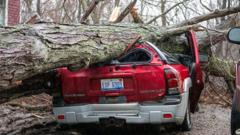
The invisible cost of a six-death storm isn't just the loss of life; it’s the slow grinding down of a community’s middle class. Many of these areas are populated by people for whom a five-hundred-dollar emergency is a crisis. A demolished garage or a car crushed by an oak tree is a financial catastrophe that can take a decade to erase.
We look at the radar maps and see red polygons. We hear the meteorologist talk about "hook echoes" and "debris balls." We track the path on our phones. But we rarely consider the person behind the screen who is currently huddled in a crawlspace, smelling the dirt and praying that the joists above their head hold for just one more minute.
The tragedy in Oklahoma and Michigan wasn't a singular event. It was a thousand individual wars fought in the dark, against an enemy that cannot be reasoned with or outrun.
The Weight of the After
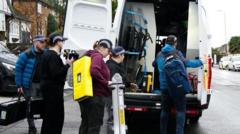
Search and rescue teams move through the debris with a specific kind of focused intensity. They use spray paint to mark the houses they’ve cleared. An "X" on a door—or what remains of a door—is a shorthand for survival.
One half of the "X" indicates the time the search was conducted and the team that did it. The other half indicates what they found. When that number is a zero, there is a collective, unspoken exhale. When that number is anything else, the air leaves the neighborhood.
The six people who didn't make it through this week’s storms leave behind holes in the social fabric that cannot be patched with drywall. They are the empty chairs at breakfast tables. They are the voices that won't be heard in the grocery store aisles. They are the reminders that for all our technology, for all our "cutting-edge" radar and early warning systems, we are still small things living on a very loud planet.
If you walk through these neighborhoods today, you will see something remarkable. You will see neighbors who haven't spoken in years sharing chainsaws and bottled water. You will see strangers driving from three counties away to help move a fallen cedar. This isn't just "community spirit." It is a primal, human response to the realization that everything we own is borrowed from the wind.
The sirens eventually stop. The clouds break, and the sun comes out, shining with a cruel brightness on the wreckage. You pick up a piece of someone’s roof from your front yard. You look at it, a simple piece of asphalt and grit, and you realize that the only thing truly standing between us and the elements is a thin layer of luck and the strength of the person standing next to us.
The freight train has passed, but the tracks it left behind are carved into the hearts of everyone who heard it coming.