The heat in the eastern forests of the Democratic Republic of Congo does not just sit; it heavy-presses against your chest until breathing feels like swallowing wet wool. In the North Kivu province, that heat carries the scent of red earth, woodsmoke, and, lately, an absolute, terrifying quiet.
When you walk into a village where the fever has taken hold, you do not hear shouting. You do not hear mourning, not at first. You hear the absence of children playing. You notice the doors that remain shut at noon.
Ebola is not a new enemy here. It is an old ghost that knows the pathways of the forest better than any mapmaker. The latest dispatches from the Ministry of Health and international monitoring bodies read like a ledger of despair: eighty lives gone. To a reader sitting thousands of miles away under the cool hum of an air conditioner, eighty is a statistic. It is a minor data point on a global health dashboard, easily swiped away to check the weather or the stock market.
But eighty is not a number.
Ebola is a thief that requires a very specific currency. It demands the destruction of human connection. To understand what is happening right now in the thick, contested terrains of eastern DR Congo, you have to look past the spreadsheets and look at the hands of a mother named Bahati.
Bahati is a composite of three women I spoke with during my time reporting on previous outbreaks along the Ebola River basin, but her reality is entirely accurate to the ground right now. She knows that under normal circumstances, when a child burns with a fever, you press them to your chest. You wipe their brow with the hem of your skirt. You hold their hand so they know they are not alone in the dark.
Ebola turns that instinct into a death sentence.
The virus thrives on love. It waits for the moment of touch, transmitting through the very fluids that bind us in caregiving—sweat, tears, blood. When Bahati’s eldest son began vomiting, she faced a choice that no human being should ever have to make. Distance or devotion. If she held him, she risked orphaned her remaining two children. If she stayed back, he would die looking at a mother who appeared to have abandoned him.
Consider the biological malice of this pathogen. It is a filovirus, a microscopic strand that looks under an electron microscope like a cruel piece of thread tangled on itself. Once it enters the bloodstream, it targets the endothelial cells that line the blood vessels. It systematically dismantles the body's ability to clot. It causes internal and external bleeding, organ failure, and a profound, rapid dehydration.
The science is brutal, but the sociology is worse.
In places like Butembo or Beni, the medical response is not just a scientific endeavor; it is a geopolitical minefield. This is a region scarred by decades of conflict. Dozens of armed militia groups roam the hills. The local population has learned, through generations of betrayal, to distrust anyone wearing an official uniform.
Then, the white trucks arrive.
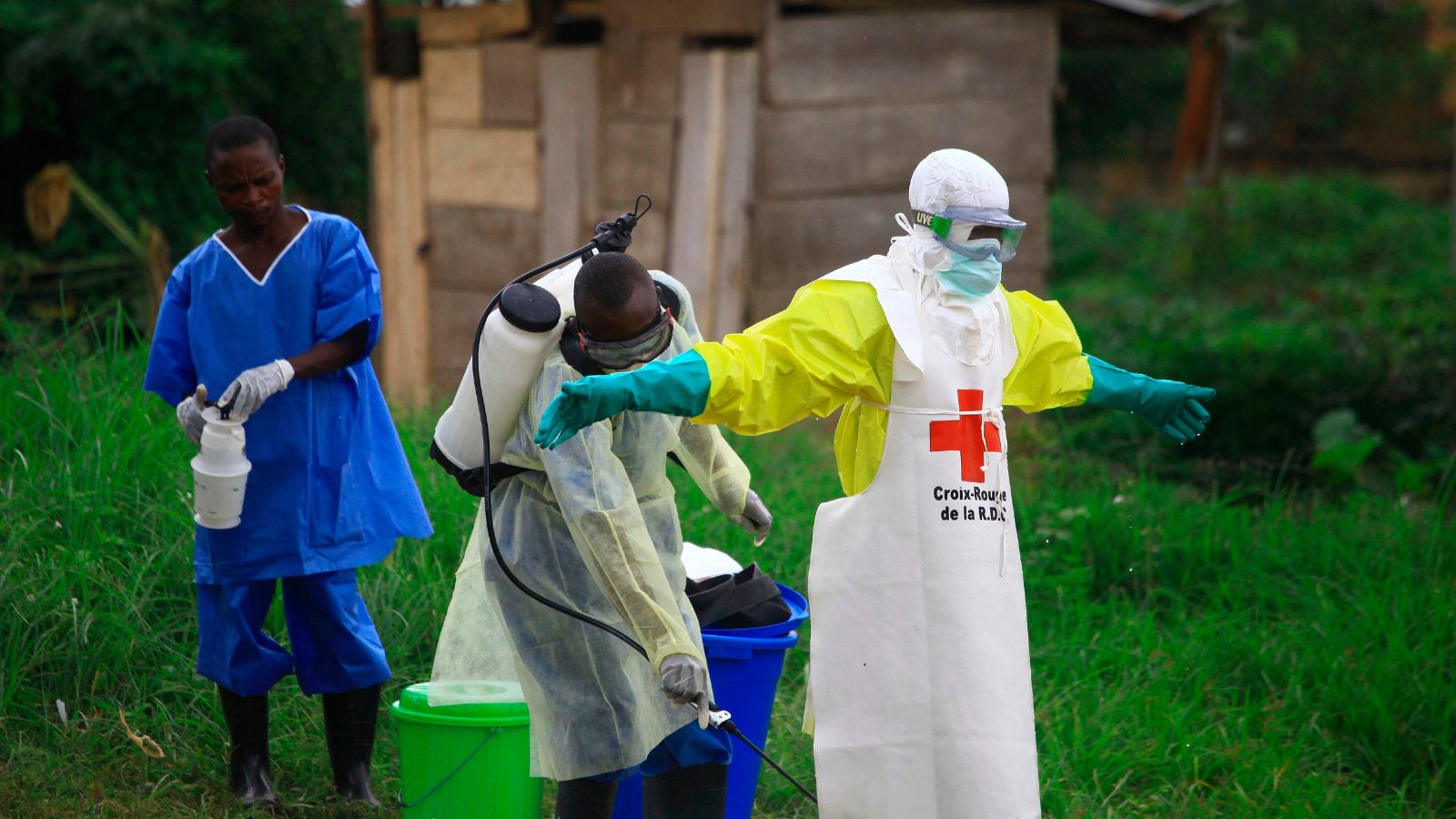
Foreigners and urban elites step out, encased in thick, ghostly white personal protective equipment (PPE). They look like astronauts walking through a tropical rainforest. They do not have faces, only plastic visors smeared with condensation. They tell you that you cannot bury your grandfather according to ancestral traditions. They tell you that washing his body—a sacred act of respect—will kill everyone who attends the funeral.
Can you blame the community for pushing back?
Imagine being told that your loved one’s body is a biological weapon. The teams from the World Health Organization and local health zones face a wall of skepticism that cannot be dismantled by showing people charts or lecturing them on virology. During my days in the region, I watched an elder shake his fist at a decontamination team. He did not believe in the virus; he believed what his eyes told him—that whenever the white trucks showed up, people died, and their bodies vanished into unmarked, chlorinated graves.
That distrust is the true vector of the disease.
The medical community has incredible tools now that did not exist during the catastrophic West African outbreak of 2014. We have Ervebo, a highly effective vaccine. We have monoclonal antibody treatments like Ebanga and Inmazeb that can save lives if administered early. The science has advanced remarkably.
Yet, eighty people are dead. Why?
Because a vaccine is useless if it stays inside a solar-powered fridge because the health workers are hiding in a ditch from gunfire. The security crisis in eastern DR Congo means that tracking a contact—finding everyone who sat next to a feverish patient on a motorbike taxi—is an act of extreme bravery. Health workers are targeted by rebel groups who view the Ebola response as a lucrative government scheme or a foreign intervention.
The math of an outbreak is simple, relentless, and terrifying. If one person infects two people, and those two infect four, the curve climbs toward the sky. The only way to break that chain is contact tracing. You must find the circle of contacts, isolate them, and vaccinate the surrounding ring of the community.
But how do you trace a contact through a war zone?
You don't. You lose track of them. They flee into the forest or cross the border into Uganda or Rwanda to escape a militia raid, carrying the invisible thread of the virus with them. The boundary lines drawn on political maps mean absolutely nothing to a microscopic organism seeking its next host.
The true weight of this crisis hits you in the treatment centers, often called an ETC (Ebola Treatment Center). Inside the high-risk zone, the air smells of bleach so strong it burns the back of your throat. The sound of plastic boots squelching through puddles of disinfectant becomes the soundtrack of your days.
I remember watching a nurse named Jean-Pierre through the orange plastic mesh fencing that separates the clean zone from the contaminated area. He had been working six-hour shifts in the suffocating heat of the suit. When he finally peeled off the layers of rubber and plastic, his scrubs were so soaked with sweat they clung to his ribs like wet tissue paper. His fingers were wrinkled and white from the moisture trapped inside his gloves.
I asked him why he kept doing it, especially when his neighbors whispered that he was a traitor for working with the international agencies.
He looked at his hands, raw and trembling. He told me about a little girl who had survived the week before. She was five years old. Her entire family had perished. When she was cleared to leave, she was designated a vainqueur—a victor. Before she stepped through the exit shower, she reached out her hand to touch his gloved finger.
"If we leave," Jean-Pierre said, his voice barely above a whisper, "the forest takes everyone."
The current outbreak, with its toll of eighty lives, is a warning bell ringing in an empty room. It tells us that global health security is not a matter of stockpiling medicine in Geneva or Washington. It is a matter of building a bridge of trust across a river of historical trauma in places like North Kivu.
If we view this as merely an African problem, or a Congolese problem, we misunderstand the nature of our modern world. A virus can travel from a remote village in the Congo to an international airport lounge in under thirty-six hours. The health of a child in Goma is directly connected to the health of a commuter in London or New York.
The solution does not lie in more security checkpoints or harsher border closures. It lies in listening. It lies in hiring local youth to do the contact tracing instead of bringing in outsiders who do not speak the local dialect. It lies in recognizing that a traditional healer is not an enemy to be bypassed, but the first line of defense who must be brought into the fold.
The sun sets early in the valleys near the Rwenzori Mountains, dropping behind the ridges and plunging the villages into sudden, absolute darkness. The generator at the local clinic sputters, its fuel running low. Inside a small mud-brick house, a woman starts to cough.
Her family looks at her. They look at the door.
The decision they make in the next five minutes—whether to hide her under a blanket or to walk three miles through rebel territory to a clinic with a white flag outside—will dictate whether the number stays at eighty, or becomes eighty-one, then one hundred, then a thousand.
The world is waiting to see if they will open that door, unaware that our own safety hangs on the hinges.