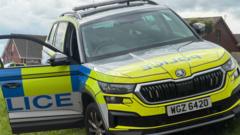
The metal of a cruiser door is cold. It is a specific kind of reinforced, industrial cold that presses through a uniform shirt during a late-night shift. For a patrol officer, that vehicle is not just transportation. It is an office, a shield, and a sanctuary. You learn the exact hum of its engine. You trust its weight.
Then, in a fraction of a second, that weight turns against you.
The radio chatter on a standard Tuesday night usually forms a predictable background hum. False alarms. Minor traffic stops. The mundane rhythms of a city settling into sleep. But the atmosphere changes when a call comes in about a stolen vehicle. The air inside the cabin grows heavy. Your pulse shifts. You do not think about statistics or policy in that moment; you think about the geometry of the streets, the glare of oncoming headlights, and the human being behind the wheel of a machine they have no right to possess.
It is a vulnerability few outside of law enforcement truly understand. We look at a police car and see authority. A predator sees a weapon.
The Physics of a Betrayal
Imagine standing on the asphalt, the flashing blue and red lights painting the brick walls of the alleyway in rhythmic strokes of crimson and cobalt. You are stepping out to investigate. Your boots crunch on broken glass.
Then comes the sound.
It is not the sound of an engine accelerating away from you. It is the terrible, whining screech of a transmission being slammed into reverse. Tires tear at the pavement. In that instant, the cruiser—the very symbol of your protection—is rushing toward you at thirty miles per hour.
A standard police interceptor weighs roughly four thousand pounds. When propelled backward by panic and criminal intent, it ceases to be a tool of the law. It becomes a blunt force instrument. The human body is remarkably fragile when measured against two tons of moving steel. The impact is a sickening, metallic thud, followed by the sensation of the ground rushing up to meet you.
The instinct to survive is a violent, chemical surge. As the officer is struck, pinned, or thrown across the hood, the world slows to a crawl. The smell of burning rubber fills the air. The blinding glare of the taillights dominates the field of vision.
Then, a gunshot shatters the night.
The Calculus of a Split Second
Why fire?
Mainstream media reports these incidents with clinical detachment: An officer was struck, a shot was fired, the suspect fled. The words are dry. They read like a grocery list of misfortunes. They entirely miss the calculus of survival happening inside an officer’s chest.
When an officer draws their weapon while being compromised by a moving vehicle, it is not an act of aggression. It is a desperate, reflexive bid to stop a lethal threat. You are already injured. The ground is unstable. Your dominant hand reaches for the holster while your mind processes a terrifying equation: If I do not stop this vehicle right now, it will roll over me.
Consider the mechanics of that shot. Your footing is gone. The target is moving. The glass of the windshield or the frame of the door alters the trajectory. It is an impossible shot taken under impossible circumstances. The report of the firearm is deafeningly loud, yet to the officer, it sounds muted, drowned out by the roaring adrenaline in their ears.
And then, silence. Or rather, the chaotic aftermath that feels like silence. The stolen car speeds away, leaving a trail of fluid on the pavement and an officer down in the dark.
The Ripple in the Concrete
The true cost of these encounters is rarely measured in the immediate medical reports. A broken leg heals. Bruises fade from purple to yellow and then vanish. The deeper fracture occurs in the collective psyche of a precinct.
When a civilian vehicle is stolen, it is a property crime. When a police car is taken and weaponized against its own crew, it feels like a violation of the social contract. It sends a chilling message through the ranks: nothing is safe. The tools provided to keep the peace can be turned into instruments of execution in the blink of an eye.
The families of those who wear the badge feel this shift acutely. They watch the news updates with a hollow feeling in their stomachs. They recognize that every shift is a roll of the dice, but seeing a cruiser crumpled against a wall, or reading about an officer struck down by their own unit, adds a layer of nightmare that logic cannot dispel. It forces a realization that the barrier between order and chaos is paper-thin, held together only by the bravery of individuals who are entirely flesh and blood.
The suspect who stole the car, who shifted the gears, who pressed the gas pedal into the floorboards, is often running from something small. A missed parole hearing. A minor possession charge. A panic-induced flight response that spirals into an attempted murder charge. The asymmetry is staggering. A life can be permanently altered or ended over a handful of bad decisions made in a stolen vehicle.
The flashing lights eventually fade. The investigators pack up their yellow tape. The street is washed clean of oil and glass, leaving only the dark scuff marks of tires that tell the story of a Tuesday night turned upside down. The city moves on, oblivious to the fact that on one specific corner, the world changed forever for a person who simply went to work hoping to make it home for breakfast.


