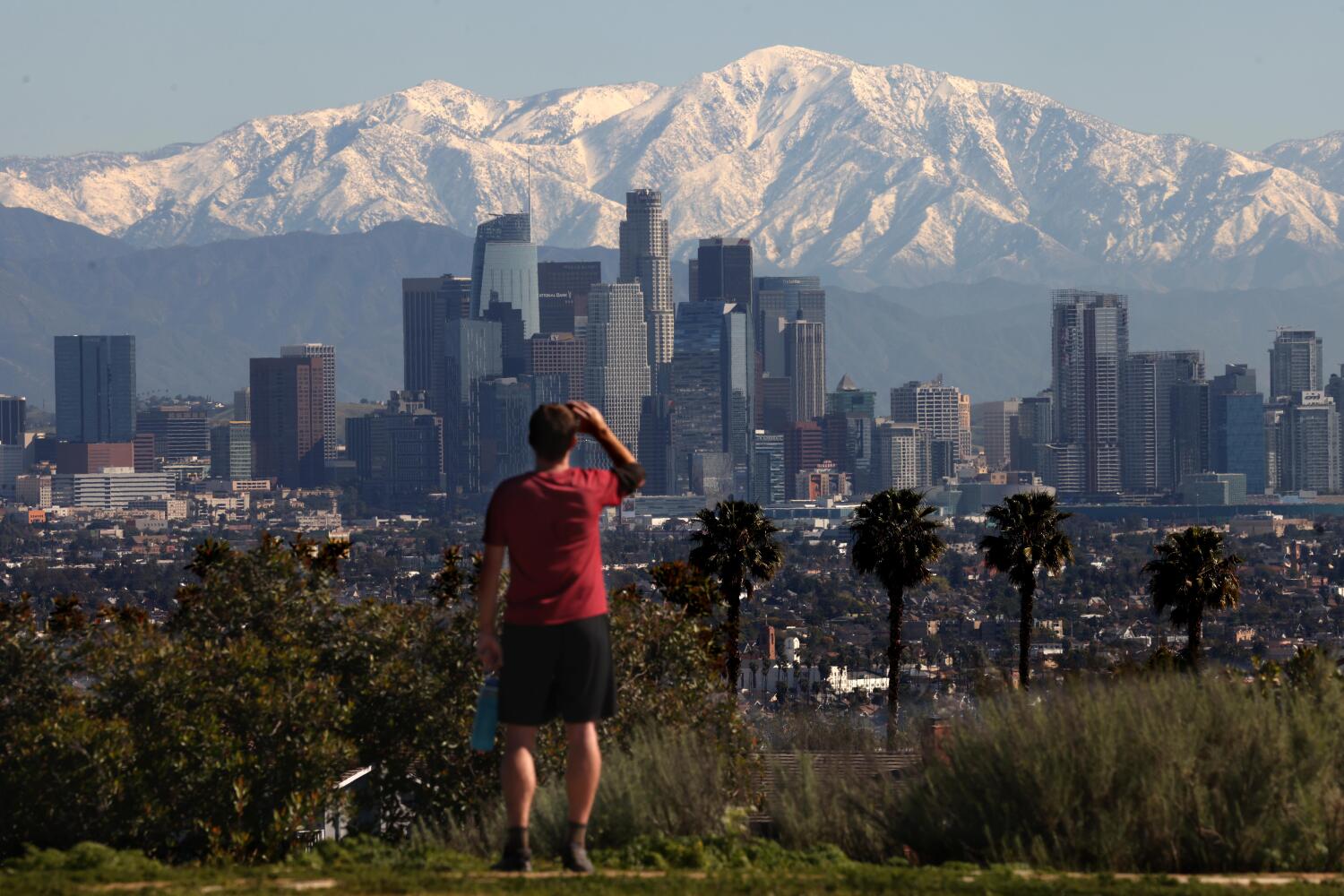
Southern California is currently staring down a thermal anomaly that threatens to shatter century-old records. While local news broadcasts fixate on beach weather and lighthearted warnings to find your sandals, the underlying data points to a far more aggressive shift in the regional climate than a simple "warm week." High-pressure ridges are locking over the Great Basin, driving temperatures into the high 80s and 90s across the Los Angeles Basin and Inland Empire. This isn't just a brief flirtation with summer; it is a fundamental rewrite of the seasonal calendar.
The immediate cause is a classic but amplified Santa Ana wind event. As cold air sinks over the high deserts of Nevada and Utah, it is forced through the narrow mountain passes of the Sierra Nevada and the Transverse Ranges. Gravity and pressure do the heavy lifting here. As that air drops in elevation, it compresses. Building on this topic, you can also read: Why the Green Party Victory in Manchester is a Disaster for Keir Starmer.
Compression means heat.
For every 1,000 feet the air descends, it warms by roughly 5.5 degrees Fahrenheit. By the time those gusts hit the coastal plains of Orange County or the San Fernando Valley, they are bone-dry and searing. This week, the ridge is so stationary and the pressure gradient so sharp that we are seeing triple-digit possibilities in February—a month historically defined by "June Gloom" precursors and steady rain. Analysts at The Washington Post have shared their thoughts on this trend.
The Infrastructure of Heat Fatigue
Los Angeles was built for a Mediterranean climate that no longer exists in its original form. The city’s physical footprint—a sprawling expanse of asphalt and dark roofing—acts as a massive Urban Heat Island. During these record-breaking stretches, the concrete absorbs solar radiation all day and bleeds it back into the atmosphere at night.
This prevents the "diurnal cooling" that Southern Californians have relied on for decades. When the nighttime low stays above 70 degrees, the human body cannot shed the heat stress accumulated during the day. This is where the danger lies. It isn’t just the peak afternoon temperature that kills; it is the lack of recovery time at night.
The electrical grid is the next domino. We are seeing a shift in energy demand patterns that usually wait until August. Utility providers are forced to balance the load as millions of air conditioning units kick on simultaneously in a season traditionally reserved for maintenance and grid upgrades. If the high-pressure system doesn't budge, the strain on local transformers becomes a silent threat to public safety.
The Mirage of the Permanent Summer
There is a psychological trap in Southern California weather reporting. We treat "sunny and 85" as a win, a perk of the zip code. But for the region's agricultural belts and water reserves, these heat spikes are a deficit.
The Snowpack Erosion caused by mid-winter heat is a long-term disaster disguised as a beach day. When temperatures in the Cajon Pass or the foothills hit the 90s, the freezing level in the mountains skyrockets. Any existing snow begins to melt prematurely or, worse, sublimates directly into the atmosphere without ever reaching the reservoirs.
Water Volatility and Soil Moisture
- Flash Droughts: High temperatures coupled with single-digit humidity suck moisture directly out of the soil.
- Fuel Loading: Vegetation that flourished during the last rainy cycle dries out in days, turning lush hillsides into tinderboxes.
- Evaporative Demand: The atmosphere essentially acts as a sponge, demanding more water from the earth than it can possibly give back.
Investors and homeowners often overlook the "hidden tax" of these heat events. Increased irrigation costs, skyrocketing utility bills, and the accelerated degradation of building materials under intense UV exposure are the quiet ways a record-breaking week drains the local economy.
Why the Jet Stream is Stalling
The "Why" behind this specific heat event is found in the Jet Stream’s increasing waviness. Normally, a fast-moving river of air circles the globe, keeping weather systems moving. However, as the temperature difference between the Arctic and the Equator shrinks, that river begins to meander.
It creates massive loops. When a northward loop—a ridge—parks itself over the West Coast, it acts like a physical barrier. It blocks storms and traps hot air in place. This "blocking pattern" is why we aren't just seeing a hot Tuesday; we are seeing a hot week, or a hot month.
The predictability of the seasons has evaporated. We are now in an era of weather whiplash, moving from atmospheric rivers and flooding to record-breaking heat in the span of a fortnight. This volatility makes traditional planning—for farmers, for city officials, and even for the average resident—nearly impossible.
The Fire Risk is No Longer Seasonal
The most dangerous myth in California is the "Fire Season." It used to have a start and an end. Now, it is a permanent condition.
When a heatwave hits in late winter, the fire departments are often at lower staffing levels or have equipment in the shop for annual service. The "off-season" is when the work gets done. But the wind doesn't care about the fiscal year. These Santa Ana events, supercharged by the heat, create a scenario where a single spark in the Santa Monica Mountains can escalate into a major conflagration before the first air tanker can get off the ground.
We are seeing a convergence of factors that go far beyond a "warm spell." It is the intersection of a stubborn high-pressure system, a weakened jet stream, and a landscape that has been baked dry by a decade of rising baselines.
Critical Safety Checks for Record Heat
- Hydration Dynamics: Start increasing water intake 24 hours before the peak heat arrives. Once you feel thirsty, you are already behind.
- Pet Safety: Asphalt temperatures can reach 140 degrees when the air is only 90. If you can’t hold the back of your hand on the pavement for seven seconds, it will burn their paws.
- Vulnerable Populations: Check on elderly neighbors who may be reluctant to run their AC due to cost concerns. Heat-related illness is often a quiet killer.
The Economic Reality of the Heat
Coastal real estate prices have long been buoyed by the "perfect" weather. But as these heat events become more frequent and more intense, the insurance industry is taking notice. We are seeing a recalibration of risk. It isn't just about fire; it's about the long-term habitability of the inland valleys where temperatures are increasingly pushing past the limits of human comfort.
The cost of living in Southern California is high, but the cost of cooling it is becoming the new overhead. Businesses that rely on outdoor foot traffic see a sharp decline when the mercury hits 95. Construction projects slow down. The productivity loss associated with extreme heat is a multi-billion dollar drag on the state's GDP.
We have to stop viewing these weeks as anomalies. They are the baseline. The record-breaking heat of today is the average Tuesday of tomorrow. This requires a shift in how we build our homes, how we manage our water, and how we talk about the weather. It isn't just time to bring out the flip-flops; it’s time to rethink the sustainability of the Southern California lifestyle.
Check your local cooling center locations and verify your emergency alert settings on your phone, as these temperature spikes often coincide with localized power outages that can leave you without communication during the hottest hours of the day.