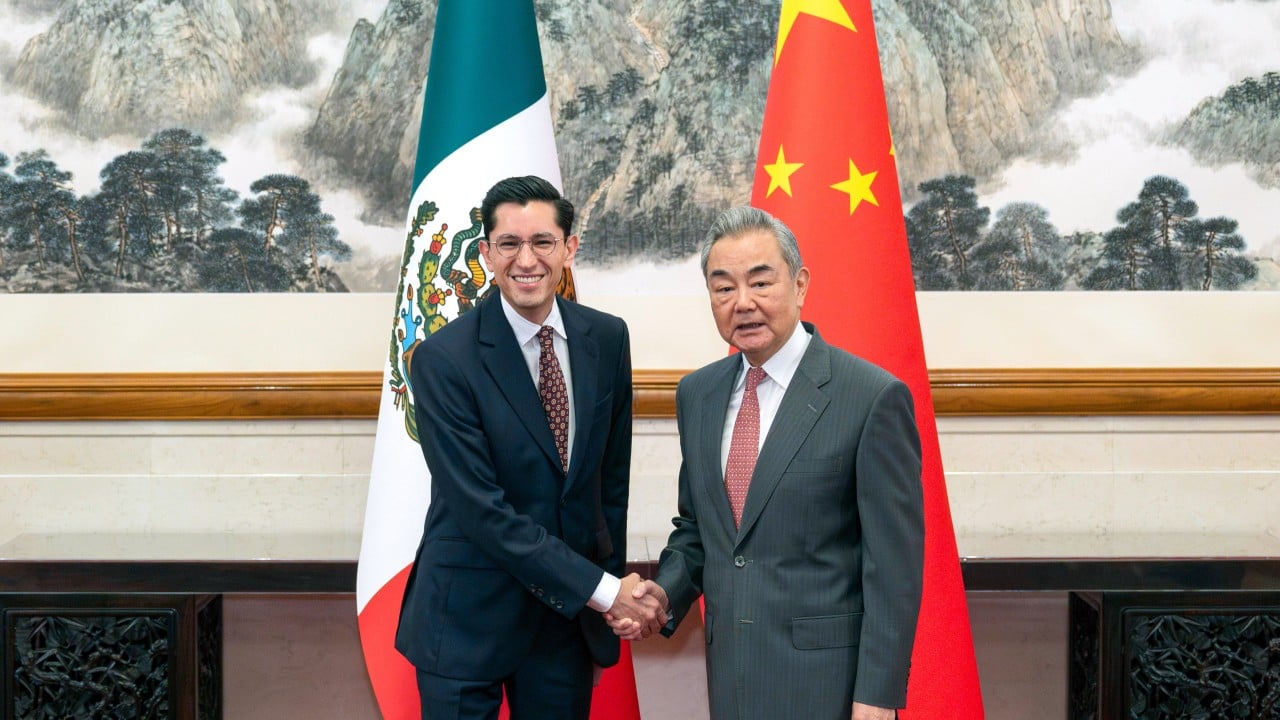
Bilateral statecraft in North America faces a severe structural stress test as Washington attempts to erect protective trade perimeters around its southern border. When Chinese Foreign Minister Wang Yi met with Mexican officials in Beijing to issue a stark warning against third-party interference, he articulated more than routine diplomatic friction. He exposed the breaking point of modern economic sovereignty. Mexico occupies an uncomfortable intersection: it is legally bound by integrated continental trade architectures while serving as an indispensable manufacturing proxy and transshipment valve for Chinese industrial capital seeking entry into the North American market.
The Mechanics of Bilateral Coercion
Washington’s pressure campaign operates through three distinct vectors designed to limit Mexico's strategic autonomy. First, trade surveillance mechanisms target steel and aluminum supply chains, demanding that Mexico mirror American protective tariffs to prevent Chinese raw materials from bypassing US trade walls. Second, regulatory interventions target foreign investment screening. Recent amendments submitted to the Mexican Senate under President Claudia Sheinbaum’s administration mandate national security reviews for foreign acquisitions in sensitive technological verticals, including artificial intelligence, energy infrastructure, and semiconductors. Third, diplomatic pressure frames economic engagement with Beijing as a direct security threat to the United States-Mexico-Canada Agreement.
This creates a severe optimization problem for Mexico City. On one hand, proximity to the United States market dictates geographic and economic gravity. On the other hand, diversification through Chinese capital injection offers vital infrastructure financing, technological partnerships, and manufacturing inputs that lower domestic production costs. When external actors demand exclusivity, they force middle powers into a zero-sum compliance matrix that penalizes multi-vector diplomacy.
The Chinese Counter-Strategy of Strategic Insulation
Beijing’s response relies on institutional counter-balancing and the rhetoric of Global South solidarity. By casting US demands as illegitimate external interference, Beijing positions itself as a defender of national autonomy rather than an aggressive mercantilist actor. This diplomatic positioning is paired with tactical economic entanglements. Mexican officials visiting Beijing routinely negotiate high-level bilateral mechanisms, ranging from regional trade logistics—such as consular expansions in commercial hubs like Chongqing—to preparations for hosting major multilateral summits like the 2028 Asia-Pacific Economic Cooperation forum.
China’s objective is the creation of structural insulation. By embedding itself deeper into Mexican supply chains, Beijing ensures that any abrupt decoupling forced by Washington imposes immediate, painful friction costs on Mexican domestic industries. This strategy transforms Mexico from a passive recipient of American trade edicts into an active site of great power competition where local authorities can extract diplomatic leverage by managing the velocity of foreign influence.
The North American Trade Fracture
The friction between Washington and Mexico City cannot be viewed in isolation; it is intimately tied to the broader collapse of trilateral consensus within North America. Recent trade breakdowns between Ottawa and Washington over restrictions on third-party trade agreements demonstrate a coordinated American policy shift. The White House is systematically attempting to close every backdoor allowing non-market economies to utilize secondary jurisdictions as assembly hubs for export into the United States.
For Mexico, complying with these extraterritorial demands risks triggering internal economic contraction by disrupting cost-effective industrial inputs. Defying them risks severe retaliatory measures during upcoming trade pact reviews. The structural dilemma is stark: absolute alignment with Washington sacrifices national sovereignty and economic efficiency, while unmanaged alignment with Beijing triggers immediate protectionist retaliation from North America's primary consumer market.
Execute a measured foreign policy posture by codifying strict legislative thresholds for foreign investment screenings that apply uniform metrics to all non-continental actors, thereby diffusing geopolitical targeting while satisfying baseline security concerns without formally surrendering sovereign trade independence.


