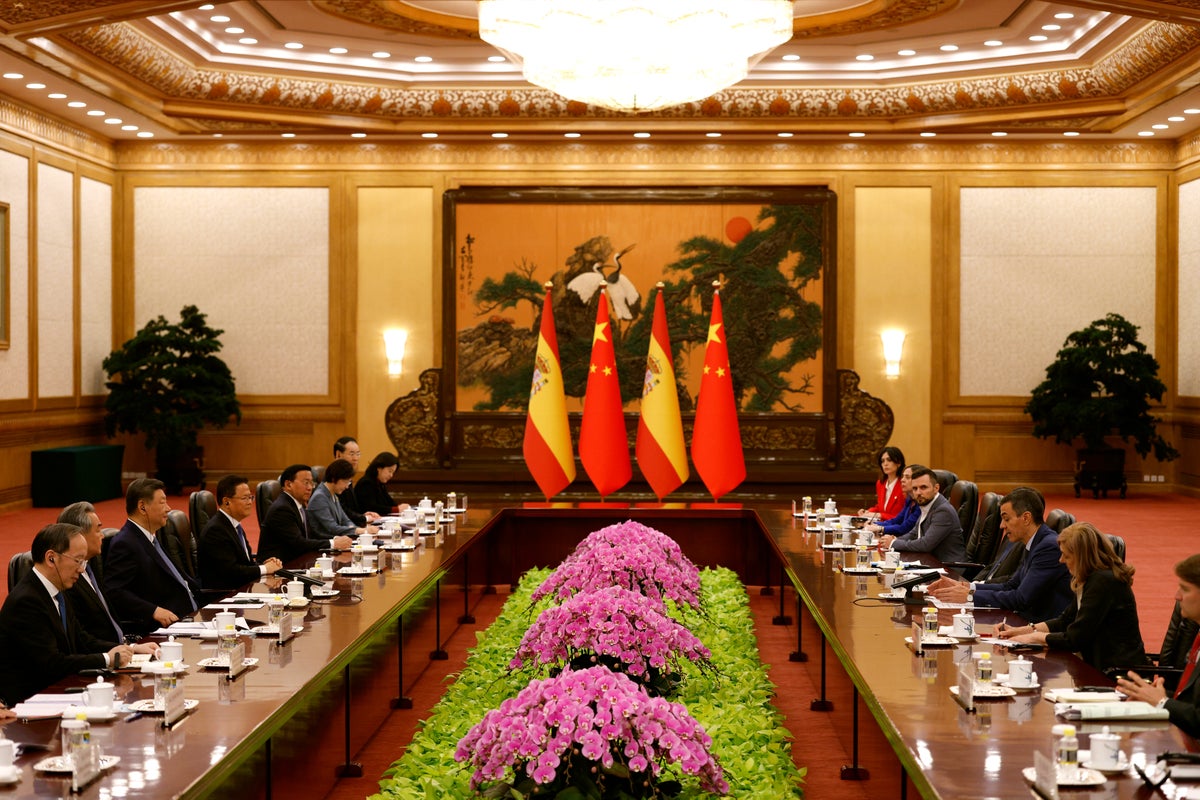
Don't let the polite handshakes and garden walks fool you. When Chinese President Xi Jinping and Spanish Prime Minister Pedro Sánchez sat down in Beijing, the stakes were a lot higher than a standard 20th-anniversary celebration of a "strategic partnership." They’re effectively trying to rewrite the rules of a global game that feels like it’s falling apart.
While much of the West is busy building walls and talking about "de-risking," Spain is playing a different hand. Sánchez’s frequent trips to China—this being his fourth in four years—show that Madrid isn't interested in the cold-shoulder approach. Instead, both leaders are leaning hard into multilateralism. But why does that matter to you? Because the outcome of this "bridge-building" will dictate everything from the price of your next electric car to how the world handles the next massive climate shock. In other developments, read about: The Empty Chair at the Table in Ramstein.
The Electric Vehicle Elephant in the Room
You can't talk about China and Spain without talking about the trade war that almost was. Or maybe the one that’s still simmering. The European Union has been aggressive lately, pushing for heavy tariffs on Chinese electric vehicles (EVs). They claim unfair subsidies are flooding the market. China, naturally, calls this "bullying."
Here’s where it gets interesting. Sánchez didn't just nod along with the EU's hardline stance. After his 2024 visit, he famously called for the EU to reconsider those tariffs. He knows that Spain’s own green transition is tethered to Chinese tech. BBC News has also covered this important topic in extensive detail.
- Investment flows: Chinese companies like CATL and Chery aren't just selling cars; they're moving into Spanish factories.
- The 331% Jump: In 2025, Chinese investment in Spain skyrocketed from €149 million to over €634 million.
- Economic Symbiosis: Trade between the two surpassed $55 billion in 2025.
If Spain backs the EU's tariffs blindly, they risk losing the very investments they need to modernize their own industrial base. It’s a delicate balancing act. Xi knows this and is using Spain as a pragmatic voice within the EU to remind Brussels that "no one wins a trade war."
Safeguarding Multilateralism Isn't Just a Buzzword
When politicians say "multilateralism," your eyes probably glaze over. Honestly, it sounds like something found in a dusty textbook. But in the context of Xi and Sánchez, it’s a direct response to a world that’s becoming increasingly "unipolar" or "fragmented."
They’re essentially arguing that global problems—think climate change, debt relief in the Global South, and AI regulation—can't be solved by one or two superpowers calling the shots. Xi sees the EU as a "pole" in a multipolar world. By strengthening ties with Spain, China is betting on a Europe that thinks for itself rather than just following Washington’s lead.
For Spain, this is about strategic autonomy. Madrid needs to expand its network so it isn't solely dependent on the whims of trans-Atlantic politics. By aligning with China on issues like the Paris Agreement and global health, Spain gains leverage. They're advocating for a "dialogue-based" approach. It's a gamble that being a "bridge" is more profitable than being a "barrier."
Areas Where the Interests Align
- Green Energy: China has the manufacturing scale; Spain has the wind and sun.
- Digital Transformation: Both countries are obsessed with smart cities and high-tech manufacturing.
- Global Stability: From the Middle East crisis to the Russia-Ukraine conflict, both leaders are positioning themselves as the "adults in the room" who want negotiated settlements over escalation.
What Most People Get Wrong About This Relationship
Critics often argue that Spain is being "soft" or that China is just looking for a "weak link" in the European chain. That’s a massive oversimplification.
Spain still firmly holds to the "One China" policy and remains a committed member of NATO and the EU. They aren't switching sides. They're just acknowledging a reality that many are too scared to say out loud: you can't solve 21st-century problems by ignoring the world's second-largest economy.
Sánchez is looking at the numbers. While the US is a vital ally, the growth engine is increasingly in the East. By fostering (let's say "encouraging") a stable relationship with Beijing, Spain is protecting its own economic future. It’s pragmatism, plain and simple.
The Road Ahead for China and Europe
The "Spanish Model" of engagement is likely to be watched closely by other European capitals. We’ve already seen leaders from the UK, Germany, and France making their own treks to Beijing. They’re all asking the same question: how do we compete with China without destroying the global trade system?
The next steps won't be easy. There are still massive disagreements on human rights, data privacy, and maritime security. But if Xi and Sánchez have their way, those disputes will happen within a framework of "mutual respect" rather than through the lens of a new Cold War.
Keep an eye on the 15th Five-Year Plan in China and Spain’s own digital goals. They’re remarkably similar. If these two can actually align their development strategies, it might just provide the stability the global market is desperately craving.
If you’re a business owner or an investor, the takeaway is clear: don't bet on a total decoupling. The "bridge-builders" are working overtime, and Spain is currently leading the construction crew. Stop expecting a clean break between East and West; start preparing for a more complex, multipolar reality where "multilateralism" is the only way to keep the lights on.