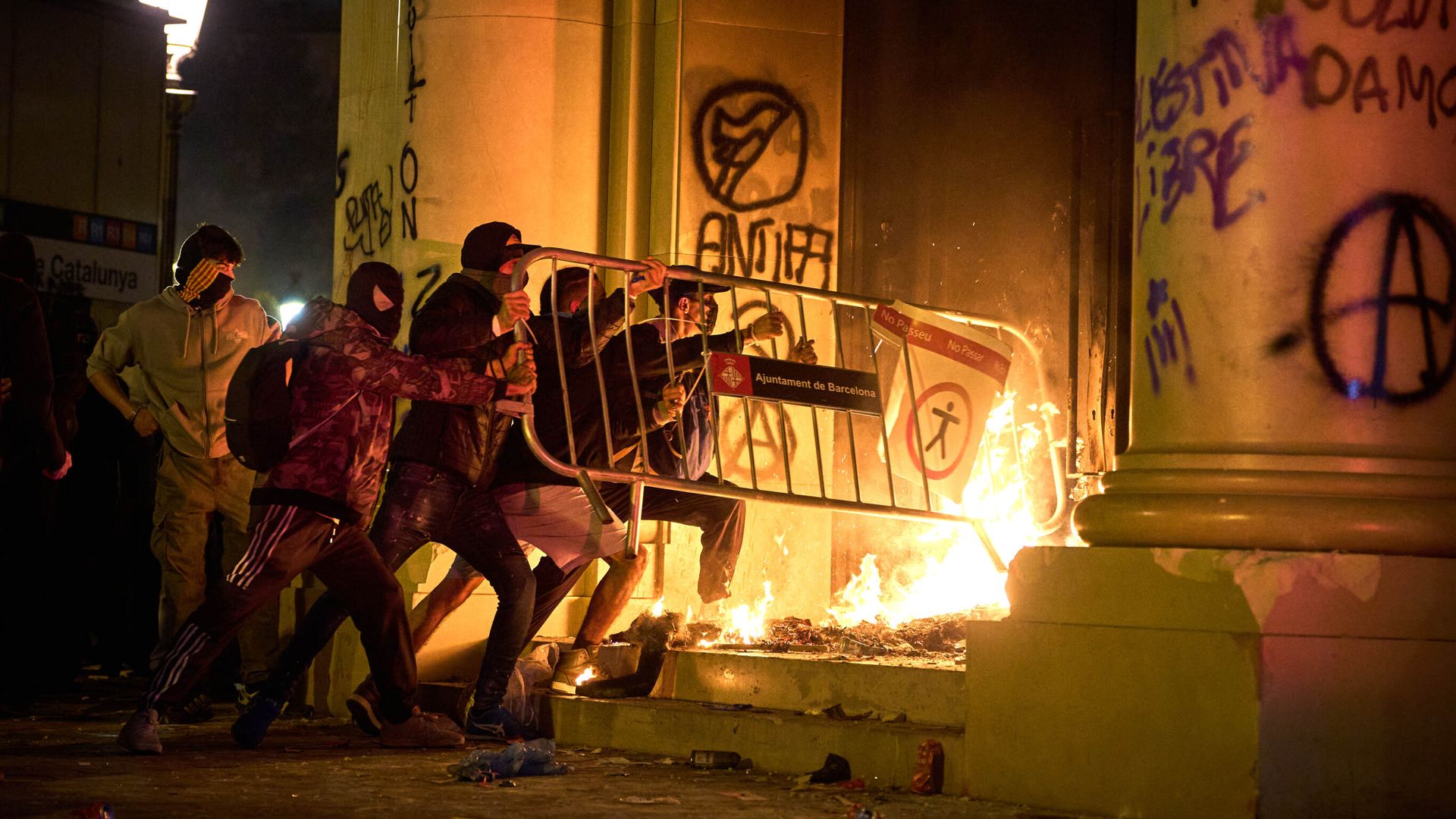
Turn on any international cable channel when Madrid or Barcelona lights up with tear gas and burning dumpsters, and you will hear the exact same breathless script. Anchors call it a breaking point. Pundits frame millions of marching workers as a spontaneous explosion of working-class desperation pushing Europe's fourth-largest economy to the brink of collapse.
That narrative sells ads. It also completely misunderstands how modern Spanish labor politics actually works. You might also find this related article interesting: The Ghosts Who Came Home After Forty Years of Silence.
The competitor coverage of general strikes in Spain relies on lazy consensus. It treats street clashes as proof of imminent systemic failure, equates union headcounts with genuine economic paralysis, and assumes that mass mobilization automatically translates into legislative leverage. None of that holds up under scrutiny. When millions take to the streets in Spain, you are rarely watching a revolution. You are watching a highly choreographed, state-subsidized ritual designed to preserve institutional relevance for legacy unions while shifting the real economic pain onto the very people who cannot afford to march.
The Myth of Spontaneous Working-Class Fury
International reporters love dramatic visuals. A burning barricade in front of the Banco de España makes for great television. What cameras never capture is the bureaucratic machinery humming quietly behind the smoke. As highlighted in recent reports by NPR, the implications are worth noting.
Spain's labor relations operate under a corporatist framework established after the transition to democracy in the late 1970s. Two massive confederations, the Unión General de Trabajadores (UGT) and Comisiones Obreras (CCOO), dominate collective bargaining. Under Spanish labor law, any agreement negotiated by these representative unions automatically applies to every worker in that sector across the entire province or country—whether those workers belong to a union or not.
Think about the incentive structure that creates.
Union membership in Spain sits among the lowest in the European Union, hovering around 12 to 15 percent of the workforce according to OECD data. Yet union influence over wage floors and regulatory policy remains enormous. Because workers receive the benefits of collective bargaining without paying dues, the major confederations rely heavily on public subsidies, training grants, and institutional representation on state boards to survive.
To justify those subsidies and prove their relevance to the government in Moncloa, union leadership must periodically demonstrate their capacity to mobilize bodies. A general strike is not an act of desperation; it is a proof-of-concept audit.
I have sat across the table from European labor economists and Madrid corporate counsel during three separate nationwide walkouts over the past fifteen years. Every single time, the pattern is identical. Months before a brick is thrown, union bosses and ministry officials have already mapped out the rough contours of the eventual compromise. The street clashes—usually instigated by radical fringe groups or youth syndicates that the major unions publicly disavow while privately benefiting from the media oxygen—serve to raise the political temperature just enough for both sides to claim victory when they sign the deal they were going to sign anyway.
Why "Millions on Strike" Is a Statistical Illusion
When headlines scream that millions joined a general strike, ask one simple question: how are they counting?
In Spain, strike participation is a partisan blood sport with two wildly divergent scoreboards. Union press offices calculate participation by counting every worker absent from a shift, every student skipping class, and every shop shuttered out of fear of picket lines. Meanwhile, the Ministry of the Interior and business associations like the Confederación Española de Organizaciones Empresariales (CEOE) measure electricity grid consumption drops and social security registration data.
Electricity demand never lies. You cannot fake megawatts.
During major Spanish general strikes—including the massive mobilizations against labor reforms in 2010 and 2012—actual national electricity consumption typically drops by only 10 to 15 percent compared to a normal workday. That is roughly equivalent to a quiet Friday in August or a mild public holiday.
The gap between "millions marching" and a 12 percent drop in power consumption exposes the two-tier reality of the Spanish labor market.
- The Protected Insider: Civil servants, public transit operators, heavy manufacturing employees, and utility workers enjoy ironclad job security. When a strike is called, they lose a single day's wages—sometimes covered by union strike funds—with zero risk of termination. They make up the bulk of the daytime marches.
- The Precarious Outsider: Temporary contract workers, hospitality staff, gig couriers, and small-business owners make up the backbone of Spain's private sector. They cannot afford to lose a day's pay, nor can they risk alienating an employer when their contract expires at the end of the month.
When coercive pickets—known locally as piquetes informativos—force small cafés and retail shops to pull down their metal shutters in central Madrid or Barcelona, international correspondents count those closed doors as solidarity. In reality, a family-run bakery losing eight hundred euros in daily revenue because masked youths blocked the entrance is not participating in a protest. It is absorbing an uncompensated tax.
The Macroeconomic Reality Nobody Wants to Discuss
If you want to understand why Spanish workers are genuinely angry, stop looking at the placards and look at the structural math of the Spanish economy.
Spain suffers from a chronic productivity trap. For decades, growth has leaned heavily on low-value-added sectors—tourism, hospitality, retail, and construction—while capital investment in high-tech manufacturing and research has lagged behind Northern Europe. According to Eurostat, Spanish labor productivity per hour worked has barely budged in real terms over the past twenty years, while housing costs in urban hubs like Madrid, Barcelona, and Valencia have exploded.
No general strike can legislate productivity into existence.
When unions demand blanket wage hikes or rigid restrictions on dismissal without addressing why Spanish firms remain too small to scale—over 99 percent of Spanish enterprises are small or medium-sized businesses with fewer than 250 employees—they trigger a predictable feedback loop:
- Compliance costs rise. Small businesses face higher social security contributions and stricter firing penalties.
- Hiring freezes. Rather than taking on permanent staff, owners rely on overtime, automation, or informal cash labor.
- Youth unemployment spikes. Spain consistently posts the highest or second-highest youth unemployment rate in the EU, routinely sitting north of 25 percent.
Economists like Juan Ramón Rallo and researchers at the Bank of Spain have documented this insider-outsider divide extensively. Every time labor laws are tightened to protect existing permanent contracts, the burden of economic adjustment falls entirely on young people entering the workforce. Yet young workers are routinely marched out to the front lines of protests to fight for regulations that actively lock them out of stable careers.
Dismantling the Wrong Questions
When violent protests hit Spain, search engines flood with predictable questions from outside observers. Most of them start from a broken premise.
Is Spain on the verge of economic collapse?
No. Spain has frequently outperformed Germany and France in raw GDP growth over recent quarters, driven by booming tourism, renewable energy investment, and European Union recovery funds. Street violence is a symptom of distributional conflict—fights over how the pie is sliced—not an indicator that the bakery is burning down. Markets barely flinch during Spanish general strikes because institutional investors know the political choreography inside out.
Do general strikes actually force the Spanish government to back down?
Rarely on the core issues. Look at the historical record. The 2010 and 2012 general strikes failed to stop either the Socialist government of José Luis Rodríguez Zapatero or the conservative government of Mariano Rajoy from passing sweeping labor market deregulation. When governments do make concessions following a strike, they almost always offer symbolic wins—funding for social dialogue committees, minor pension adjustments, or delayed implementation timelines—while leaving structural fiscal targets untouched because Brussels ultimately holds the purse strings.
Are the clashes driven by the majority of protesters?
Not even close. Tens of thousands of families, retirees, and teachers walk peacefully down Gran Vía or Passeig de Gràcia with whistles and banners, go home by 2:00 PM, and have lunch. The fiery clashes at night involve a tiny, organized minority of professional agitators, radical separatist youth groups, and anarcho-syndicalists who use mass demonstrations as cover to battle the Policía Nacional or Mossos d'Esquadra. Media outlets splice daytime crowd aerials with nighttime riot footage, creating the false impression that millions of Spaniards are actively burning their own cities.
How Businesses and Investors Should Actually Respond
If you run operations in Spain, manage European supply chains, or allocate capital in Iberia, reacting to strike headlines with panic is a rookie mistake. I have watched foreign executives delay facility expansions and reroute logistics contracts at massive expense because they mistook television drama for operational risk.
Here is how you actually navigate a Spanish general strike without bleeding money:
- Audit your logistics 72 hours early. Strikes in Spain are legally required to be announced well in advance, and minimum service decrees (servicios mínimos) are published in the official state gazette beforehand. Port authorities in Valencia and Algeciras, along with rail freight operators, publish exact operational windows. Move time-sensitive inventory 48 hours prior and lock in road freight outside major urban ring roads.
- Ignore headline participation numbers; watch the grid. Monitor Red Eléctrica de España's real-time demand curve on the morning of the strike. By 9:00 AM, you will know with mathematical precision whether the strike has real industrial bite or is purely a municipal transit and public-sector event.
- Protect front-line retail without confrontation. If you operate street-level commercial spaces in city centers, forcing staff to keep shutters open against aggressive pickets invites property damage and employee trauma. Close early, document the interruption for commercial insurance or force majeure clauses, and keep your team safe.
- Separate political noise from regulatory trajectory. Never make long-term hiring or capital expenditure decisions based on strike rhetoric. Read the actual draft legislation sitting in the Congreso de los Diputados and track Brussels' fiscal compliance deadlines. That is where real policy is made.
The Uncomfortable Truth About the Contrarian View
Dismissing general strikes as political theater carries one major blind spot that no serious analyst should ignore: theater can accidentally catch fire.
While the institutional machinery of Spanish strikes is predictable, prolonged inflation in essentials like rent and groceries erodes the patience of people who do not care about union politics. When real disposable income stagnates for years while political elites trade corruption scandals in Madrid, institutional unions risk losing control of the crowd. If mainstream confederations lose their ability to channel anger into predictable, single-day walkouts, what replaces them will not be polite negotiations in ministry boardrooms. It will be leaderless, decentralized populism from both the far left and far right that refuses to play by the 1978 rules.
For now, though, the system is functioning exactly as designed. Politicians get to posture as defenders of stability. Union leaders get their cameras, their subsidies, and their seat at the table. Television networks get their footage of burning barricades.
And the millions of Spanish workers who actually keep the country running? They will wake up tomorrow morning, step over the swept glass on the sidewalk, and go back to paying for all of it.