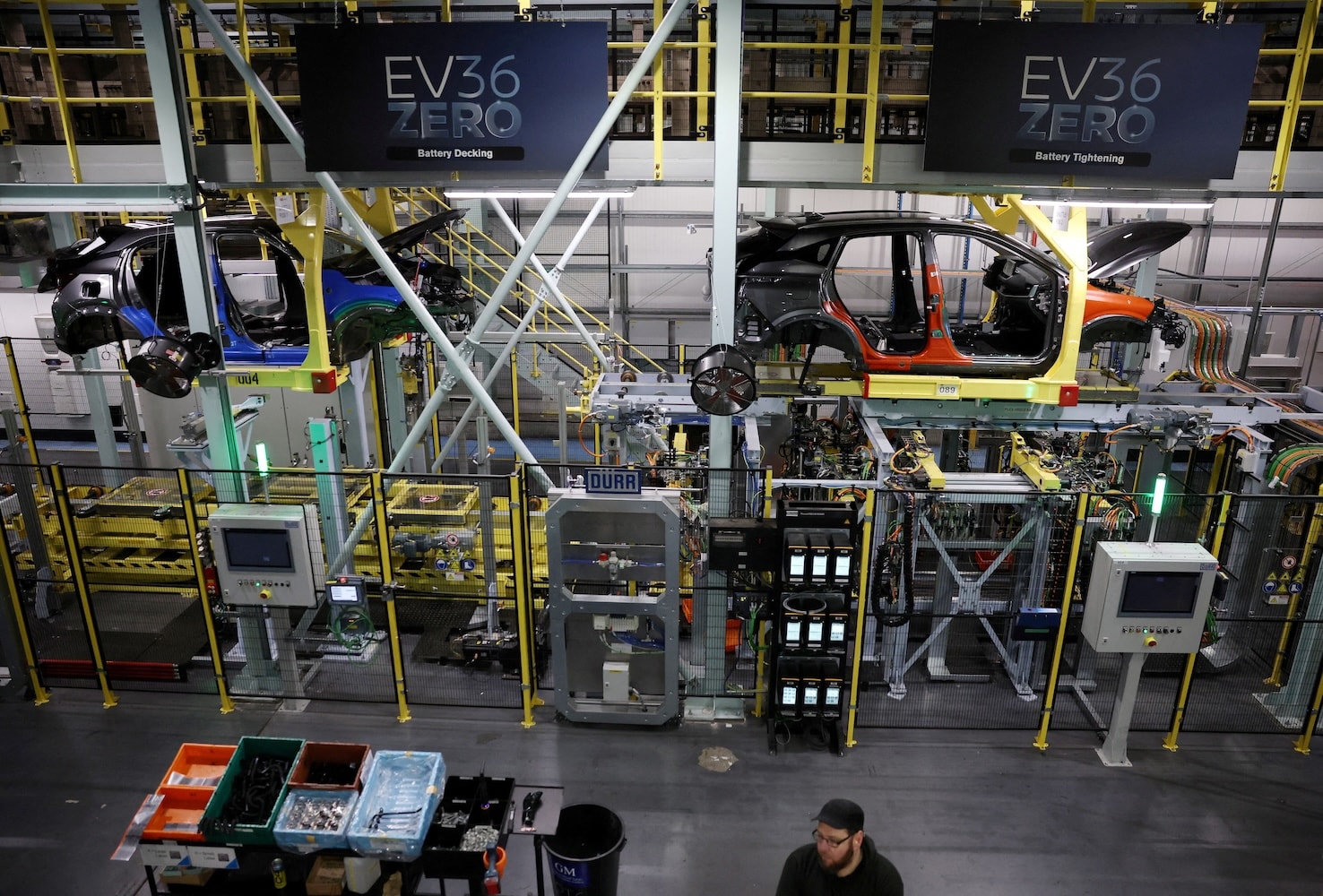
The rain in Northeast England doesn't just fall. It sweeps sideways off the North Sea, sharp and relentless, blurring the outline of the massive industrial buildings that sit on the edge of Sunderland. Inside one of those buildings, a machine presses down with a concussive, rhythmic thud. It is the sound of a steel sheet becoming a car door.
Every morning, thousands of workers walk through those gates, shaking the water from their coats. They are part of an quiet statistical miracle. Last year, more than one in every three cars manufactured in the entire United Kingdom came from this single location.
Think about that.
On any crowded British motorway, look at the vehicles humming along the asphalt. A massive portion of that national movement was born right here, shaped by hands that know the precise heat of a welding arc and the specific whistle of the pneumatic lines. Yet today, the air inside the canteen carries a subtle, unspoken tension. The conversation isn’t about the weekend football match. It is about a giant shifting its weight. The British government is currently locked in high-stakes discussions regarding a financial support package for this vital hub. It is a negotiation about numbers, yes, but those numbers carry the weight of entire livelihoods.
When a factory of this scale faces a transition, it isn't just an item on a corporate balance sheet. It is a seismic event for a community that remembers exactly what happens when the furnaces go cold.
The Gravity of the Factory Floor
To understand why Whitehall officials are losing sleep over a car plant, you have to look at the sheer scale of dependency. Let’s create a composite figure to understand the stakes. Call him David. David has worked in body assembly for twelve years. His father was a shipbuilder on the River Wear, a trade that vanished into history books and left behind a generation of men who felt the sudden, terrifying irrelevance of their skills. David bought his house because of the plant. His kids go to school because of the plant. The local pub, the corner shop, the logistics firm down the road that hauls the steel—they all exist in the gravitational pull of this manufacturing center.
This isn't just about the people holding the tools. The automotive supply chain is a delicate, sprawling web. For every worker on the line, there are five more in smaller engineering firms, component warehouses, and delivery trucks across the region. When the plant breathes, the region inhales. If it stumbles, a whole economy gasps for air.
The current discussions center on a reality that the global automotive industry can no longer ignore. The internal combustion engine is dying a slow, legislated death. The future is electric, silent, and incredibly expensive to build. Nissan’s facility has proven it can dominate the traditional market, but transitioning a colossal infrastructure to pure electric vehicle production requires billions in capital.
The corporate boardrooms in Tokyo look at the map of the world and see options. They see subsidies in America. They see massive state backing in Europe. The UK government knows that staying silent is not an option. If they do not offer a competitive environment, the investment moves. And when the investment moves, the future moves with it.
The Subsidy Dilemma
The debate inside the treasury offices is often framed as a simple question: why should taxpayer money be used to support a massive, profitable multinational corporation? It is a fair question. It deserves a serious answer.
The complexity lies in the shifting nature of global trade. We are no longer living in an era of free-market purity, if we ever were. Governments worldwide are actively competing to anchor the green technologies of the next half-century. The United States introduced massive green subsidies that drew global capital like a magnet. The European Union responded with its own relaxed state aid rules.
If the UK chooses to stand on principle and refuse state support, it doesn't punish the corporation. The corporation simply builds its new battery mega-factories elsewhere. The punishment falls entirely on the local communities.
Consider the math behind the manufacturing sovereignty of a nation. Building a car is an intricate puzzle of thousands of parts. Under post-Brexit trade rules, a certain percentage of a vehicle’s value must originate within the UK or the EU to avoid crippling tariffs. The most valuable part of an electric car is its battery. If Britain cannot manufacture its own batteries at scale, every electric car built here becomes subject to taxes that make them unsellable abroad.
Suddenly, that statistic—one in three cars—shrinks. The lines slow down. The rhythm changes.
The Human Cost of Abstract Policy
It is easy to get lost in the jargon of "rules of origin," "capital expenditure," and "net-zero targets." Policy papers are written in a language devoid of blood and muscle. But the reality of manufacturing is deeply visceral.
Walk into the facility at midshift. The smell is a mixture of ozone, hot grease, and industrial primer. The precision is astonishing. Robots move with an eerie, synchronized grace, swinging massive steel panels through the air, stopping mere millimeters from each other. But the soul of the place remains human. It is the inspectors checking the gap tolerances with practiced fingers. It is the engineers recalibrating the software on the fly.
This expertise cannot be bought overnight. It is passed down. It is a culture of making things that takes decades to cultivate and only a few months of neglect to destroy.
When a government debates a support package, they aren't just buying machinery or subsidizing a foreign company's profits. They are anchoring capability. They are ensuring that the collective intelligence of a specialized workforce doesn't evaporate into the gig economy or the service sector. They are deciding whether the UK wants to be an architect of the transition or merely a consumer of components made by other nations.
The Quiet Turning of the Wheel
The negotiations continue behind closed doors in London and Tokyo. There will be press releases filled with carefully sanitized quotes about partnership, sustainability, and economic resilience. But the real story isn't in the wording of a memorandum of understanding.
The real story is found in the evening shift change at Sunderland.
The rain has cleared, leaving the tarmac glittering under the sodium lights. Hundreds of workers stream out of the exit, their boots clicking against the pavement. They are tired, their shoulders aching from the shift, heading home to families that rely on the stability of those giant assembly halls. Behind them, the factory windows remain illuminated, a vast island of light against the darkened northern landscape. The machinery keeps turning, pressing steel, shaping the future, waiting to see if the country it carries on its back will step forward to catch it.

