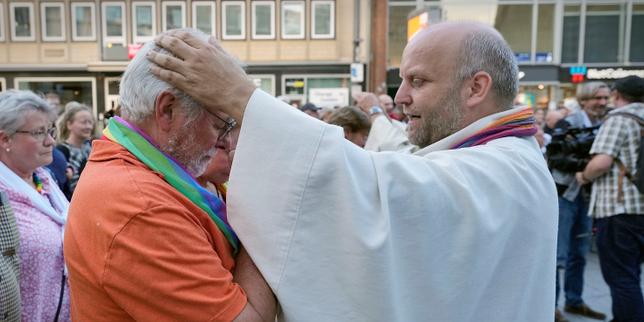
Rain slicked the cobblestones of Frankfurt as a small group of priests and laypeople gathered near the cathedral. They weren't there for a protest, at least not in the traditional sense. They were there for a blessing. In the pews sat couples who had spent decades together—men who had supported each other through illness, women who had raised children in the shadow of a church that officially viewed their love as "intrinsically disordered."
The air was thick with the scent of beeswax and damp wool. When the priest raised his hands to offer a blessing, he wasn't just performing a rite. He was stepping into a theological minefield that stretches from the Rhine to the Tiber.
The Vatican has watched this scene with growing alarm. Recently, the Holy See issued a sharp "reminder" to the German Catholic Church, an attempt to pull the reins on a movement that feels, to many in Rome, like a runaway train. The core of the conflict is the Synodal Path, a reform process launched by German bishops and lay organizations. They are asking for things that were once unthinkable: the ordination of women, an end to mandatory celibacy, and, most pressingly, the formal blessing of same-sex unions.
Rome’s response was a cold splash of water. The Dicastery for the Doctrine of the Faith made it clear: individual bishops do not have the authority to change established Church teaching or introduce new sacramental practices. To the Vatican, this is a matter of unity. To the people in those Frankfurt pews, it is a matter of existence.
Consider a hypothetical couple, Lukas and Jakob. They have been active members of their parish for twenty years. They run the food pantry; they sing in the choir. When they ask for a blessing, they aren't asking for a wedding—they know the distinction between a civil union and the sacrament of matrimony. They are asking for the Church to acknowledge that the grace of God can exist within their commitment to one another.
When the Vatican says "no," it isn't just a legalistic denial. It is a moment of profound cognitive dissonance for a German Church that is hemorrhaging members. In Germany, the Church is funded by a voluntary tax system. As people leave, the resources to maintain the "stone walls"—the massive cathedrals and sprawling social services—dwindle. The German bishops see the writing on the wall. They believe that if the Church does not adapt to the moral sensibilities of the 21st century, it will become a museum of a forgotten era.
But the Vatican operates on a different timeline. It thinks in centuries, not fiscal quarters. From the perspective of Pope Francis—who has tried to strike a balance between pastoral "tenderness" and doctrinal "clarity"—the German approach risks a schism. If Germany goes its own way, what happens to the Church in Africa or Eastern Europe, where the culture is vastly more conservative? The Pope’s fear is a "Protestantization" of the Catholic Church, a splintering into national bodies that no longer share a common heart.
This isn't just a debate about rules. It's a debate about what a blessing actually is.
In the traditional view, a blessing is a sign of approval for a lifestyle that conforms to God's plan. If the lifestyle doesn't conform, the blessing cannot be given. It would be a lie. But the German reformers argue for a "pastoral" blessing. They suggest that God’s mercy is not a reward for perfection, but a tool for the journey. They see a blessing as a hand on a shoulder, not a stamp of legal approval.
The tension reached a breaking point when the German Synodal Path voted overwhelmingly to move forward with these blessings by 2026. The Vatican’s intervention was a "halt" sign placed firmly in the middle of that road. The letter from Rome reminded the Germans that they are part of a global body. It emphasized that "the local Church cannot initiate new practices that affect the discipline of the universal Church."
It was a power move. Pure and simple.
However, the reality on the ground in cities like Berlin, Munich, and Cologne is often very different from the directives issued in Latin from behind the Leonine Walls. Many German priests have already been performing these blessings in secret or semi-secret for years. They do it because they see the tears of the people in front of them. They do it because they believe that a Church that refuses to bless love is a Church that has forgotten its primary mission.
This creates a "shadow church." On paper, the rules are being followed. In practice, the rules are being ignored. This disconnect is dangerous for any institution. It breeds cynicism. It turns the clergy into rebels and the laity into skeptics.
The German bishops find themselves in an impossible position. If they obey Rome, they lose their flock. If they obey their flock, they lose Rome.
The stakes are invisible but heavy. They are measured in the silence of a man who feels he must choose between his faith and his partner. They are measured in the frustration of a bishop who sees his pews emptying while his hands are tied by a bureaucracy thousands of miles away.
History shows that when the Church faces these kinds of pressures, it either breaks or it bends. During the Reformation, it broke. During the Second Vatican Council in the 1960s, it bent—opening the windows to let in "aggiornamento," or fresh air.
Today, the air in the German Church feels stagnant to some and revolutionary to others. The Vatican's reminder to "remain in order" is an attempt to keep the windows shut against a wind that is already blowing through the aisles.
Lukas and Jakob don't care about the Dicastery for the Doctrine of the Faith. They don't care about the internal politics of the Synodal Path. They care about whether the institution that baptized them, taught them to pray, and buried their parents still has a place for them at the table. They are looking for a sign that they aren't just "problems to be solved," but people to be loved.
The Vatican can issue all the letters it wants. It can cite canon law and appeal to tradition until the ink runs dry. But it cannot stop a priest from whispering a prayer over two people who have spent a lifetime caring for one another.
The "order" the Vatican seeks is a uniformity of practice. The "disorder" the Germans are embracing is the messy, complicated reality of human affection. Between these two poles, the future of the Catholic Church is being rewritten, word by word, blessing by blessing, in the quiet corners of parish halls where the law ends and the human story begins.
The cobblestones in Frankfurt remain wet, the candles continue to flicker, and the door to the cathedral stays heavy, wooden, and closed—yet the prayers being whispered inside have already drifted past the roof, indifferent to the boundaries of the law.