Retail analysts love a cute gimmick. Give a legacy brick-and-mortar chain a viral fashion accessory, and suddenly every business column on the internet is praising a "brilliant turnaround strategy."
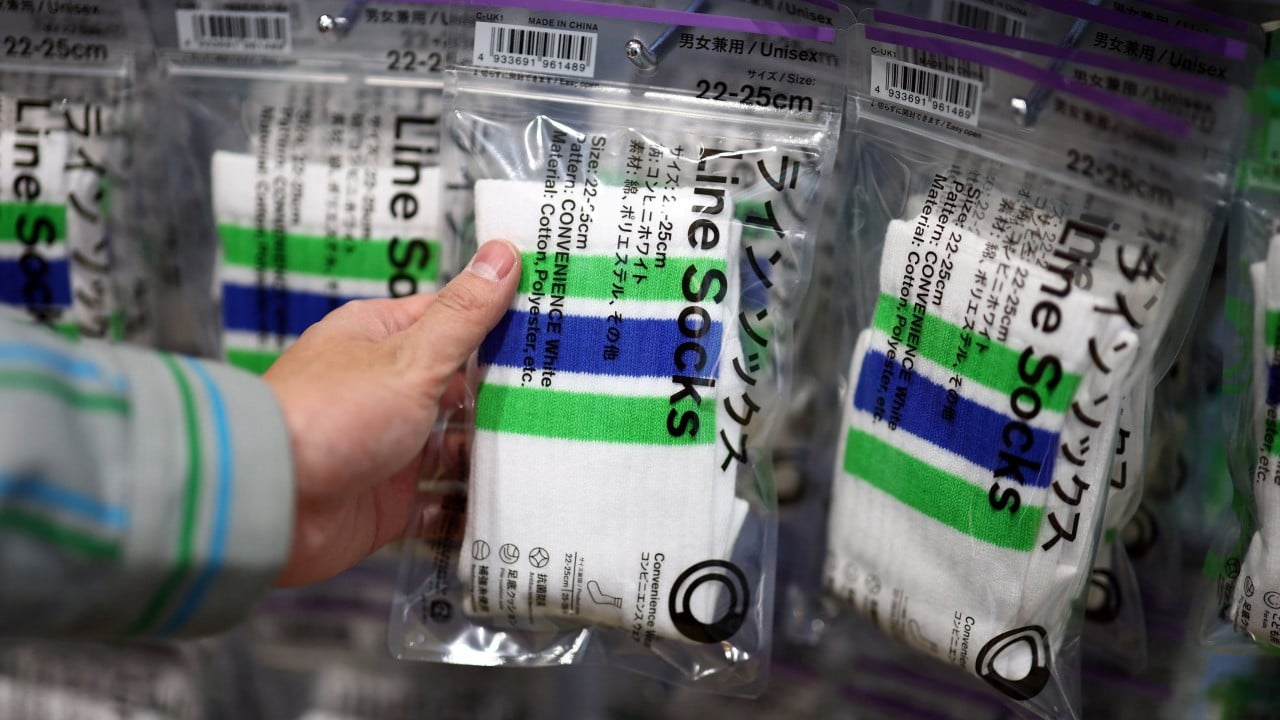
Take the breathless coverage surrounding FamilyMart’s "Convenience Wear" line—specifically those green-and-blue striped tube socks designed by Hiromichi Ochiai. The standard industry narrative goes like this: Japan’s convenience store sector is saturated, 7-Eleven and Lawson are eating FamilyMart’s lunch on fresh food, so FamilyMart cleverly pivoted to high-margin streetwear to survive the konbini wars.
That narrative is pure retail fan fiction.
Selling 429-yen socks next to fried chicken and printer paper isn't a survival strategy. It is a distraction. When you look at the actual unit economics of Japanese convenience stores, betting on apparel to save a 16,000-store franchise network is like putting a designer spoiler on a car with a blown head gasket.
The Lazy Consensus About the Konbini Wars
Every mainstream analysis of Japan’s convenience store rivalry relies on the same tired framing. They look at the Big Three—Seven-Eleven Japan, FamilyMart, and Lawson—and treat them like fast-fashion brands fighting for cultural relevance.
Here is what they miss: konbini are not retail stores. They are ultra-dense logistics networks masquerading as neighborhood pantries.
I have watched dozens of legacy retailers burn millions chasing "lifestyle extensions" because fixing supply chain friction is boring and launching an apparel capsule gets you written up in Vogue. The business press falls for it every single time. They see a viral TikTok of tourists buying FamilyMart socks in Shibuya and extrapolate that into a fundamental shift in retail competitiveness.
Let’s look at the actual battlefield. In Japan, there are roughly 55,000 convenience stores serving a shrinking, aging population. Market saturation isn't a looming threat; it happened a decade ago. Growth no longer comes from opening new locations on empty corners. It comes from stealing foot traffic from the rival across the street and squeezing every fraction of a percent out of daily store sales (nippan).
7-Eleven dominates this game not because their brand is cooler, but because their proprietary cold-chain logistics and item-by-item inventory management allow them to turn over high-margin, fresh bento boxes and barista-grade coffee faster than anyone else on earth. Their average daily sales per store consistently tower over both FamilyMart and Lawson by more than 100,000 yen.
You do not close a 100,000-yen daily sales gap with tube socks.
The Math Behind the Viral Sock Mirage
Let’s break down the cold, hard math of convenience store real estate.
A standard Tokyo konbini operates in roughly 100 to 150 square meters of floor space. Every single centimeter of shelf space—what retail operators call linear shelf facing—is a warzone. To justify its existence on a gondola, a SKU has to earn its keep through inventory turnover, not just gross margin percentage.
Yes, apparel carries a significantly higher gross margin than a bottle of green tea or an onigiri rice ball. On paper, a 45% to 50% margin on a pair of socks looks intoxicating compared to the razor-thin margins on cigarettes, magazines, or utility bill payments.
On paper. In reality, retail isn't graded on margin percentage alone. It is graded on GMROI—Gross Margin Return on Investment.
GMROI measures how much gross profit a retailer makes for every yen tied up in inventory. Fresh food has a lower percentage margin, sure, but a tuna mayo onigiri turns over three times a day. You invest the cash at 6:00 AM, sell it by noon, and reinvest the profit by dinner.
Socks sit.
Even viral socks sit. A customer buys lunch 250 days a year. A customer buys emergency socks twice a year—usually when they get caught in a sudden downpour in Shinjuku or miss the last train home and have to crash at a capsule hotel.
When FamilyMart dedicates prime eye-level endcaps to folded t-shirts, boxer briefs, and striped socks across 16,000 locations, they are tying up working capital in slow-moving inventory and starving their core traffic drivers of oxygen.
The Franchisee Friction Nobody Talks About
There is an even darker secret behind the "Convenience Wear" hype that corporate PR teams carefully scrub from press releases: franchisee inventory risk.
Japanese convenience stores operate predominantly under a franchise model where store owners split gross profits with corporate headquarters. Under standard Japanese konbini accounting rules (the infamous "konbini accounting" system heavily scrutinized by Japan's Fair Trade Commission), the cost of unsold inventory—known as shrinkage or disposal loss—falls heavily on the franchisee, not the franchisor.
When corporate forces franchisees to carry dozens of new apparel SKUs across multiple sizes (Small, Medium, Large, Extra Large) and seasonal colorways, they are multiplying backroom complexity.
- Size fragmentation: Unlike a can of Boss Coffee, which has one SKU, a t-shirt requires four. If a store sells out of Medium and Large, the remaining Small and XL units become dead weight collecting dust.
- Labor drain: Japan is suffering from a historic labor shortage. Konbini clerks are already juggling cooking fried chicken, brewing coffee, processing parcel deliveries, handling tax payments, and restocking drinks. Forcing exhausted part-time staff to refold wrinkled apparel displays and manage size-run restocks is operational sabotage.
- Capital lockup: Every yen a franchise owner spends stocking slow-moving sweatshirts is a yen they cannot spend optimizing their hot food displays during peak commuter rushes.
Why FamilyMart Actually Did This (The Real Strategy)
If apparel doesn't fix daily store sales and irritates franchisees, why did FamilyMart’s leadership—backed by trading giant Itochu Corporation—go all-in on Convenience Wear?
Because they were desperate for a loss leader that didn't look like a discount.
Before Itochu took FamilyMart private in 2020, the chain was suffering from a severe identity crisis. 7-Eleven owned food quality and supply chain precision. Lawson owned specialty desserts (like their Uchi Café sweets) and health-conscious positioning. FamilyMart was stuck in the middle—the Pepsi to 7-Eleven's Coke, famous mostly for Famichiki (their boneless fried chicken) and little else.
When you are trapped in a commoditized middle, competing on price is suicide. Competing head-to-head on fresh food R&D against 7-Eleven’s massive scale is a losing battle.
So FamilyMart used fashion as a Trojan Horse for foot traffic.
The striped socks weren't designed to make FamilyMart a clothing company. They were designed to give younger, urban demographics a reason to walk past a 7-Eleven and push open a FamilyMart door. Once that 22-year-old walks in for a pair of viral socks, they grab a Famichiki, a highball, and a pack of gum.
That is a customer acquisition play, not a core business model transformation. Calling FamilyMart’s sock strategy a "survival blueprint" is like claiming Costco survives on $1.50 hot dogs. The hot dog gets you in the warehouse; the bulk pallets of detergent and steaks pay the bills.
What People Get Wrong About the Future of Konbini
When observers ask, "Can fashion save FamilyMart?" they are asking the wrong question entirely. The real question is: Who wins when the physical store stops being the primary point of sale?
Look at where the real money is moving in Tokyo right now. It isn't into cotton-blend socks. It is into three unsexy, ruthless operational battlegrounds.
1. Retail Media Networks
FamilyMart installed massive digital signage screens (FamilyMartVision) above the registers in thousands of stores. Why? Because 15 million people stand in front of those registers every single day, staring blankly for 45 seconds while waiting for their chicken to be bagged.
Selling ad inventory to consumer packaged goods companies at 80% margins blows apparel economics out of the water. You don't have to fold a digital ad. You don't have to worry about a digital ad going out of season or getting stolen. Attention is the highest-margin SKU in modern retail.
2. Automated Micro-Fulfillment and Quick Commerce
While commentators were writing odes to striped socks, the real existential threat to traditional konbini was quietly scaling: dark stores and ultra-fast delivery apps.
In dense urban centers like Tokyo and Osaka, consumers are increasingly unwilling to walk even three minutes down the street when delivery platforms can drop groceries at their door in 20 minutes. Lawson—now backed by telecom giant KDDI—is aggressively integrating digital loyalty data, mobile ordering, and automated robotics to turn neighborhood stores into hyper-local fulfillment hubs.
3. Demographic Adaptation (The Silver Shift)
Viral streetwear appeals to Gen Z tourists in Harajuku. Meanwhile, the actual backbone of Japan’s economy is rapidly graying.
In rural and suburban prefectures—where over 60% of konbini actually operate—customers don't care about designer collaborations. They care about fresh produce, pre-portioned single-serving meals for elderly households, pharmaceutical access, and banking services. Lawson has already pivoted hard into pairing stores with drugstore pharmacies and fresh vegetable stands. Betting your brand identity on youth streetwear while your core domestic customer base turns 70 is a dangerous tightrope walk.
The Uncomfortable Truth About Brand Extensions
To be completely fair, FamilyMart’s apparel gamble isn't without merit. If you look strictly at brand equity, Convenience Wear achieved something remarkable: it erased the stigma of buying emergency clothing at a convenience store.
Ten years ago, buying underwear or socks at a konbini was an admission of defeat—a walk of shame after an unexpected overnight stay. By bringing in a legitimate Tokyo Fashion Week designer and upgrading the fabric weight and packaging, FamilyMart turned a necessity purchase into a badge of urban cool. Even 7-Eleven and Lawson scrambled to upgrade their own basic apparel lines in response.
Credit where it is due: as a marketing campaign, it was a masterclass in earned media.
Where the analysis goes off the rails is confusing marketing brilliance with operational durability. Marketing gets you the first visit. Operations get you the next five hundred.
If I were advising a retail executive looking at FamilyMart’s playbook today, I would tell them to admire the PR stunt—and then immediately look at what happens in the backroom.
- Never confuse viral velocity with baseline volume. A product that sells out during a launch week because hypebeasts are flipping it on Mercari does not mean you have built a sustainable category.
- Protect your core traffic engines at all costs. If expanding a novelty category slows down checkout lines or crowds out high-frequency consumables, you are cannibalizing your own store.
- Watch the franchisee P&L, not just corporate press releases. Any retail initiative that looks great on a corporate earnings slide while squeezing store-level labor and working capital will eventually trigger a mutiny among operators.
The Verdict on the Konbini Arms Race
The convenience store rivalry in Japan will not be won on a runway. It will be won in the cold-storage trucks rolling down the Tomei Expressway at 3:00 AM. It will be won by whoever figures out how to run a store with half the staff using AI-driven ordering and automated restocking. It will be won by whoever owns the consumer's mobile wallet and daily food habits.
FamilyMart’s striped socks bought them headlines, tourist yen, and a temporary cultural halo. That is great for quarterly buzz.
Just don't mistake a clever pair of socks for the legs that actually carry the business.