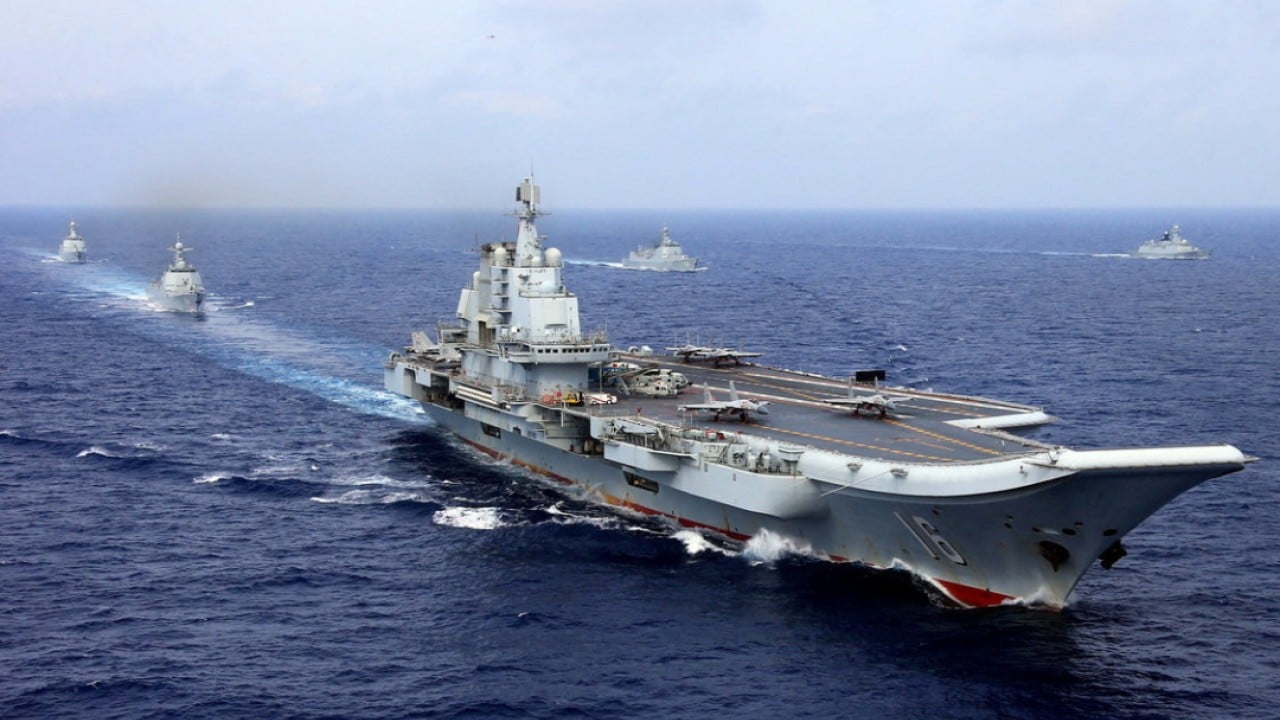
Every time the People’s Liberation Army (PLA) runs a naval drill in the Taiwan Strait, Western defense pundits reach for the exact same playbook. They look at satellite imagery of destroyers, draw red circles around carrier killer missiles, and ask a breathless, recycled question: Is the PLA rehearsing operations to keep US forces out of a Taiwan conflict?
That question is a decade out of date. It assumes Beijing is still practicing for a hypothetical rainy day. It treats Anti-Access/Area Denial (A2/AD) as a theoretical shield the PLA is still trying to forge, rather than a mature, operational architecture they have spent twenty years perfecting.
The lazy consensus in Washington and London treats Chinese military exercises like a dress rehearsal for a Broadway show. Analysts count hulls, measure sortie rates, and debate whether the PLA Rocket Force has enough Dongfeng-26 missiles to sink a Nimitz-class carrier. By framing these drills as "rehearsals," mainstream commentary lulls policymakers into believing the United States still holds the initiative—that the Pentagon can simply decide whether or not to intervene when the balloon goes up.
They are wrong. The PLA isn't rehearsing to keep the US out. They are normalizing a permanent siege posture, mapping the electromagnetic spectrum of the Western Pacific, and turning a wartime blockade into a peacetime administrative routine. If you are still asking whether China is practicing to deny access to the Seventh Fleet, you have already missed the war that is happening right now in the gray zone.
The A2/AD Fallacy and the Myth of the "Rehearsal"
To understand why the mainstream defense narrative fails, we have to dismantle the core premise of the "rehearsal" theory. In military doctrine, a rehearsal implies a temporary spike in readiness before a discrete event. You stage forces, practice a maneuver, and stand down.
The PLA Eastern Theater Command does not stand down. Look at the tempo of operations since August 2022. What used to be an extraordinary show of force—crossing the median line of the Taiwan Strait—is now daily commuter traffic for J-16 fighters and Type 052D destroyers.
I have sat in briefings with defense contractors and Pentagon planners who still model a Taiwan contingency like a 1990s Gulf War scenario. They build war games around a clean "D-Day," assuming US Carrier Strike Groups will steam unimpeded from Yokosuka or Guam, establish air superiority, and roll back Chinese air defenses. That operational reality died around 2015.
Here is the actual mechanic of what these drills accomplish:
- Sensor Calibration: Every time the PLA stages a joint blockade drill, US and allied intelligence assets—RC-135 Rivet Joints, P-8 Poseidons, and space-based signals intelligence—scramble to watch. The PLA isn't hiding from them. They are baiting them. Beijing is recording the exact electronic signatures, radar frequencies, and reaction times of American reconnaissance networks.
- Logistical Stress-Testing: Moving munitions, fuel, and amphibious lift across Fujian province isn't about showing off for CNN cameras. It is about finding the bottlenecks in China’s civilian-military fusion rail and port infrastructure before a single shot is fired.
- Cognitive Attrition: By blurring the line between a routine exercise and an actual invasion mobilization, Beijing destroys the West’s warning time. When the real transition to war happens, it won't look like a sudden bolt from the blue. It will look like Tuesday.
Calling this a "rehearsal" gives the Pentagon a psychological safety blanket. It implies the curtain hasn't gone up yet. In reality, the PLA is actively shaping the battlespace so that by the time the US National Command Authority realizes an invasion or quarantine is underway, the cost of entry will already be prohibitive.
The Geography of Denial: Why the First Island Chain Is a Killing Box
Defense analysts love to talk about American technological superiority. They cite fifth-generation stealth, superior submarine quieting, and battle-hardened crews. All of that is true, and none of it alters basic physics.
Geography in the Western Pacific favors the PLA overwhelmingly. Taiwan sits roughly 100 miles off the coast of mainland China. It sits over 5,000 miles from Hawaii and more than 7,000 miles from California. Even from forward bases in Okinawa or Guam, US forces face the tyranny of distance, operating at the end of fragile, multi-thousand-mile logistics tethers.
Meanwhile, the PLA fights from its own backyard. Their airfields, missile brigades, command bunkers, and logistics depots are buried deep inside continental China, protected by the densest integrated air defense system on earth.
Imagine a scenario where a US Carrier Strike Group attempts to push inside the First Island Chain during high-intensity hostilities. To survive, an American carrier must defend against simultaneous, multi-axis saturation attacks:
- Sub-surface: Quiet diesel-electric Yuan-class submarines lurking in the shallow, acoustically noisy waters of the East China Sea, armed with supersonic wake-homing torpedoes and anti-ship cruise missiles.
- Surface: Type 055 cruisers carrying over a hundred vertical launch cells packed with YJ-18 and YJ-21 hypersonic anti-ship ballistic missiles.
- Air: H-6K bombers launching stand-off munitions from well outside the engagement range of carrier-based F/A-18s and F-35Cs.
- Land: The PLA Rocket Force firing salvos of DF-21D and DF-26 missiles, guided by a sprawling constellation of Yaogan reconnaissance satellites and high-altitude stealth drones.
Western commentary frequently treats these capabilities in isolation, debating the kill probability of a single missile against an Aegis cruiser. That misses the point entirely. The PLA does not need to sink an American carrier to keep the US out of the fight. They only need to force the carrier to stay 1,000 nautical miles east of Taiwan to survive.
At 1,000 miles out, the unrefueled combat radius of an F-35C is completely exhausted before it even reaches the Taiwan Strait. If the carrier is forced back to preserve the hull, the PLA has achieved total operational success without firing a single shot at an American ship.
What People Get Wrong About a Taiwan Blockade
When searching for answers on this topic, readers usually fall into two camps: those who think China will launch a massive D-Day amphibious assault tomorrow, and those who think a naval blockade is a low-risk, bloodless alternative. Both assumptions are fatally flawed.
Will China invade or blockade Taiwan?
The premise of this question creates a false binary. In PLA military doctrine—specifically the Science of Military Strategy published by the Academy of Military Sciences—blockade operations (often termed Joint Blockade Campaigns) are not a standalone alternative to an invasion. They are the opening phase of a unified campaign. You starve the island of energy, ammunition, and internet connectivity while degrading its air defenses, softening the target before amphibious and airborne forces cross the strait.
Can the US Navy break a Chinese blockade?
Breaking a blockade is not like running the Berlin Airlift. You cannot simply escort a commercial LNG tanker through the Bashi Channel under the guns of coastal defense batteries and call it a day. To break a PLA blockade, the US Navy would have to actively suppress Chinese sensors, destroy mobile missile launchers on the Chinese mainland, and sink PLA Navy surface combatants. That means striking targets inside sovereign Chinese territory. Any president who orders strikes on the mainland is knowingly crossing the threshold into a direct, potentially nuclear conflict between superpowers.
Why doesn't the US just station more troops in Taiwan?
Because tripwire forces only work when the adversary believes you are willing to go to war over the tripwire. Stationing a brigade of US Marines in Taipei wouldn't deter Beijing; it would create an immediate hostage crisis. Without the logistics infrastructure to sustain and reinforce those troops under fire, they would be cut off within 48 hours of hostilities breaking out.
The Real Threat Isn't Kinetic—It's a Quarantine
If you want to understand how Beijing actually plans to keep the US out, stop looking at the PLA Navy and start looking at the China Coast Guard (CCG) and the Maritime Militia.
The smartest strategists in Beijing know that a full-blown shooting war with the United States carries existential risks for the Chinese Communist Party. Sinking an American carrier guarantees total war, global economic collapse, and potential regime instability.
So why kick down the front door when you can just change the locks?
Instead of a military blockade—which is legally an act of war under international law—Beijing is rehearsing a law enforcement quarantine. Picture this: China declares a customs inspection regime around Taiwan's major ports like Kaohsiung and Keelung. They don't send gray-hulled warships to enforce it. They send white-hulled China Coast Guard cutters—vessels that are literally repurposed Type 054A frigates with the missiles stripped off, painted white, and reinforced for ramming.
Under this quarantine scenario, Beijing announces that all commercial vessels entering Taiwanese waters must submit to boarding and inspection by Chinese maritime authorities.
Watch what happens to the global economy the second that announcement drops:
- Lloyd’s of London and major maritime insurers immediately pull war-risk coverage for any container ship or LNG carrier heading to Taiwan.
- Commercial shipping conglomerates—Maersk, MSC, Evergreen—halt routes to Taiwan overnight. Not because a shot was fired, but because no board of directors will risk a $150 million vessel and its cargo being impounded in Xiamen.
- Taiwan imports roughly 98% of its energy and 70% of its food. Within two weeks, the island's power grid begins rolling blackouts, and the global semiconductor supply chain freezes solid.
Now put yourself in the Situation Room in Washington. How does the United States respond to a Coast Guard customs inspection?
If the US Navy sends guided-missile destroyers to shoot at white-hulled Coast Guard ships enforcing what Beijing calls "domestic customs law," Washington looks like the military aggressor escalating a law enforcement dispute into World War III. Allies like Japan, South Korea, and the Philippines—who rely heavily on Chinese trade—will hesitate to join a kinetic coalition over customs inspections.
By operating just below the threshold of armed conflict, the PLA and CCG neutralize America's conventional military superiority. You cannot use a $2 billion stealth bomber to solve a maritime law enforcement blockade.
The Uncomfortable Truth About American Deterrence
Admitting the flaws in the US defense posture doesn't mean Beijing holds an unbeatable hand. Every strategy has massive vulnerabilities, and the contrarian view must account for where China’s own plan falls apart.
The PLA’s entire A2/AD architecture relies on a fragile, hyper-centralized kill chain. To hit a moving carrier at 1,500 miles, Chinese missiles depend on real-time data links connecting space-based sensors, over-the-horizon radars, and command centers. If the US blinds those satellites, jams the data links, or severs the undersea fiber-optic cables connecting coastal sensors, the PLA’s long-range precision strike capability turns into blind artillery.
Furthermore, the PLA has not fought a peer-level war since 1979—and their performance against Vietnam in that border conflict was notoriously messy. Centralized command structures breed rigidity. When things go wrong in the fog of war, junior PLA officers are culturally and institutionally conditioned to wait for orders from Beijing rather than improvise.
Yet, banking on Chinese incompetence is not a strategy. Right now, Washington is losing the deterrence equation because it is buying the wrong hardware for the wrong fight.
For decades, the Pentagon has prioritized exquisite, multi-billion-dollar platforms—aircraft carriers, high-end fighters, and massive surface combatants—that serve as lucrative targets in a contested littoral zone. Congress fights to keep legacy shipyards open while starving the industrial base of the exact munitions needed to survive a high-intensity war: long-range anti-ship missiles, sea mines, unmanned underwater vehicles, and hardened forward fuel depots.
How to Actually Break the Trap
If policymakers want to stop the PLA from locking the US out of the Western Pacific, they need to abandon the fantasy of fighting a clean, symmetric war on China’s doorstep. Deterrence requires shifting from a strategy of denial by dominance to a strategy of denial by attrition.
- Turn Taiwan Into an Unpalatable Porcupine: Stop selling Taipei big-ticket prestige items like Abrams tanks and conventional surface ships that will be cratered in the first six hours of a conflict. Flood the island with mobile, dispersed, low-signature weapons: truck-mounted Harpoon coastal defense systems, thousands of smart sea mines, shoulder-fired air defenses, and autonomous loitering munitions. Make the Taiwan Strait an impassable graveyard for amphibious shipping.
- Disperse the Force Across the Second Island Chain: The era of concentrating thousands of airmen and dozens of aircraft at massive bases like Kadena in Okinawa is over. Those bases are sitting ducks for PLA Rocket Force ballistic missiles. The US Air Force and Marine Corps must rapidly scale Agile Combat Employment—operating small teams from dozens of austere, dispersed airstrips across Micronesia, Palau, and northern Australia, forcing the PLA to spread its missile inventory thin.
- Invest in the Undersea Asymmetric Advantage: The one domain where the PLA remains decades behind is anti-submarine warfare. American Virginia-class and Los Angeles-class attack submarines can operate inside the First Island Chain with near impunity, hunting PLA amphibious fleets and logistics ships even if the skies above are completely contested. Maximize submarine production and underwater drone swarms immediately.
- Prepare Economic Counter-Blockade Measures: If Beijing attempts a Coast Guard quarantine of Taiwan, the response shouldn't be a suicidal naval charge into the Taiwan Strait. The US and its allies control the maritime chokepoints of the Indian Ocean—specifically the Malacca Strait. Nearly 80% of China's imported oil passes through that narrow strip of water. Deterrence means making it crystal clear to Beijing that any maritime quarantine of Taiwan will be met with an immediate, global interdiction of Chinese energy and raw material shipments thousands of miles away, completely outside the range of the PLA's missiles.
The mainstream media will keep running breathless headlines every time Chinese bombers circle Taiwan, asking if the PLA is "rehearsing" to keep America out. Ignore the noise. The rehearsal ended years ago. The siege is already underway, and the only question left is whether Washington will wake up before the trap snaps shut.