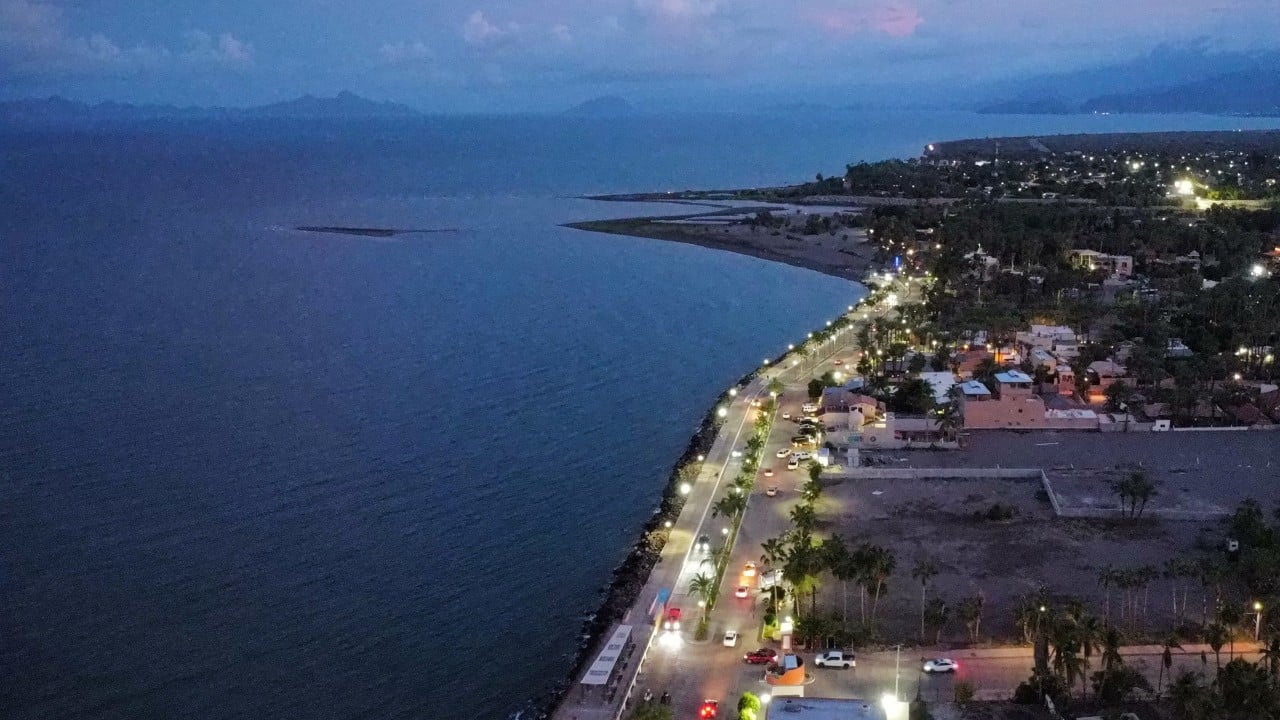
Every time a Pacific storm gathers strength, the script writes itself. Satellite feeds loop dramatic infrared spirals. Cable anchors clutch their pearls. Headlines shriek about catastrophic downpours and biblical deluges bearing down on the Mexican coastline. When Hurricane Polo tracked toward Baja California Sur and the mainland, the narrative followed the exact same well-worn script. Emergency alerts flashed. Evacuation buses rolled. Officials warned of total devastation.
Then the storm made landfall, battered the coast, dropped its water, and dissipated over the mountains. The cameras packed up. The politicians promised rebuilding funds. And everyone went back to sleep until the next low-pressure anomaly formed off the coast.
It is a comforting illusion. It allows us to point our collective finger at the sky, curse the fury of nature, and treat the resulting catastrophe as an unpreventable act of God.
It is also complete nonsense.
The dangerous floods associated with Hurricane Polo, much like every major weather event before it, were not manufactured in the upper atmosphere. They were engineered in municipal planning offices, cemented over by corrupt real estate developers, and subsidized by a disaster response industry that profits far more from emergency relief than from boring, preventative engineering.
If you want to understand why water destroys homes in towns like Cabo San Lucas, Guaymas, or Talpa de Allende, stop looking at Doppler radar. Look at zoning permits. Look at concrete channels choked with debris. Look at decades of institutional apathy that chose short-term political expediency over basic urban hydrology.
The Theater of Emergency Management
Let us look at how the machinery actually operates. When a hurricane forms, the bureaucratic machinery swings into overdrive. CONAGUA activates hundreds of brigade units. Federal agencies deploy thousands of electrical workers. Shelters open their doors. The federal government issues severe weather warnings that dominate international news cycles.
This mobilization looks impressive on paper. It projects competence. It signals to international observers that the state is taking decisive action to protect its citizens.
Behind the high-visibility PR campaign lies a glaring structural failure. All of this energy is purely reactive. It treats the symptom while ignoring the disease. Pouring millions of pesos into temporary shelters, emergency food packets, and post-storm debris removal is the disaster equivalent of handing out buckets on a sinking ship while refusing to patch the hull.
I have watched regional governments blow astronomical sums on emergency logistics while municipal drainage systems remain clogged with decades of uncollected trash and neglected silt. The math is perverse. Preventative maintenance does not make for good television. You cannot cut a ribbon in front of a clean, unglamorous subterranean drainage pipe. You cannot hold a dramatic press conference celebrating a sewer system that successfully handled a downpour because, by definition, nothing happened.
Emergency declarations, however, unlock funds, suspend procurement laws, and create lucrative contracts for well-connected contractors. Crisis is an economic engine. As long as disaster management rewards the cleanup rather than the hardening, local authorities have a perverse incentive to keep letting the floods happen.
The Geography of Negligence
Water obeys physics, not political boundaries. When heavy rainfall hits the rugged terrain of western Mexico, precipitation seeks the path of least resistance. For millennia, nature carved out specific arterial paths—arroyos, riverbeds, and natural floodplains—to channel millions of gallons of runoff safely back into the Pacific.
Then humans arrived with bulldozers and concrete mixers.
In cities across Baja California Sur, Sonora, and Jalisco, urban growth has systematically paved over natural drainage basins. Developers built housing complexes directly inside active arroyos because the flat, sandy soil made for cheap construction. Local city councils, blinded by property tax revenues and tourist expansion dreams, happily signed off on the permits. Environmental impact assessments were treated as bureaucratic hurdles to be bribed around rather than scientific realities to be respected.
When Hurricane Polo dumped feet of water across the region, those dry riverbeds remembered what they were. They reclaimed their territory. When a home built on a dried-up stream bed gets swept away, calling it a natural disaster is an insult to nature. It was a structural engineering homicide.
Consider the infrastructure failures reported during the storm. Seawalls collapsed. Bridges washed out. Roads turned into raging torrents. Local reports noted that barriers built to prevent water infiltration failed instantly under the pressure of storm surges.
We are told this is unprecedented. We are told the storm was too powerful, too erratic, too vicious for human engineering to withstand. This is a convenient falsehood designed to shield incompetent planners from accountability. Modern civil engineering has mastered water management for centuries. The Dutch hold back the North Sea. Modern metropolises route massive typhoons safely through urban cores.
Mexico's coastal infrastructure did not fail because Hurricane Polo was uniquely apocalyptic. It failed because it was built out of cheap materials, designed with zero margin for error, and maintained with a level of neglect that borders on criminal negligence.
The False Promise of Evacuation Culture
There is a distinct fetishization of evacuation in modern emergency management. If you tell people to leave their homes, put them in a gymnasium for forty-eight hours, and hand them a blanket, you have fulfilled your legal duty of care.
Except most people do not want to leave. And frankly, in many cases, they should not have to.
Forcing families out of their homes because the municipality refused to build proper flood defenses is an abdication of governance. When a fisherman in Baja California worries about losing everything while out on the water, or when families scramble to salvage their belongings as muddy water pours through their front doors, they are paying the price for systemic municipal failure.
Evacuation is a necessary safety valve when a storm breaks all historical records, but it should be the absolute last line of defense—not the primary strategy. When evacuation becomes the default plan for every moderate-to-severe tropical system, it ceases to be emergency management and becomes institutional resignation.
Worse still, the aftermath of these storms exposes the deep economic vulnerability of the population. Displaced residents return home to find their properties ruined, their vehicles totaled, and their livelihoods shattered. In regions already plagued by economic insecurity and cartel extortion, the fiscal drain of recurring flood damage cripples small businesses and hollows out local tax bases. The reconstruction funds that do trickle down often become points of friction and corruption, further entrenching the poverty cycle.
The storm passes in forty-eight hours. The debt and structural decay linger for years.
Dismantling the Myth of the Climate Bogeyman
Whenever severe weather strikes, an army of commentators rushes to pin every drop of rain on global climate change. While planetary warming undeniably alters atmospheric moisture content and intensifies weather anomalies, hiding behind macro-level climate trends is a coward's way out of local accountability.
Blaming climate change for a flooded neighborhood in Guaymas is like blaming global economics for a personal bankruptcy when you spent your mortgage money on luxury cars.
The climate is changing. Everyone with a functioning brain knows this. Storms may carry more moisture; wind patterns may shift. Knowing that extreme weather is becoming more frequent means that building infrastructure to twentieth-century standards is professional malpractice. If local governments know that storms will drop heavier rainfall totals, the only rational response is to double down on aggressive urban hardening, strict zoning enforcement, and radical watershed restoration.
Instead, politicians use climate change as a universal get-out-of-jail-free card. Oh, the bridge washed out? Climate change. Oh, the drainage system overflowed in twenty minutes? Unprecedented climate anomaly.
It is a linguistic shield that protects lazy mayors and corrupt zoning boards from facing the consequences of their own administrative failures.
What Competence Actually Looks Like
If we want to stop writing the same tragic article every time a hurricane grazes the coast, we need a complete ideological inversion of how we handle water and weather in Latin America.
First, criminalize development in arroyos and floodplains. Not through soft guidelines or advisory memos, but through strict, heavily enforced criminal penalties for municipal officials who sign off on permits in high-risk zones. If a developer builds luxury condominiums in a natural drainage basin, seize the property, forfeit the bonds, and hold the signatories legally liable for any downstream destruction.
Second, pivot funding from emergency cleanup to subterranean engineering. Take the hundreds of millions spent on post-storm relief, military-style rescue deployments, and temporary shelter logistics, and divert fifty percent of it into massive, long-term civil works projects. Build real retention basins. Dredge rivers before the rainy season arrives. Upgrade electrical grids to underground conduits that do not snap the moment a strong wind blows.
Third, stop treating weather events as surprises. Meteorologists track these systems days, sometimes weeks, in advance. If the data shows a high-probability precipitation event heading toward a specific watershed, prepositioning resources is fine, but the real metric of success should be zero structural failures in zones that have been mapped as vulnerable for thirty years.
Finally, empower local communities with independent auditing power over municipal public works budgets. When citizens can track every peso spent on drainage maintenance and see the physical results before the storm hits, the accountability loop closes.
Hurricane Polo was a warning shot, just as dozens of tropical depressions before it were warning shots. The sky is not conspiring against us. The water is simply doing what water has always done.
The only thing truly drowning in Mexico isn't the coastal towns. It's the political will to build something that lasts.