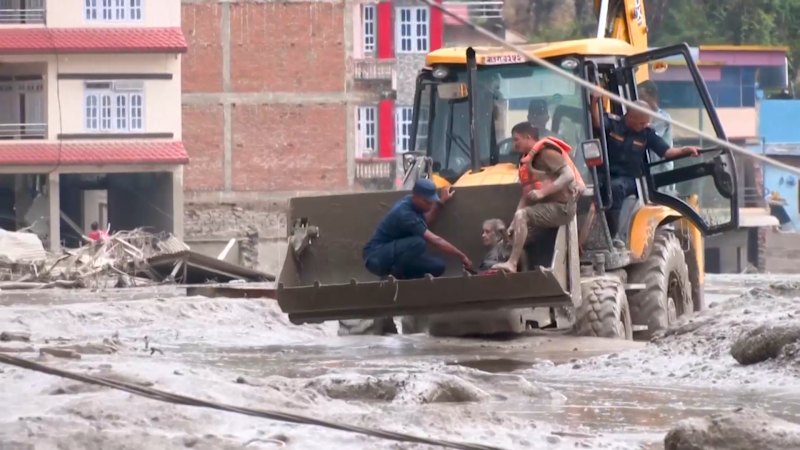
The headlines weep over a tragic act of nature. A massive glacier and rock collapse high in the Himalayas triggered a sudden, catastrophic torrent down the Bhotekoshi and Trishuli river systems. Hundreds are dead. Thousands remain missing. The lazy consensus in every major newsroom points a collective finger at climate change, painting the disaster as an unavoidable strike from an angry sky.
It is a convenient fiction.
Climate change sets the stage, but human hubris wrote the script. We are not merely witnessing a natural disaster; we are watching the predictable, mathematical collapse of unbridled infrastructure development built directly inside a high-altitude death trap. For decades, developers, states, and planners ignored basic geomorphological realities to chase hydropower and tourism dollars in narrow Himalayan gorges. When a six-hundred-meter-wide shelf of ice and rock broke loose from an altitude of 5,200 meters, it did not encounter an empty wilderness. It smashed directly into active construction sites, poorly planned border settlements, and vulnerable river valleys packed with workers.
To understand why this catastrophe claimed hundreds of lives, we must stop asking how much rain fell or how fast the ice melted. We need to look at why we keep building heavy industrial projects in active, unstable glacial pathways.
The Hydropower Mirage and Tunnel Blindness
Consider the engineering reality of projects like the Upper Trishuli-1 Hydropower facility in the Rasuwa district. When the wall of water, mud, and pulverized ice tore down the valley, workers were trapped inside tunnels. News reports focused on the heroism of the rescue operations—pulling survivors out caked in dark brown mud.
Nobody is asking why multi-million-dollar energy projects are concentrated in zones with extreme susceptibility to glacial lake outburst floods and ice avalanches.
Geoscientists have mapped Himalayan instability for years. The data shows that as permafrost thaws and glaciers retreat at unprecedented rates, high-altitude slopes lose their structural integrity. Yet, economic incentives override basic survival logic. Planners treat the Himalayas like a stable European alpine valley, ignoring the immense gravitational potential energy stored in rapidly destabilizing vertical terrain.
Imagine a scenario where a corporate board must personally occupy a residential camp built fifty meters from a glacial-fed torrent every monsoon season. Concrete standards would change overnight. Instead, risk is externalized onto migrant laborers, local villagers, and trekking tourists. When the disaster strikes, it is branded as an unforeseen "act of God," absolving planners of any structural accountability.
Dismantling the Missing Persons Data Gap
The casualty figures themselves reveal institutional failure. In the immediate aftermath, discrepancies between local police reports, national disaster management authorities, and international tourism boards exposed an alarming truth. Thousands of people were unaccounted for not just because the flood moved fast, but because commercial and administrative tracking in these remote corridors is fundamentally broken.
When a disaster authority has to scramble to add nearly a thousand hydropower construction workers to a missing persons list days after the event, it proves that baseline safety audits and headcounts were non-existent. You cannot protect a workforce you have barely bothered to register.
The presence of hundreds of foreign nationals—trekkers, pilgrims heading to Mount Kailash, and international engineers—adds another layer of reckless exposure. Tourism boards market the Himalayas as a mystical adventure playground while downplaying the lethal mechanics of moving tectonic plates and melting permafrost.
The Real Protocol Shift
If we continue to treat these events as anomalies, the death toll will only climb. Resilience requires discarding three dangerous myths:
- The Myth of Predictable Seasons: Traditional monsoon planning is dead. Glacial collapses and sudden debris flows do not adhere to historical calendar windows.
- The Myth of Reinforcement: Building higher concrete walls along narrow gorges does nothing when an entire mountainside drops 1,200 meters into a valley. You cannot engineer your way out of bad geography.
- The Myth of Rapid Recovery: Early warning systems are useless if downstream infrastructure gives people zero physical space to evacuate.
We must implement mandatory setback zones for all permanent human habitation and industrial construction in high-risk Himalayan river corridors. If a valley shows high susceptibility to glacial avalanches, commercial development must be legally prohibited, regardless of its energy or tourism potential.
The mountain did not ambush us. We simply built our houses in its path, and then acted surprised when it rolled over.


