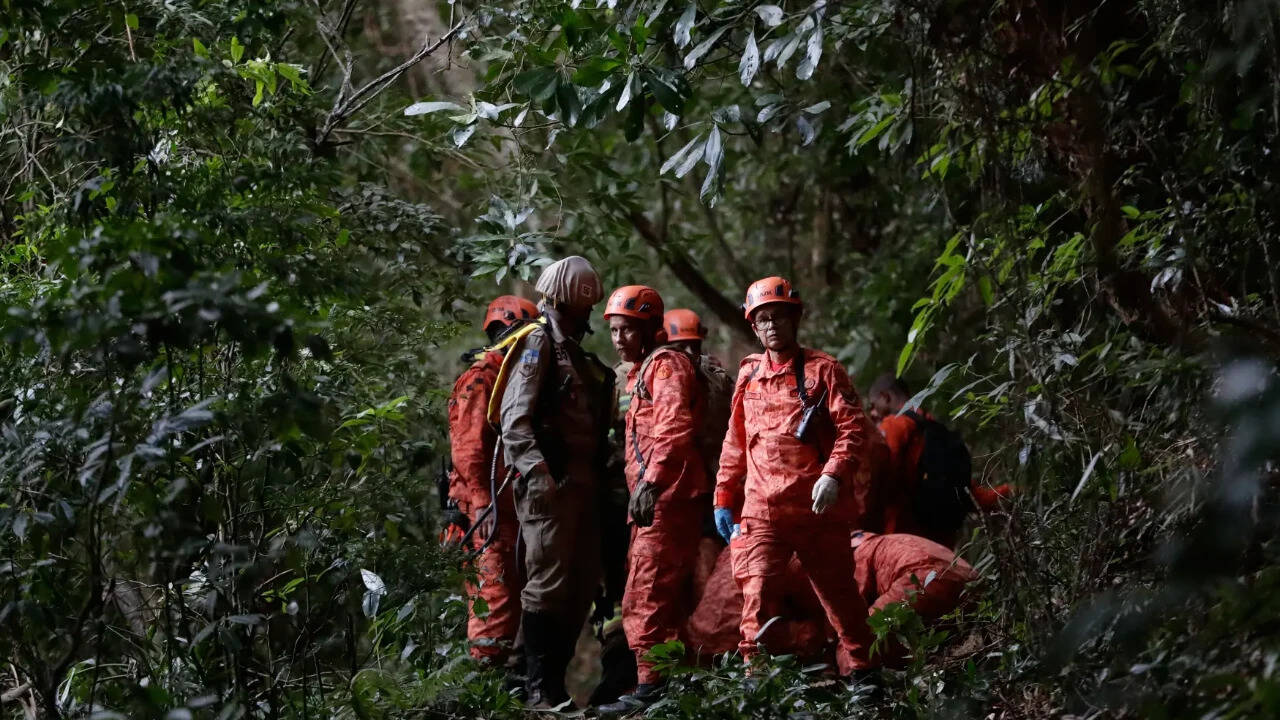
"Four killed after helicopter crashes on steep hillside in Rio de Janeiro."
The ink dries. The wreckage is cleared. The press blames a sudden patch of fog.
Every time this exact headline recycles itself, the global aviation community collectively rolls its eyes while the public weeps. It is the laziest consensus in modern journalism. We are fed a continuous loop of "freak accidents" and "unpredictable tragedies."
I have spent years dissecting aviation safety failures, watching operators bleed millions trying to fix the wrong problems while regulators look the other way. Let me tell you exactly what happens when a helicopter hits a granite mountain in Rio de Janeiro.
It is rarely a mechanical failure. It is rarely an unpredictable act of God.
It is a business failure.
The Scapegoat of Meteorology
Media outlets love to talk about Rio's sudden weather changes. They paint a dramatic picture of a pilot ambushed by a rogue cloud, a victim of mother nature's fury.
This is fiction.
Meteorology is a hard science. We have satellites, doppler radar, and highly localized predictive weather models. The microclimates of the Tijuca Massif are deeply documented and entirely predictable. When a pilot encounters blinding fog rolling over a ridgeline in Rio, it is almost never a surprise. It is a calculated risk that failed.
Aviation operates primarily on two distinct sets of rules: Visual Flight Rules (VFR) and Instrument Flight Rules (IFR). Most scenic flights and quick-hop executive transports in urban environments operate strictly under VFR. The mandate is brutally simple: you must be able to see the ground, the horizon, and the obstacles in front of you.
When a VFR pilot flies into Instrument Meteorological Conditions (IMC) — heavy fog, blinding rain, or low-hanging stratocumulus clouds — they lose their external visual references. This is not a weather anomaly. It is a chain of terrible decisions culminating in a fatal error.
In the industry, we call the resulting crash CFIT. Controlled Flight Into Terrain.
Read that acronym again. Controlled.
The machine was working perfectly. The rotors were spinning. The engine was burning fuel. The helicopter was flown directly into a rock face because the person at the controls could not see the rock face. The steep hillside didn't jump in front of the aircraft.
Why does a highly trained pilot fly a perfectly good machine into a cloud hiding a mountain? Because turning back costs money.
The Economics of "Get-There-Itis"
This is where the real tragedy lives. It is a psychological trap known in aviation circles as "get-there-itis," amplified by raw, unfiltered capitalism.
Helicopter operations run on razor-thin profit margins. Aviation fuel is expensive. Routine maintenance is astronomical. Insurance premiums for rotorcraft eat up the gross revenue. Whether it is a wealthy executive commuting from a compound in Barra da Tijuca to a meeting in Centro, or a family paying top dollar for a scenic tour around Christ the Redeemer, the pressure is constantly on the pilot to complete the mission.
If a pilot turns around because of low clouds, the operator has to refund the ticket. VIPs throw tantrums. Tour operators lose their daily margin.
I have seen companies push pilots to the absolute edge of legal weather minimums. The unwritten culture dictates that "good" pilots get the job done. The pilots who scrub flights for "a little fog" get quietly replaced by cowboys willing to roll the dice.
The official accident report will eventually say "pilot error." The reality is systemic economic pressure. The pilot is just the last line of defense in James Reason’s famous Swiss Cheese model of accident causation. All the other defensive layers — dispatch pressure, poor route planning, inadequate safety culture, managerial greed — aligned perfectly long before the rotors ever started turning.
The Physiology of a Death Spiral
To understand the brutality of these crashes, you need to understand what happens to a human being when the horizon vanishes.
Humans are not evolved for three-dimensional flight. We rely on our eyes for spatial orientation. When a VFR pilot enters a cloud, visual input drops to zero. The brain desperately searches for data and falls back on the vestibular system — the fluid-filled canals in the inner ear.
The inner ear lies.
Within seconds of losing visual reference, a pilot can suffer from severe spatial disorientation. If a helicopter banks gently into a turn, the fluid in the inner ear accelerates. But if that turn is held constant, the fluid stabilizes. The brain falsely registers that the aircraft is flying straight and level.
When the pilot corrects what they think is a drift, they actually throw the helicopter into a steep, accelerating dive. This is called a graveyard spiral. The pilot looks at their instruments telling them they are diving, but their body screams that they are flying straight. Panic sets in. Sensory overload takes over.
A pilot without rigorous, recent, and continuous instrument training will lose control of a helicopter in IMC within 60 seconds.
By the time the granite hillside appears through the fog, pulling pitch to climb out is a physical impossibility.
Hardware Realities and Topographical Hostility
Let us examine the specific geography of Rio de Janeiro. It is a dense metropolis built into a jungle-covered mountain range, directly bordered by a massive ocean.
You have granite monoliths sticking up hundreds of meters into the flight paths. You have cold Atlantic currents meeting the hot, dense urban heat island of the city. This creates intense thermal activity. Massive updrafts. Violent downdrafts. Fast-moving layers of marine fog that drape over the peaks in minutes.
Flying a light helicopter through these corridors requires absolute discipline and an aircraft capable of outperforming the environment.
Many operators utilize light piston-engine helicopters, like the Robinson R44, to keep overhead costs low. These are magnificent, reliable machines when operated within their limits. But they are not immune to physics.
Imagine a scenario where a light piston helicopter is operating near its maximum gross weight. Four adult passengers plus fuel. It is a hot, humid Brazilian afternoon. High temperatures and high humidity result in a high "density altitude." The air is literally thinner.
Thinner air means the rotor blades generate less lift. It means the engine generates less horsepower. Your performance margins shrink to practically nothing.
If that heavily loaded, underpowered helicopter encounters a sudden downdraft near a steep hillside, the pilot might demand more power than the engine can give. The main rotor RPM drops. The aircraft sinks. You are out of altitude, out of airspeed, out of engine power, and out of ideas.
The lazy narrative ignores this complex physics problem entirely, preferring to label the event a sad mystery.
The Normalization of Deviance
People assume that if a company is selling tickets and operating out of a public heliport, it must be perfectly safe. They assume the aviation authority — in Brazil's case, ANAC — is policing the skies with an iron fist.
Here is the downside to my own contrarian view: I desperately want to believe regulations work to protect the consumer.
But enforcement is a completely different beast than legislation.
You can write a thousand pages of rules dictating VFR weather minimums and mandatory maintenance intervals. But who is sitting in the cockpit enforcing them? No one. Commercial aviation relies heavily on self-reporting and a deeply ingrained culture of compliance.
When an operator knows the regulator is underfunded and understaffed, the temptation to bend the rules grows. It never starts with a fatal crash. It starts small. Flying a little closer to the clouds than legally allowed. Taking off when the visibility is borderline but "good enough." Skipping a minor maintenance check to keep the bird flying for the weekend rush.
Sociologist Diane Vaughan coined the perfect term for this: the normalization of deviance.
The abnormal becomes the standard operating procedure. The red flags are ignored because "we did it yesterday and nothing bad happened." The entire system operates in a state of degraded safety until the day the weather closes in a little faster, the engine runs a little hotter, and four people die on a hillside. Then, everyone acts shocked.
Dismantling the Passenger's Flawed Premise
When tourists visit a city like Rio, they jump on Google and ask the wrong questions.
"What is the safest helicopter tour company?"
"Which helicopter ride has the best views?"
These queries assume that the baseline of the industry is inherent safety, and you are simply shopping for amenities.
You need to completely redefine how you view this transaction. The right question is: "Under what specific conditions should I absolutely refuse to get into a helicopter?"
Consumers treat helicopters like taxis. You get in, you put on the headset, you take a selfie, and you arrive at your destination. They are not taxis. They are highly complex aerodynamic machines operating in an unforgiving, high-risk environment where gravity bats last and gravity always wins.
If you want to survive your vacation, you need to take ownership of your personal risk management.
If you look at the sky and see low, gray clouds shrouding the tops of the mountains, cancel your flight. I do not care if the operator insists it is perfectly safe. I do not care if you lose a $300 deposit. Your life is worth more than a scenic photo of a statue.
If the pilot seems rushed, anxious, or dismissive of your direct questions about the current weather conditions, walk away from the helipad.
If the aircraft looks heavily worn, if the seatbelts are frayed, or if the operator is packing passengers in without asking for your exact body weight—a critical metric for weight and balance calculations—demand your money back.
The media will continue to publish the exact same tragic headlines. They will interview crying relatives and baffled local officials who promise a thorough, sweeping investigation. The investigation will drag on for two years, quietly blame the deceased pilot for spatial disorientation, and file the paperwork away in a dusty cabinet.
Nothing changes until the economic incentives change. Until paying passengers refuse to fly in marginal weather, operators will continue to push the limits of physics and luck.
Do not trust the shiny brochure. Do not blindly trust the operator's assurances. Trust the sky. If you cannot see the mountain, the mountain can still kill you.


