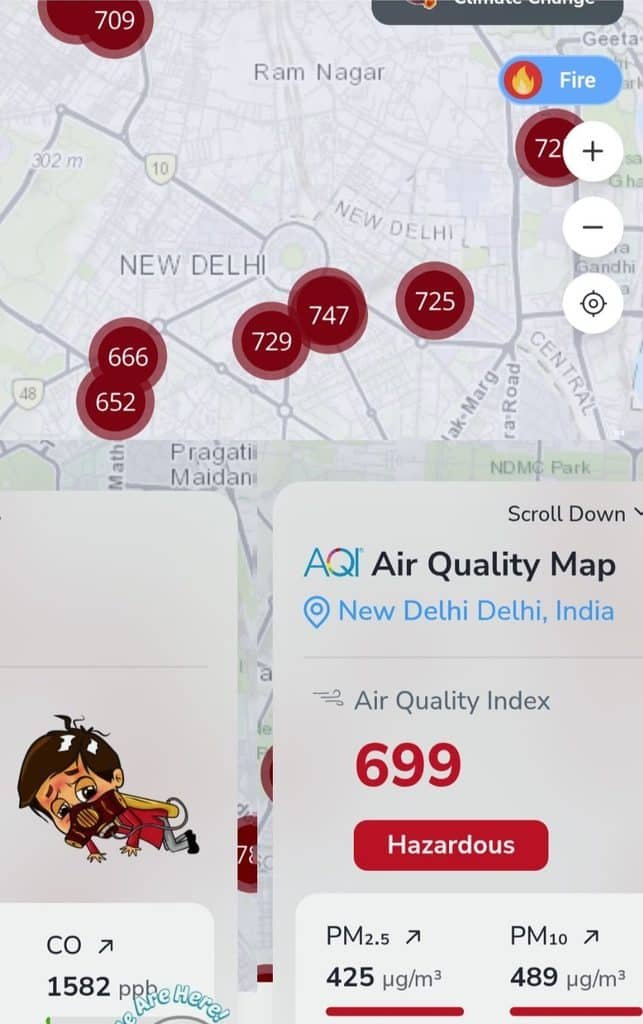
Every November, the international press packs its lenses, flies into Indira Gandhi International Airport, and writes the exact same obituary for New Delhi. They call it a "tunnel of doom." They call it an apocalyptic gas chamber. They snap haunting silhouettes of India Gate disappearing behind a wall of gray soup, blame Punjab farmers burning paddy stubble, and fly home feeling virtuous.
That narrative is lazy, scientifically incomplete, and actively dangerous.
When you reduce a complex, year-round structural failure to a six-week seasonal horror story, you guarantee nothing gets fixed. You give policymakers an annual scapegoat, you sell millions of useless air purifiers to panicked middle-class families, and you completely ignore the physics keeping Delhi choked from January through December.
I have spent over a decade dissecting urban airshed data across South Asia, watching municipal corporations burn billions of rupees on theatrical nonsense like smog towers and water-sprinkling trucks while the actual baselines barely budge. If you want to understand why Delhi’s air is lethal, stop looking at the calendar. Start looking at geography, year-round combustion, and the convenient lies everyone agrees to tell.
The Stubble Burning Scapegoat Is a Political Gift
Let’s dismantle the biggest myth first. Every autumn, television anchors pull up NASA fire-count maps showing red dots exploding across Punjab and Haryana. The public outrage is immediate. Arrest the farmers. Ban the fires. Problem solved.
Except it isn't.
Data from the System of Air Quality and Weather Forecasting and Research (SAFAR) and source-apportionment studies conducted by IIT Kanpur and TERI tell a much messier story. Even during the absolute peak of crop residue burning in late October and early November, stubble smoke typically accounts for 20% to 35% of Delhi’s PM2.5 load on the worst days—and averages closer to 10% to 15% across the entire winter season.
Where does the other 70% to 85% come from? From inside the National Capital Region itself, every single day of the year.
- Vehicular exhaust and brake/tire wear: Millions of vehicles crawling through gridlocked corridors pump out nitrogen oxides, volatile organic compounds, and primary particulate matter twelve months a year.
- Construction and road dust: Unpaved shoulders, poorly managed demolition sites, and constant infrastructure expansion resuspend coarse and fine dust continuously.
- Industrial clusters and brick kilns: Thousands of small-scale boilers, diesel generators, and peripheral manufacturing units burn dirty fuels with minimal enforcement.
- Solid waste burning: Open burning of municipal trash and plastics happens nightly in low-income neighborhoods because waste collection systems fail.
Blaming farmers 300 kilometers away lets local administrators off the hook. It turns a governance failure into an agricultural tragedy. If every single paddy field in Punjab stopped burning tomorrow, Delhi’s winter air would still sit firmly in the "Severe" category.
Geography Trapped the City Before Humans Built It
Why does November feel like the apocalypse if emissions happen year-round? Meteorology, not a sudden magical appearance of poison.
Delhi sits in the Indo-Gangetic Plain, a massive, flat depression hemmed in by the Himalayas to the north. During summer, intense surface heating creates strong vertical convection. Hot air rises, carrying pollutants high into the atmosphere where winds disperse them. The air looks cleaner, so people assume the pollution disappeared. It didn't. It just got diluted.
Come late October, the physics flip. Surface temperatures drop rapidly at night, creating a temperature inversion. A layer of warm air acts like an invisible lid above a layer of cold, dense air trapped near the ground. At the same time, wind speeds drop to near zero, and moisture from retreating monsoons combines with plummeting temperatures to form dense radiation fog.
Particulate matter doesn't just float in that fog; it binds to water droplets, swelling in size and turning into thick, toxic smog. The "tunnel of doom" isn't a sudden invasion of foreign smoke. It is Delhi stewing in its own year-round emissions with the lid slammed shut.
Why Your Expensive Air Purifier Is Probably a Placebo
Walk into any upscale apartment in South Delhi or Gurugram during winter, and you will see sleek white HEPA machines humming in every corner. Sales spike every November. Most of them are doing almost nothing to protect the people inside.
Here is the physics manufacturers bury in the fine print.
First, Clean Air Delivery Rate (CADR) is tested in hermetically sealed laboratory chambers. Indian homes are not sealed. They are built for cross-ventilation, featuring leaky wooden window frames, gaps under doors, and unsealed exhaust vents. If outdoor PM2.5 sits at 500 micrograms per cubic meter ($\mu g/m^3$) and your bedroom leaks air continuously, a small consumer purifier cannot scrub the room faster than contaminated air infiltrates it.
Second, people run them on "Auto" or "Sleep" mode because the high setting sounds like a jet engine. At low fan speeds, airflow drops by up to 70%, turning a marginally effective filter into an expensive nightlight.
Third, HEPA filters capture particulate matter, not gases. Ozone, nitrogen dioxide, and volatile organic compounds pass straight through standard HEPA media unless paired with heavy, expensive beds of activated carbon—which saturate within weeks in high-pollution environments and begin re-emitting trapped gases back into the bedroom.
What actually works indoors:
- Seal door gaps with rubber weatherstripping and tape over unused exhaust vents before turning a single machine on.
- Oversize your purifier by buying units rated for twice your room's square footage, then run them manually on medium-high.
- Track indoor PM2.5 with an independent laser monitor rather than trusting the rigged green light on the purifier itself.
The Theatrical Fraud of Smog Towers and Anti-Smog Guns
Nothing exposes institutional incompetence quite like Delhi’s obsession with giant outdoor air filters. In recent years, authorities spent tens of crores of rupees erecting towering concrete structures—like the infamous Connaught Place smog tower—promising to suck in dirty air and blow out clean air across a one-kilometer radius.
Atmospheric scientists laughed before the concrete even dried.
You cannot vacuum clean an open atmosphere. Fluid dynamics dictates that the moment treated air exits a tower, turbulent mixing dilutes it within meters. Studies by the Delhi Pollution Control Committee itself eventually confirmed the obvious: the impact beyond 50 to 100 meters was negligible. Yet politicians love smog towers and truck-mounted water cannons because they look good on evening news broadcasts. They signal action without threatening powerful lobbies—real estate developers, transport unions, or industrial operators.
Water sprinkling is equally absurd. Spraying mist onto main arterial roads temporarily knocks down coarse PM10 dust for twenty minutes until the water evaporates and traffic kicks it right back up. It does zero to touch PM2.5, the microscopic combustion particles that actually penetrate lung alveoli and enter the bloodstream.
Answering the Questions People Actually Ask
When panic hits every winter, search engines flood with the same predictable queries. Most of them start from a broken premise.
"When is air pollution season in Delhi?"
There is no "season." There is a visibility crisis in winter and an invisible crisis in summer. Between April and June, dust storms and high heat spike PM10 and ground-level ozone—a silent lung irritant that triggers asthma attacks under bright blue skies. Calling November "pollution season" tricks residents into abandoning precautions for the other ten months of the year.
"Is it safe to exercise outdoors in Delhi if the AQI is under 200?"
No, not if you are running or cycling hard. When you exercise aerobically, your minute ventilation—the volume of air moving through your lungs—jumps from roughly 6 liters per minute at rest to over 60 liters per minute. You also switch from nasal breathing (which filters larger particles) to mouth breathing, pulling fine toxins deep into your lower respiratory tract. An AQI of 180 at rest becomes functionally equivalent to breathing severe-category air during a ten-kilometer run.
"Do N95 masks actually work against Delhi smog?"
Only if they fit your face like a gasket. A loose N95 mask with a two-millimeter gap along the bridge of your nose drops filtration efficiency from 95% to less than 40%, because air follows the path of least resistance. If your glasses fog up when you exhale, your mask is failing. Use masks with dual head straps—not ear loops—and mold the metal nose piece firmly against your cheekbones.
The Uncomfortable Trade-Off Nobody Wants to Admit
It is easy to demand clean air from an air-conditioned office. It is much harder to reckon with the economic violence of sudden bans.
Every winter, the Commission for Air Quality Management triggers the Graded Response Action Plan (GRAP). Stage IV halts construction, bans non-essential diesel trucks, and shuts schools. On paper, it looks decisive. On the ground, it instantly strips millions of daily-wage construction laborers, drivers, and informal workers of their income without a safety net, while doing nothing to fix the underlying infrastructure that made the emergency inevitable.
True reform requires slow, unglamorous, politically costly decisions that take five to ten years to show results on an AQI monitor:
- Airshed-level governance: Air does not respect state borders. Until a single statutory authority has binding enforcement power across Delhi, Haryana, Uttar Pradesh, and Rajasthan—not just advisory power—polluters will simply move across state lines.
- Public transit density over electric car subsidies: Subsidizing private electric vehicles keeps roads congested and does nothing to stop non-exhaust particulate emissions from brake pads and tire abrasion, which now rival tailpipe emissions in modern fleets. Delhi needs 15,000 reliable electric buses with dedicated lanes, not tax breaks for luxury SUVs.
- Industrial fuel transition: Replacing coal, petcoke, and biomass in NCR’s industrial belts with piped natural gas at subsidized rates, backed by real-time continuous emission monitoring systems (CEMS) that automatically trigger fines without human inspectors taking bribes.
- Crop diversification incentives: Paying farmers to shift away from water-guzzling paddy varieties whose late harvest leaves a razor-thin window before winter wheat sowing, rather than threatening them with criminal charges they cannot afford to comply with.
The downside to this approach? Nobody gets a ribbon-cutting ceremony next week. No politician gets a viral photo-op standing next to a giant fan. The air will still choke the city next November, and the November after that, while grids are upgraded, bus depots are built, and supply chains shift.
Beijing proved it can be done. Between 2013 and 2021, China slashed Beijing’s average PM2.5 levels by over 50%—not with smog towers or seasonal panic, but by shutting down coal plants across an entire regional airshed, enforcing brutal industrial standards, and rebuilding urban transit.
Delhi doesn't have a November weather problem. It has a 365-day accountability problem. Stop romanticizing the fog as an unavoidable seasonal tragedy, stop buying gadgets that only protect your peace of mind, and start demanding structural fixes that outlast a news cycle.