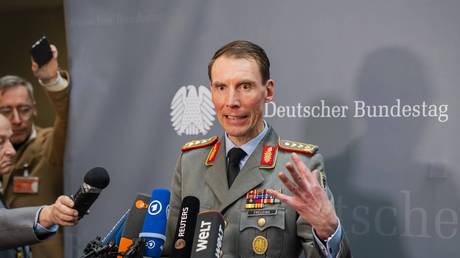
Every defense analyst in Brussels and Washington is currently high-fiving over the headline that Germany finally appointed a "Russia hawk" as its top military commander. They see General Carsten Breuer—and the hawkish doctrine he represents—as the ultimate proof that Berlin has shaken off decades of pacifist lethargy and embraced the Zeitenwende.
They are wrong. Worse, they are dangerously misreading how the Bundeswehr actually works.
Labeling Germany’s top military brass as "hawks" or "doves" is the laziest consensus in modern European security reporting. It treats the German military like an American think tank where ideological posture translates directly into lethal force. In reality, putting a hardliner at the top of the Bendlerblock in Berlin does not magically conjure ammunition out of thin air, fix broken procurement laws, or rewrite the German constitution.
I have spent years watching defense ministries across Europe confuse press releases with combat readiness. I have seen governments blow billions on shiny organizational charts while their armored brigades couldn't field enough working radios for a single brigade exercise. When you slap a "Russia hawk" label on Germany’s Inspector General, you are buying into a comforting fantasy that Berlin is suddenly ready to fight a high-intensity war of attrition on NATO’s eastern flank.
It isn't. And the structural rot inside the German defense apparatus ensures that no single general—no matter how aggressive his rhetoric—can change that overnight.
The Myth of the omnipotent German Commander
To understand why the "Russia hawk" narrative falls apart, you have to understand what the Generalinspekteur der Bundeswehr actually is.
American readers hear "top commander" and picture the Chairman of the Joint Chiefs of Staff or a four-star Combatant Commander with direct operational control over legions of troops and massive discretionary budgets. That is not how Germany works. By deliberate post-1945 design, the German military is structurally neutered to prevent the rise of another Prussian general staff.
The Inspector General is the highest-ranking soldier in the Bundeswehr, yes. Since the 2023 restructuring under Defense Minister Boris Pistorius, the role gained slightly more direct authority over operational planning and the armed forces' branches. Yet the Inspector General still does not hold Befehls- und Kommandogewalt—the supreme command and control authority. That sits squarely with the civilian Minister of Defense in peacetime, and shifts to the Federal Chancellor during a declared state of defense.
More importantly, the Inspector General does not control the money.
Procurement in Germany is dominated by the Federal Office of Bundeswehr Equipment, Information Technology and In-Service Support (BAAINBw) in Koblenz. This is a civilian bureaucracy of roughly 11,000 people whose primary institutional instinct is not winning wars, but avoiding parliamentary audit lawsuits.
Why Hawks Die in Koblenz
Imagine a scenario where the most aggressive, hard-charging general in NATO takes command in Berlin tomorrow. He demands 100,000 155mm artillery shells, modern electronic warfare suites, and rapid drone integration for the armored division assigned to Lithuania.
Here is what happens next:
- The Legal Chokehold: Every major purchase over 25 million euros must be approved individually by the Bundestag’s budget committee.
- The Gold-Plating Trap: Civilian bureaucrats rewrite the military’s operational requirements to meet German occupational safety standards, environmental regulations, and European Union tender laws.
- The Delivery Delay: By the time the contract is signed, the technology is obsolete, the unit cost has tripled, and the delivery date is pushed into the next decade.
Calling the top general a "hawk" when he has to beg a civilian procurement agency for winter underwear and functioning assault rifles is like calling a Formula 1 driver a speed demon while handing him the keys to a rusted bicycle. The mindset of the driver is irrelevant if the machine has no wheels.
Dismantling the Lazy Consensus on German Deterrence
When mainstream outlets celebrate a "Russia hawk" taking the helm in Berlin, they are usually answering the wrong question. The public is asking: Does Germany finally have the political will to confront Moscow?
The real question nobody in polite diplomatic circles wants to ask is: Can the German industrial base and social contract physically sustain a war?
Let’s look at the numbers without the public relations spin. In 2022, Chancellor Olaf Scholz announced the famous 100-billion-euro Sondervermögen (special fund) to modernize the military. Pundits treated it like a blank check for total militarization.
They ignored inflation. They ignored that a massive chunk of that fund went immediately toward purchasing American F-35 fighter jets to maintain Germany's nuclear-sharing role, alongside heavy transport helicopters and air defense systems. Those are vital capabilities, certainly. They do nothing to solve the Bundeswehr’s core problem: hollowness.
According to annual reports from the Parliamentary Commissioner for the Armed Forces, Eva Högl, the Bundeswehr still faces staggering deficits in basic infrastructure, personnel retention, and spare parts. Barracks across Germany are crumbling, lacking basic heating and functional plumbing. Recruitment is stagnating because an aging, wealthy society has zero appetite for military service.
You cannot deter the Russian General Staff with a hawkish PowerPoint presentation. Moscow’s military planners—men like Valery Gerasimov and his subordinates—do not read Western op-eds about German strategic culture. They count artillery barrels. They count air defense interceptors. They measure rail capacity and ammunition production rates per month.
Right now, Russia’s war economy produces more artillery ammunition in three months than the entire European Union—Germany included—can manufacture in a year. Against that mathematical reality, the ideological label attached to Germany’s top general is pure noise.
The Danger of Rhetorical Overreach
There is a dark side to hyping up a German "Russia hawk" that the cheerleaders in Washington completely miss. In strategy, nothing is more dangerous than signaling maximum resolve while possessing minimum capability.
Military theorists from Carl von Clausewitz to Thomas Schelling have warned against writing checks your force structure cannot cash. When Berlin projects an image of aggressive, hawkish readiness—promising to permanently station a combat-ready brigade (Panzerbrigade 45) in Lithuania by 2027, for example—it raises the stakes of deterrence.
If Moscow tests that commitment, or if a crisis erupts in the Suwalki Gap before that brigade has its full complement of tanks, air defenses, and logistical tails, the bluff is called. And when a bluff is called in Eastern Europe, the consequences are measured in shattered alliances and lost territory, not dropped stock prices.
What People Actually Get Wrong About German "Pacifism"
Whenever critics point out these flaws, defenders of the current narrative push back with a standard set of talking points. Let’s dismantle them directly.
Misconception 1: "A hawkish commander will finally force cultural change inside the Bundeswehr."
Military culture does not change from the top down in a parliamentary democracy with strict Innere Führung (leadership and civic education) rules. German soldiers are legally defined as "citizens in uniform" who have the right—and duty—to refuse orders that violate human dignity or international law. You cannot simply bark orders and turn a bureaucratic garrison force into an expeditionary shock army. Culture follows resources and training. Without live-fire exercises and functioning equipment, morale rots regardless of who sits in the top chair.
Misconception 2: "Germany’s industrial might means it can rearm faster than anyone else once the order is given."
This is a 1940s hallucination. Modern defense manufacturing is not about converting Volkswagen factories to stamp out sheet-metal tanks. High-end defense systems require specialized microchips, rare earth minerals, energetics for propellants, and certified aerospace welders. Germany shut down its ammunition lines decades ago. Companies like Rheinmetall and Diehl Defence are expanding as fast as they can, yet they will not sign multi-billion-euro capital expenditure contracts without binding, multi-year off-take agreements from the German government. Until the Finance Ministry guarantees decade-long budgets, German industry will keep treating rearmament as a side hustle.
Misconception 3: "Appointing a hawk proves Berlin has abandoned its historical guilt over World War II."
It proves the exact opposite. The obsession with labeling German generals as "hawks" shows how desperate Western elites are to see Germany act like a normal nation-state. In truth, German domestic politics remains deeply conflicted. The rise of populist parties on both the hard right and the far left—both of which oppose arming Ukraine and advocate accommodation with Moscow—acts as a permanent handbrake on Berlin’s foreign policy. A general can talk tough about "war-readiness" (Kriegstüchtigkeit), a term Pistorius and Breuer have both popularized, while the politicians who fund him remain terrified of losing the next state election over defense spending cuts to welfare programs.
The Uncomfortable Trade-Offs Nobody Wants to Own
I will admit the flaw in my own cynicism: posture does matter to a degree. Having a top commander who understands the reality of Russian hybrid warfare, sabotage, and conventional aggression is infinitely better than having one who still believes in the post-Cold War "end of history" delusion. A leader who prioritizes homeland defense and logistics over boutique peacekeeping missions in Africa is moving the needle in the right direction.
Furthermore, Germany’s geographic position makes its military leadership vital regardless of its current readiness levels. In any major NATO conflict, Germany is the Drehscheibe—the central logistical hub through which hundreds of thousands of American, British, and French troops, tanks, and fuel trains must pass to reach Poland and the Baltics. Securing those rail lines, ports, and bridges against Russian sabotage and missile strikes is a massive undertaking that requires a clear-eyed commander.
However, acknowledging that necessity is not the same as pretending the problem is solved.
If Germany actually wants its new top commander to be feared in Moscow rather than merely praised in Brussels, it has to stop celebrating personnel appointments and start executing brutal, politically toxic reforms.
How to Actually Fix the German War Machine
Forget the headlines. If Berlin is serious about backing up its new hawkish rhetoric with real steel, three non-negotiable changes have to happen immediately.
1. Gut the Procurement Bureaucracy
The BAAINBw cannot be reformed; it must be bypassed. For critical warfighting categories—ammunition, air defense, drones, and electronic warfare—Germany needs to scrap bespoke national requirements entirely. If an allied nation like the United States, Israel, or South Korea already fields a proven system, Berlin should buy it off the shelf without spending three years testing whether the seatbelts meet German civilian highway codes.
2. Establish a Permanent Defense Spending Floor Beyond 2027
The 100-billion-euro special fund runs out in roughly two years. Once it is gone, Germany faces a massive fiscal cliff where its regular defense budget will have to jump by tens of billions of euros annually just to maintain the equipment it just bought, let alone expand the force. Without a constitutional exemption from the Schuldenbremse (debt brake) for defense spending, or savage cuts to Germany’s massive entitlement state, the Bundeswehr will hit a brick wall of insolvency before the decade ends.
3. Reintroduce Conscription—For Real
You cannot fight a peer-to-peer war without deep manpower reserves. Attrition in modern mechanized warfare is horrific; entire brigades can be burned through in weeks of intense combat. Germany suspended mandatory military service in 2011 and dismantled the draft boards, medical screening centers, and training barracks required to run it. Talking about a "Swedish model" of selective conscription is a half-measure. Without rebuilding the physical infrastructure to train tens of thousands of reservists every year, Germany has zero strategic depth.
Stop Confusing a New General With a New Army
The defense establishment loves a good narrative. It is far easier to write a profile about a stern-faced German general warning that Russia could attack NATO territory within five to eight years than it is to audit the broken supply chains of the German defense ministry.
Warnings are cheap. Press conferences are free.
Until Berlin dismantles the civilian red tape strangling its military, locks in permanent funding beyond its current special fund, and rebuilds the industrial capacity to produce shells faster than its adversaries can fire them, the ideological leanings of the man at the top are irrelevant.
Moscow isn't watching who sits in the Inspector General's chair in Berlin. They are watching the factory floors in Bavaria and the empty ammunition depots in Lower Saxony. And right now, those factories are telling a very different story than the headlines.