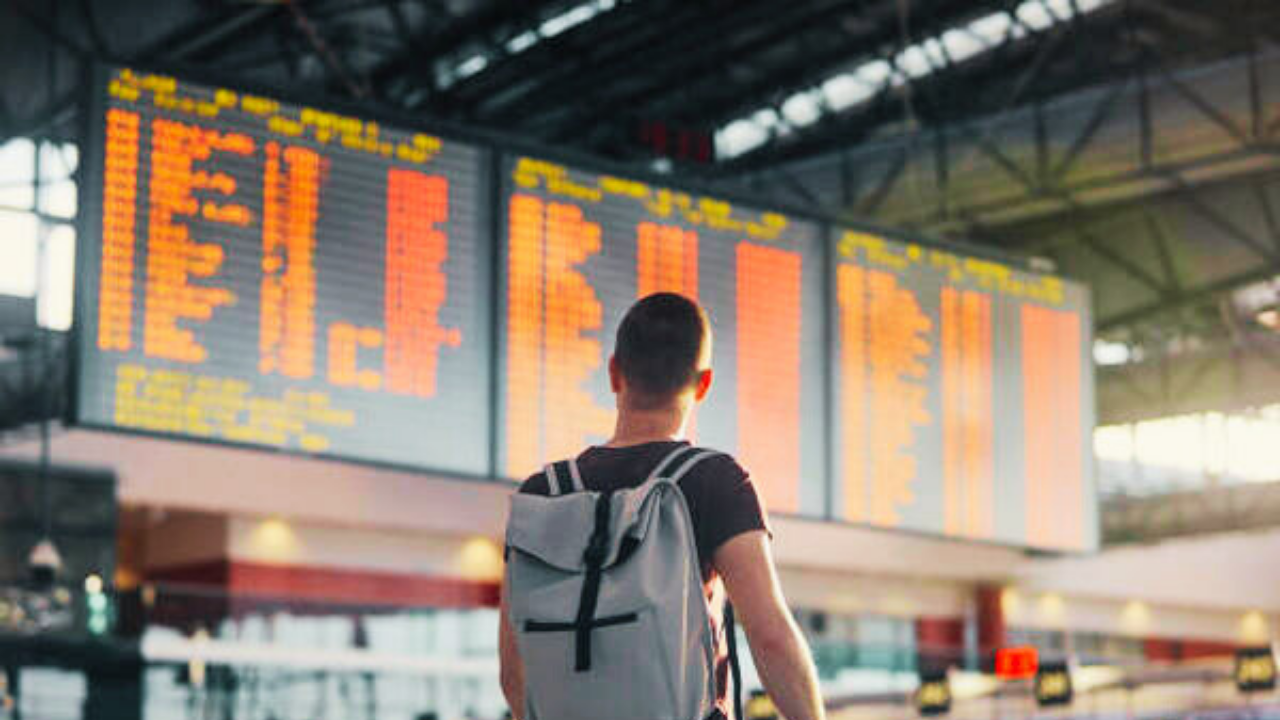
The modern traveler is a delicate creature, nurtured by the lie that a $600 economy ticket entitles them to a seamless existence through an active war zone. When the skies over the Middle East light up with ballistic trajectories, the British press reverts to its favorite trope: the "stranded" tourist. They give us tales of "nightmares from hell" because someone had to sleep on a terminal bench in Doha or wait twelve hours for a voucher in Dubai.
Let’s get one thing straight. If you are sitting in a multi-billion-dollar architectural marvel with high-speed Wi-Fi and tax-free shopping while missiles are being intercepted 500 miles away, you aren't a victim. You are an observer of history with a minor logistical inconvenience. The entitlement required to call a flight delay a "nightmare" while civilians on the ground are checking the structural integrity of their basements is staggering. For a closer look into this area, we suggest: this related article.
The media’s obsession with "travel chaos" during geopolitical upheaval is a symptom of a deeper rot in how we perceive global movement. We have commodified the world to such an extent that we view air corridors as fundamental rights rather than the fragile, politically charged privileges they actually are.
The Geography of Ignorance
Most travelers couldn't point to the Strait of Hormuz on a map, yet they feel personally insulted when its closure adds four hours to their flight to Bangkok. We treat the sky like a neutral void. It isn’t. Every foot of altitude is sovereign, contested, and increasingly volatile. To get more information on the matter, comprehensive coverage can be read on Travel + Leisure.
When you book a flight through a "hub" like Dubai, Doha, or Istanbul, you are making a conscious trade-off. You are exchanging the price of a direct flight for the efficiency of a geographic choke point. These cities didn't become global crossroads by accident; they sit at the intersection of East and West. That intersection is currently a tinderbox.
I’ve spent fifteen years navigating logistics in "hot" zones. I have seen real evacuation protocols. They don't involve complaining to a gate agent about the quality of the complimentary sandwich. They involve armored transport and satellite phones. If your biggest worry is whether your luggage will make it to Heathrow before Tuesday, the system is actually working perfectly.
The Hub Fallacy
The "nightmare" narrative relies on the idea that airlines are failing their passengers. In reality, the diversion of hundreds of wide-body aircraft in a matter of minutes—without a single mid-air collision—is a miracle of modern engineering and air traffic control.
- The Safety Paradox: You want the airline to fly you home, but you also want them to avoid being shot down. You cannot have both the "fastest route" and "absolute safety" when the airspace is being used for state-level kinetic warfare.
- The Logistics Reality: An airline like Emirates or Qatar Airways operates a "hub and spoke" model. When the hub is throttled by a closed corridor, the entire global network collapses like a house of cards. There is no "backup" for 300 grounded Boeing 777s.
- The Contract of Carriage: Read the fine print. No airline guarantees a schedule. They guarantee transport from point A to point B. The "when" and "how" are entirely at the mercy of God and the regional commanders of various air defense batteries.
If you find yourself stuck in a luxury terminal, you haven't been "abandoned." You have been diverted for your own survival. The fact that this needs to be explained suggests we have lost all sense of perspective.
Stop Asking "When?" and Start Asking "Why?"
The "People Also Ask" sections of travel forums are filled with variations of: Is it safe to fly through the Middle East? The answer is brutally honest: Usually, yes, until it isn't.
If you want a guarantee of zero delays, don't fly over regions where the last century has been defined by border disputes and proxy wars. Take the long way around. Pay the premium for a flight that skirts the entire continent. But you won’t. You’ll take the cheapest fare through the flashpoint and then act shocked when the flashpoint flashes.
We see people quoted in these "nightmare" articles saying they felt "scared for their lives" because they saw a flash in the distance or heard a rumor on Twitter. This is performative trauma. Being in a secure, guarded airport in a neutral state is perhaps the safest place you can be during a regional skirmish. The airport is the last thing anyone wants to hit; it’s the golden goose of the local economy.
The Ethics of the "Stranded" British Tourist
There is a distinct colonial hangover in the way we report these stories. The "Brit stranded abroad" is a specific archetype designed to trigger outrage. It suggests that the British passport should act as a kinetic shield against the realities of foreign conflict.
"We just want to get home," they tell the cameras, as if their desire to get back to a rainy Tuesday in Croydon outweighs the logistical complexity of rerouting 50,000 people through crowded Iranian or Iraqi airspace.
Here is the unconventional advice no travel agent will give you: Embrace the delay. If you are stuck in Doha, go to the museum. Eat the food. Acknowledge that you are witnessing a shift in the global order from the comfort of a climate-controlled lounge. Your "tragedy" is a footnote. The real story is the people beneath your flight path whose lives aren't interrupted by a delay, but ended by a strike.
The Data of Disruption
Let's look at the numbers the "nightmare" articles ignore. During a major airspace closure, air traffic controllers have to manage a $30%$ to $50%$ increase in traffic density in neighboring corridors. The math of fuel burn, holding patterns, and crew duty hours is a zero-sum game.
$$Fuel_{required} = (Distance \times BurnRate) + SafetyMargin + HoldingTime$$
When $HoldingTime$ increases because 50 planes are trying to land on two runways, the $SafetyMargin$ evaporates. At that point, the pilot's only choice is to divert to an "outstation"—often a smaller, less equipped airport. This is where the real "chaos" happens. But even then, you are in a hotel, not a trench.
The cost to the airline is astronomical. A single diverted long-haul flight can cost upwards of $250,000 in fuel, landing fees, and passenger care. They aren't keeping you there because they are lazy or cruel. They are keeping you there because the alternative is bankruptcy or a hull loss.
The Death of Resilience
We have become a society of low-resilience travelers. We rely on apps to tell us where to walk, what to eat, and when to panic. When the app stops updating, we crumble.
I’ve been in airports during coups. I’ve been grounded during volcanic ash clouds that shut down entire continents. The secret to surviving these moments isn't a "platinum" membership or a loud voice at the service desk. It’s the realization that you are not in control.
The "nightmare from hell" is a narrative choice. You can choose to be the person crying on the floor of Terminal 3, or you can be the person who understands that travel is an inherently risky venture into the unknown.
If you can’t handle a night on a lounge chair while two nations exchange fire, stay in the Cotswolds. The world is getting smaller, but it isn't getting friendlier. The corridors are closing, the maps are being redrawn, and your flight status is the least important thing happening on the planet right now.
Buy a book. Charge your phone. Shut up. You’ll be home in time for the weekend, and your "ordeal" will make a great story at a dinner party where no one actually cares about the geopolitical implications of your sixteen-hour wait.
Stop calling it a nightmare. It’s just a long day at the office of reality.
Check your flight status, or don't. The planes will move when the generals decide they can. Until then, you’re just another person waiting in a very expensive room, and that is a luxury, not a crisis.