Every time an Ebola headline flashes across a Western news ticker, the script is identical. Panic. Hand-wringing. Breathless warnings about an unstoppable wave spilling across African borders.
It is lazy journalism. Worse, it is actively harmful to public health.
Look at the standard framing around the Democratic Republic of the Congo (DRC) and its recurring Ebola outbreaks. Mainstream coverage treats every spike in cases like a zombie apocalypse movie—focusing obsessively on raw case counts, sensationalizing hemorrhagic symptoms, and portraying international health agencies as white knights racing against the clock to save helpless local populations.
That narrative is dead wrong. And if you understand how epidemiology actually works on the ground in Central Africa, you know why this panic-porn misses the point entirely.
The Lie of the "Unstoppable" Outbreak
Let’s get the biology straight first. Ebola is terrifying, yes. The Zaire ebolavirus strain routinely carries a case fatality rate between 50% and 90% without aggressive supportive care. When someone bleeds out in a clinic, it makes for dramatic television.
Here is what the cable news chyrons leave out: Ebola is actually terrible at becoming a global pandemic.
Unlike respiratory viruses such as SARS-CoV-2 or influenza, Ebola does not spread through the air. You cannot catch it because someone coughed on an airplane three rows ahead of you. Transmission requires direct contact with bodily fluids—blood, vomit, feces, sweat—from a person who is already visibly, violently sick, or from the body of someone who has died from the disease.
Think about what that means mechanically. A pathogen that incapacitates or kills its host quickly, and only spreads when that host is already bedridden and leaking fluids, has a built-in evolutionary speed limit. Public health veterans call this basic epidemiological math. High virulence almost always trades off against rapid, wide-scale transmission.
Yet, every time a cluster flares up in North Kivu, Ituri, or Equateur provinces, coverage acts as though Kinshasa, Nairobi, and London are next on the chopping block. Why? Because fear sells clicks, and nuance doesn't fit in a push notification.
What the "Race Against Time" Narrative Ignores
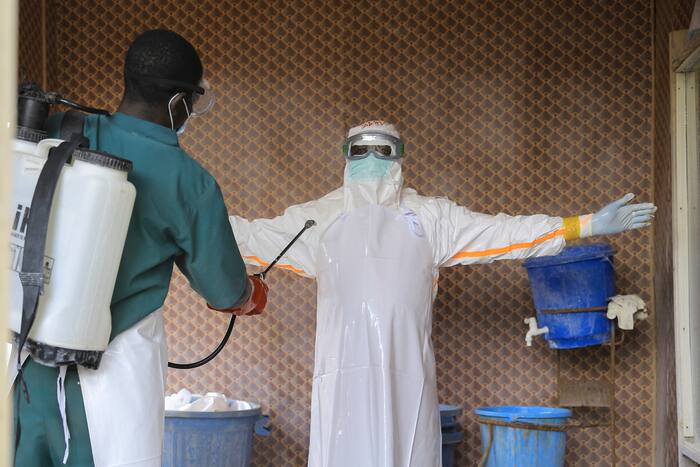
When reporters frame an outbreak as "authorities racing to slow the spread," they implicitly endorse a top-down, militarized medical response. Fly in the hazmat suits. Set up the red-zone treatment centers. Enforce quarantine checkpoints at gunpoint.
I have watched international aid organizations burn through hundreds of millions of dollars deploying this exact playbook. On paper, it looks heroic. On the ground, it often triggers the exact opposite of containment.
Imagine a scenario where your neighbor develops a high fever. Suddenly, armed soldiers and foreigners in space suits storm your village, load your neighbor into the back of a tarp-covered truck, and take them behind a fenced-off compound where nobody is allowed to visit. Two days later, your neighbor is dead, and strangers in plastic aprons bury them in a sealed bag without letting the family perform traditional funeral rites.
Would you report your own fever the next morning? Or would you hide in the forest?
During the 2018–2020 Kivu Ebola epidemic—the second-largest in history, with over 3,400 cases—this exact dynamic played out in real time. Treatment centers were burned down. Healthcare workers were murdered. Not because local Congolese citizens were "irrational" or "anti-science," as Western pundits lazily implied, but because militarized public health destroys the only currency that actually stops Ebola: community trust.
The Real Reason Outbreaks Drag On
If Ebola isn't airborne and we already have FDA-approved vaccines like Ervebo (rVSV-ZEBOV) and monoclonal antibody treatments like Inmazeb and Ebanga, why do outbreaks in the DRC keep spiralling out of control?
Stop looking at the virus. Look at the infrastructure and the geopolitics.
1. The "Vertical" Aid Trap
For decades, global health donors have poured billions into "vertical" disease programs—funding specifically earmarked for Ebola, HIV, or malaria—while ignoring the basic primary healthcare systems in the DRC.
A rural clinic in eastern Congo often lacks running water, reliable electricity, basic gloves, and sterile needles. When a patient walks in with a fever, the nurse treats them for malaria or typhoid without proper personal protective equipment because there isn't any. The clinic itself becomes an amplifier for the virus. You cannot drop a billion-dollar Ebola response team into a region where mothers still die in childbirth for lack of a $5 pair of forceps and expect locals not to notice the grotesque disparity.
2. Active Conflict Zones
Eastern DRC has endured decades of armed conflict involving over a hundred militia groups, compounded by mineral extraction battles and weak central governance. Contact tracing—the bread and butter of stopping Ebola—requires health workers to walk door-to-door every day for 21 days to check the temperatures of everyone who came near a confirmed patient.
Try doing systematic 21-day contact tracing when militia skirmishes shut down roads for a week at a time. Every time violence flares, surveillance goes blind. By the time teams regain access, three new chains of transmission have quietly ignited.
3. Weaponized Aid Money
Let’s talk about the elephant in the room that polite NGO reports bury in footnotes: the Ebola economy.
When massive emergency funds flood into an impoverished region overnight, emergency response jobs pay ten times the salary of a local doctor or teacher. Suddenly, ending the outbreak means ending the paycheck for thousands of drivers, fixers, security guards, and local officials. I have seen local administrators stall logistical clearances and community leaders demand "per diems" just to allow vaccination teams into their districts. Pretending humanitarian aid operates in a moral vacuum is naive. Incentives govern human behavior everywhere, including in a quarantine zone.
Dismantling the Common Questions
When news of a major Ebola surge breaks, people inevitably ask the wrong questions—driven by movie tropes rather than medical reality. Let's tear down the three biggest misconceptions.
Is Ebola mutating to become airborne?
No. There is zero documented evidence of any filovirus evolving airborne transmission in humans. Shifting a virus's mode of transmission from direct fluid contact to stable aerosolized respiratory droplets requires massive, structural genetic overhauls to viral surface glycoproteins and cellular tropism. Virologists like Dr. Kristian Andersen and teams at the National Institute of Allergy and Infectious Diseases (NIAID) have tracked Ebola genomes across thousands of samples. While minor mutations occur—such as the A82V glycoprotein mutation observed during the 2014 West African epidemic that slightly increased human cell infectivity—an airborne jump remains firmly in the realm of fiction.
Why don't they just lock down the borders of affected countries?
Because border closures are epidemiological theater. Borders across Central Africa—between the DRC, Uganda, Rwanda, and South Sudan—are porous lines drawn through dense forests and bustling trade corridors. Families live on one side and farm on the other. When you shut official border crossings, you don't stop movement; you simply force travelers onto unmonitored bush paths where health screeners cannot check temperatures or register contacts. The World Health Organization (WHO) has repeatedly warned against travel bans during Ebola outbreaks precisely because they blind surveillance networks and choke off medical supply chains.
If we have a vaccine, why isn't everyone in Congo vaccinated?
Because the rVSV-ZEBOV vaccine is deployed using a ring vaccination strategy, not mass population immunization. Supplies are finite, and the vaccine requires ultra-cold chain storage at minus 60 to minus 80 degrees Celsius—a logistical nightmare in equatorial regions without grid power. More importantly, vaccinating millions of unexposed people makes no sense when the virus is geographically clustered. Ring vaccination targets the contacts of confirmed cases, and the contacts of those contacts, creating an immunological firewall around the active chain of transmission. When surveillance works, ring vaccination crushes outbreaks fast. When mistrust hides cases, the ring misses the target.
What Actually Works (And Why Nobody Wants to Fund It)
If you want to stop Congo's Ebola outbreaks from hitting four- or five-digit case numbers, you have to abandon the emergency-response hero complex.
First, put local Congolese epidemiologists and community health workers in the driver's seat from day one. When the DRC's own Institut National de Recherche Biomédicale (INRB), led by veterans like Dr. Jean-Jacques Muyembe-Tamfum—who literally co-discovered the Ebola virus in 1976—runs the show with trusted local nurses, compliance skyrockets. People listen to neighbors who speak their dialect and share their grief, not foreigners barking orders through translators.
Second, integrate dignified burial protocols immediately. Nearly 60% of Ebola transmissions in rural outbreaks happen during traditional funeral preparations, where mourners wash and touch the highly infectious body. Replacing a family's sacred farewell with a clinical body bag sparks violent resistance. Replacing it with "safe and dignified burials"—where trained local teams use transparent body bags so families can still see their loved one's face, and allow religious leaders to perform prayers from a safe distance—cuts transmission overnight.
Third, admit the trade-off of decentralized care. Putting every suspected patient into a massive, centralized Ebola Treatment Center (ETC) terrifies communities and creates cross-infection risks if triage fails. Setting up smaller, transparent, community-level transit centers where families can actually see their relatives through clear partitions—like the revolutionary CUBE (Biosecure Emergency Care Unit) developed by ALIMA—changes everything. The downside? Decentralized units are harder to staff, cost more per bed in logistics, and require intense training to prevent healthcare worker infections. It is messier for donor spreadsheets, and vastly superior for saving lives.
The Verdict
Stop reading Ebola headlines like a disaster movie script. The real story in the Democratic Republic of the Congo isn't a super-virus threatening the globe. It is a predictable collision between a known, manageable pathogen and a broken, underfunded healthcare infrastructure fractured by decades of conflict.
Until global health institutions stop treating outbreaks like temporary military campaigns and start funding permanent, locally led primary care, the numbers will keep climbing. And Western media will keep selling you the same breathless panic every single time.