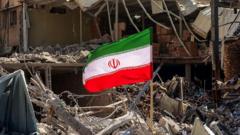
The foreign policy establishment is currently obsessed with a fantasy. They’re staring at the smoke over Tehran following the February 28 strikes and convinced they are watching the birth of a pro-Western democracy. They see President Trump’s recent demand to "be involved" in picking the next Supreme Leader as a masterstroke of regime change.
They are dead wrong.
The "lazy consensus" suggests that with Ayatollah Ali Khamenei gone, the Islamic Republic is a hollowed-out shell waiting for a Washington-approved savior to step in. This narrative ignores forty years of institutional hardening. You don’t dismantle a theocratic military-industrial complex with a few phone calls to Dana Bash or a comparison to Venezuela. If you think this ends with a liberal reformer holding a press conference in Azadi Square, you haven't been paying attention to how power actually functions in the Middle East.
The Venezuela Delusion
Trump’s insistence that Iran will "work like it did in Venezuela" with Delcy Rodríguez is the first red flag. It’s a category error. Venezuela is a petro-state with a porous military hierarchy and a localized crisis. Iran is a regional hegemon with a deeply embedded ideological vanguard—the Islamic Revolutionary Guard Corps (IRGC)—that controls roughly 30% of the national economy.
In Caracas, the U.S. could find a recognizable alternate executive. In Tehran, the "alternate" is a shadow state. When Trump calls Mojtaba Khamenei a "lightweight," he is vastly underestimating the man who has spent two decades running the Office of the Supreme Leader. Mojtaba isn't just a son; he is the architect of the security apparatus that has kept the regime alive through three decades of sanctions.
Refusing to "accept" Mojtaba doesn't make him go away. It just ensures that whoever the Assembly of Experts eventually crowns will have zero incentive to talk to Washington. We are not "picking" a leader; we are shouting at a closed door while the people behind it are arming for a generational war of revenge.
The Myth of the Moderate Savior
Every time there is a tremor in Tehran, the "reformist" ghosts are summoned. This time it's Hassan Khomeini or Ali Larijani. Let’s be clear: there are no moderates left in the upper echelons of the Iranian state. Anyone who survived the 2024-2025 purges and the recent "Operation Epic Fury" is a survivor by definition, meaning they are fully integrated into the IRGC’s survival strategy.
The Assembly of Experts is an 88-member body of clerics whose primary job is to ensure the survival of the system, not its transformation. If they pick a "moderate" face like Larijani, it won’t be to usher in democracy. It will be a tactical retreat to buy time, much like the 2015 nuclear deal. Betting on an Iranian "Gorbachev" is a losing hand. The IRGC saw what happened to the Soviet Union; they have no intention of presiding over their own liquidation.
The Junta is Already Here
While the media tracks the clerical succession, they are missing the real shift: the formalization of the military junta. With the clerical leadership decapitated or hiding in bunkers, the IRGC has moved from the "guards" of the revolution to its "owners."
The Interim Leadership Council—comprising President Masoud Pezeshkian, Chief Justice Mohseni-Ejei, and Alireza Arafi—is a placeholder. The real power is held by the commanders who control the ballistic missile silos and the drone factories. I’ve seen this play out in other collapsing regimes: when the civilian or religious facade cracks, the men with the guns don't hand over the keys. They weld the doors shut.
By demanding a "hand-picked" leader, the U.S. is actually making the IRGC’s job easier. It allows them to frame any internal opposition as a "Zionist-American plot," effectively neutralizing the genuine domestic anger of the Iranian people. We are suffocating the very revolution we claim to support.
The Cost of Being "Involved"
Let's talk about the downside of this "involvement" strategy. If the U.S. tries to force a specific candidate—or backs a "Wonderful Leader" like the one Trump claims to have in Caracas—we aren't creating stability. We are creating a civil war.
Iran is a country of 90 million people with deep ethnic fault lines. If the central authority in Tehran is perceived as a foreign puppet, the country doesn't become a democracy; it becomes Libya. It becomes a fragmented landscape of warlords and IRGC remnants fighting over nuclear scraps.
Is the U.S. ready for a twenty-year occupation of the Iranian plateau to keep a "harmony and peace" leader in power? Because that is the literal price of admission for "picking" the leader of a sovereign, hostile nation. Anything less is just noise.
The Actionable Pivot
Stop looking for a person. Start looking at the plumbing.
If the goal is to actually neuter the Iranian threat, the focus shouldn't be on who sits in the Supreme Leader’s chair. It should be on the total bankruptcy of the IRGC’s commercial empire. We need to stop treating Iran like a political problem to be solved with a "deal" and start treating it like a hostile corporate entity that needs to be liquidated.
- Ignore the Succession Theater: Whether it's Mojtaba, Arafi, or a dark horse, the policy remains the same. Do not grant legitimacy to the process by trying to influence it.
- Target the Middle Management: The top leaders are replaceable. The mid-level IRGC bureaucrats who manage the money and the logistics are not. These are the people who can be flipped or neutralized.
- Internal Decoupling: Support the Iranian people not with "regime change" rhetoric, but with the tools to bypass the state’s digital and financial control.
The status quo is a trap. The "competitor" articles want you to believe we are at a turning point where a strong hand from Washington can guide Iran to the light. That is a fairytale. We are in the middle of a brutal, messy, and violent transition from a clerical autocracy to a military one.
Pick a side? No. Pick a strategy that survives whoever the clerics choose. Because they aren't asking for your vote, and they certainly aren't waiting for a call from Mar-a-Lago.
Would you like me to analyze the specific economic holdings of the IRGC to identify the most effective leverage points for the next administration?