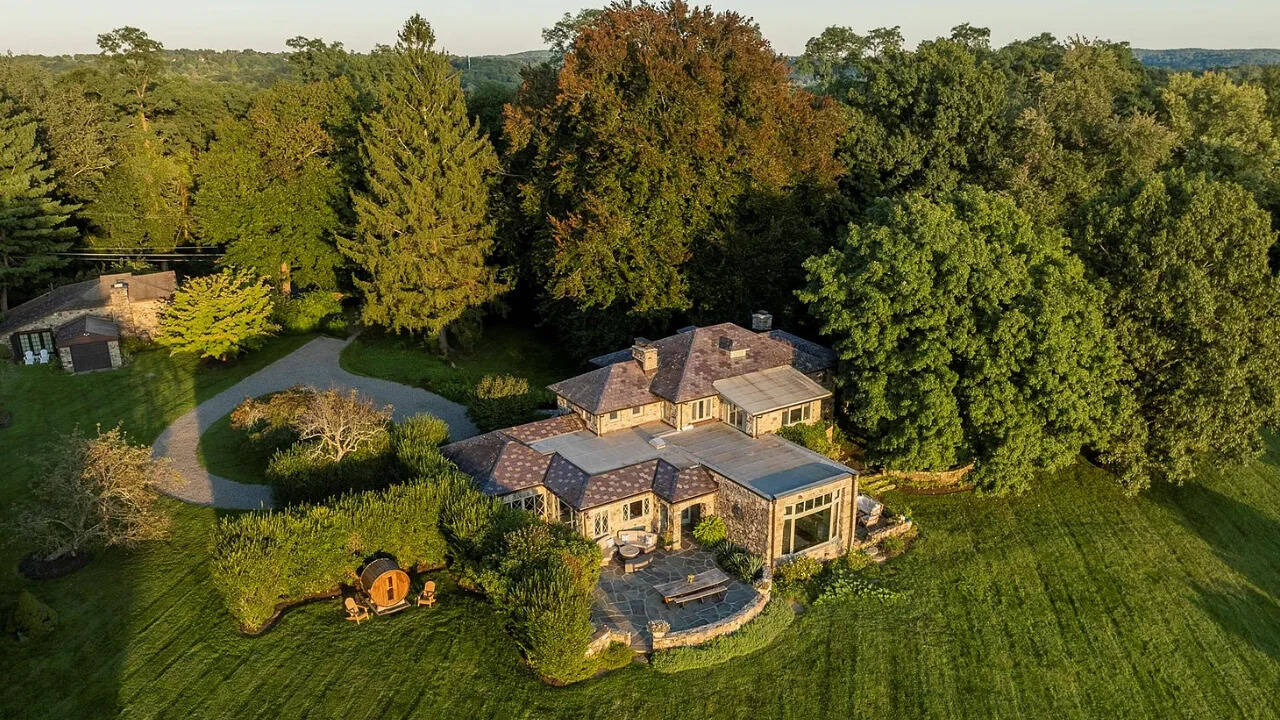
Every real estate blog in the tri-state area just tripped over itself to gush about "OldWalls," the Brewster, New York estate of American sculptor Chester Beach hitting the market for $4.15 million.
The coverage reads like a press release written by someone who has never paid a commercial heating bill in Putnam County. They rattle off the romantic pedigree. A studio built from reclaimed stone. Vintage charm. Rolling acreage. Artistic provenance.
Here is the truth that luxury listing agents pray you ignore until the ink dries at the closing table. Buying a $4.15 million historic artist compound is rarely a smart real estate investment. It is a voluntary enrollment into a high-end preservation charity where you are the sole donor.
The Provenance Tax You Never Recover
The lazy consensus in luxury real estate holds that famous artistic provenance acts as an appreciation engine. According to this fairy tale, owning the workspace of a National Academician like Chester Beach—whose work sits in the Metropolitan Museum of Art—insulates your capital against market downturns.
That logic falls apart the second you look at liquidity in the Hudson Valley.
Provenance adds emotional friction for the seller and zero functional utility for the next buyer. When Chester Beach built his studio and living quarters in Brewster, he designed a bespoke environment tailored to early-twentieth-century sculptural workflows—heavy north-facing light, massive floor loads for stone and bronze, and sprawling, uninsulated volumes of space.
Fast-forward a century. Today’s $4 million buyer in Brewster or neighboring Bedford wants radiant-heated limestone floors, subterranean geothermal wells, smart home automation, and acoustic isolation for remote executive work. They do not want to spend $800,000 retrofitting historic masonry just to stop winter drafts from whistling through antique casements.
I have watched high-net-worth buyers fall in love with architectural pedigree in Dutchess and Putnam counties, pay a 30 percent "story premium" above comparable land value, and then watch the property sit on the market for two years when they try to exit. The buyer pool for a $4.15 million modern turnkey estate is already narrow. The buyer pool for a $4.15 million historic compound requiring specialized stewardship is microscopic.
The Brutal Math of "Old Walls"
The estate is literally named OldWalls. In luxury real estate, that is less a charming moniker and more a structural warning label.
Let us look at the actual physics and economics of maintaining early-twentieth-century stone and timber construction in the Northeast:
- Thermal Bridging and Envelope Failure: Historic stone walls built without modern cavity insulation act as giant thermal sponges. In January, they pull heat out of your living space. In July, they trap humidity. Fixing this without destroying the interior aesthetic requires expensive interior framing or specialized lime-based breathable plasters.
- The Artisan Bottleneck: You cannot call a standard suburban contractor to repoint historic stonework or repair custom steel-frame studio windows. You have to hire preservation specialists. Those specialists charge $150 to $250 an hour, book out nine months in advance, and demand custom-milled materials.
- Insurance Underwriting Nightmares: Carriers across New York State are aggressively dropping policies on older, high-value structures with bespoke architectural features. Replacement cost valuations on a historic sculptor’s studio routinely exceed market value by 50 percent, driving annual premiums into five-figure territory before you even factor in liability for sprawling acreage.
Imagine a scenario where you buy OldWalls at ask, put 20 percent down, and decide to modernize the mechanicals and roof over your first three years. Between property taxes in Brewster, specialized insurance, routine groundskeeping, and capital improvements, your unrecoverable carrying costs will easily eclipse $250,000 a year. You are paying a quarter-million dollars annually just to hold an illiquid asset.
What Buyers Are Really Asking (And Why It Is the Wrong Question)
Whenever a trophy estate like this hits the wire, prospective buyers start asking the wrong questions. They ask, "Will this property hold its value?" or "How much does it cost to renovate a historic studio?"
Those questions assume you are buying a house. You are not. You are buying land with a museum attached to it.
If you want to know whether $4.15 million makes sense for OldWalls, strip away every single structure on the parcel in your mind. Look strictly at the underlying acreage, the privacy buffer, the proximity to Metro-North rail lines into Grand Central, and the local zoning laws regarding subdivision or accessory structures.
In Brewster, prime unencumbered acreage has a clear, quantifiable baseline value. If the land alone is worth $2.5 million, you are paying $1.65 million for the existing structures. Could you build a comparable square footage of high-end stone and timber construction today for $1.65 million? No. Construction costs in the Hudson Valley easily run $600 to $900 per square foot for custom luxury work.
On a replacement-cost basis, the structures look like a bargain. On an operational-cost basis, they are a liability.
When Historic Estates Actually Make Financial Sense
To be completely fair, dismissing every historic property as a money pit misses the one scenario where these assets outperform standard luxury builds.
If you are an end-user with a ten-to-fifteen-year horizon who views housing strictly as a consumption expense—no different than buying a yacht or funding a private art collection—then OldWalls delivers something no new-construction toll-brother mansion can ever replicate. You cannot manufacture hundred-year-old patina. You cannot fake the spatial volume of a true working sculpture studio.
Furthermore, if the property allows for conservation easements or historic tax credits—though private residential credits in New York are notoriously restrictive compared to commercial adaptive reuse—an aggressive tax strategist can sometimes offset a fraction of the carrying burden.
The Contrarian Playbook for Buying Pedigree Real Estate
If you are staring at a $4.15 million listing like Chester Beach’s estate and still feel the pull to write an offer, drop the romanticism and negotiate like a distressed-debt buyer.
- Audit the Envelope Before Making an Offer: Do not rely on a standard home inspector. Bring in a building envelope engineer with thermal imaging cameras and a historic masonry specialist during your due diligence window. Quantify every single dollar of deferred structural maintenance and deduct 100 percent of it from your bid.
- Price the Illiquidity: Factor a 24-month marketing timeline into your exit strategy. If your capital needs to be liquid within five years, walk away today.
- Separate the Land from the Legacy: Value the acreage using local comps, add the depreciated functional value of the main residence, and assign zero dollar value to the famous former owner’s name. Let the seller keep the bragging rights; you keep your equity.
- Verify Zoning for Modern Additions: Before closing, confirm with the town building department that you can construct a modern, hyper-efficient guest house or pool pavilion elsewhere on the lot. Living in a modern secondary structure while using the historic studio strictly for entertaining or creative work solves 80 percent of the daily livability headaches.
Real estate media loves a fairy tale because romance sells clicks. Savvy buyers know better. Respect the art, admire the history, and never pay full retail for someone else's nostalgia.



