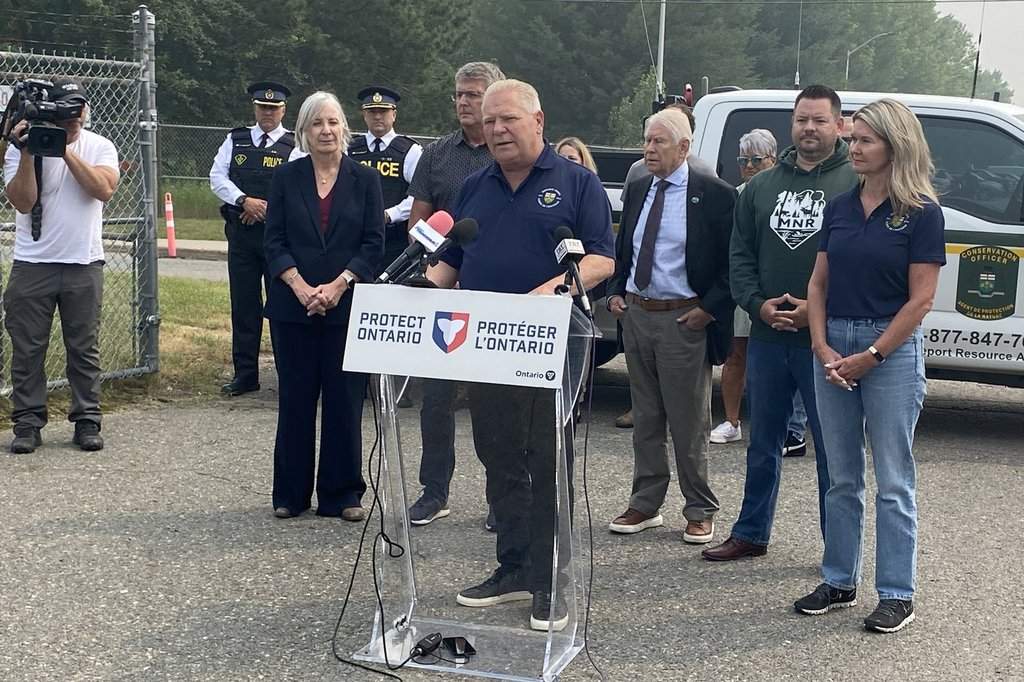
Photo ops do not put out forest fires.
Premier Doug Ford landing in Thunder Bay to "assess" the northern Ontario wildfire crisis is a textbook exercise in political theater. The media tracks his itinerary, the opposition barks about provincial underfunding, and the government reality-distorts the crisis by calling it a "miracle" that nobody has died yet.
Meanwhile, Collins First Nation residents had to flee approaching walls of flame in boats because the provincial detection apparatus failed to spot the fire until it was on their doorstep. Over 190 fires are scorching the north, hotel rooms in Thunder Bay are maxed out, and the political establishment is running a PR playbook designed for a climate reality that expired thirty years ago.
The lazy consensus screams for more money, more water bombers, and more top-down government management. They are completely wrong. The obsession with emergency response funding misses the structural rot of our entire fire management philosophy.
The Suppression Paradox
For a century, North American firefighting has operated under a single, flawed premise: put out every fire as fast as possible. I have watched provincial agencies burn through millions of dollars chasing this exact mandate.
It backfires completely. When you suppress every single blaze, you stop the natural cycle of smaller, low-intensity burns that clear out underbrush. The result? Dead wood, dry pine needles, and dense brush accumulate year after year. The forest becomes a giant powder keg. When a fire inevitably breaks out during a dry spell, it does not just burn—it explodes.
The 550-square-kilometre monster tearing south of Lac des Mille Lacs is not just the product of bad weather. It is the direct consequence of decades of aggressive suppression. By treating fire as an enemy to be conquered rather than a biological process to be managed, we have engineered the very mega-fires now forcing thousands to flee.
Decentralization Over Bureaucracy
Look at how Collins First Nation and Whitesand First Nation had to evacuate. They did it themselves because the Ministry of Natural Resources and Forestry (MNRF) was too slow, too blind, or too bogged down in provincial red tape to trigger help in time.
The province brags about deploying 150 crews and 80 aircraft. It sounds impressive on a teleprompter in Toronto. In reality, centralized command structures are too slow for fast-moving blazes that swallow towns overnight.
We need to shift funding away from centralized provincial bureaucracies and directly into localized, indigenous-led forest management. First Nation communities do not need a press conference from a visiting politician; they need autonomous funding to manage their own lands through controlled cultural burns during the off-season. They need the authority to trigger local alerts without waiting for a bureaucrat in a southern Ontario office to sign off on a travel permit.
The Cold Truth About Air Support
Water bombers look spectacular on the evening news. They make great backdrops for politicians promising to "spare no expense." But any seasoned forestry insider will tell you the truth: aircraft do not put out out-of-control mega-fires. They cool the edges so ground crews can dig lines. When a fire is ripping through the canopy of a dry Boreal forest, dumping water from the sky is like throwing a cup of water on a bonfire.
The obsession with buying more heavy machinery is a distraction. The real bottleneck is a severe lack of experienced boots on the ground. The province relies heavily on out-of-province crews from Alberta and the Yukon just to keep up. Why? Because the seasonal wage structure for forest firefighters in Ontario is abysmal, leading to massive staff turnover. We are sending inexperienced, underpaid twenty-year-olds into raging infernos while the senior experts walk away in frustration.
Rebuilding the Forest Economy
If we want to stop northern Ontario from burning to the ground every summer, we must stop treating wildfire response as a reactive emergency fund.
- Fund Mitigation, Not Just Suppression: Transition the MNRF budget from a 90/10 split favoring suppression to a model that heavily funds mechanical thinning and prescribed burns around northern townships.
- Professionalize the Force: Transform forest firefighting from a low-wage summer gig into a year-round career path focused on fuel management in the winter and active firefighting in the summer.
- End the Insurance Traps: Lodge owners near Upsala have noted they cannot even trigger insurance coverages until formal provincial evacuation orders are stamped. This delay forces people to stay in harm's way until the flames are literally knocking on their cabins.
The downside to this shift is obvious: letting fires burn in remote areas means accepting weeks of thick smoke choking southern cities and drifting across the border. It means dealing with angry political blowback from voters who want immediate, visual action. But the alternative is continuing the current cycle—waiting for the next inevitable disaster, watching more family businesses burn to the ground, and waiting for another politician to fly in to express their deep concern.