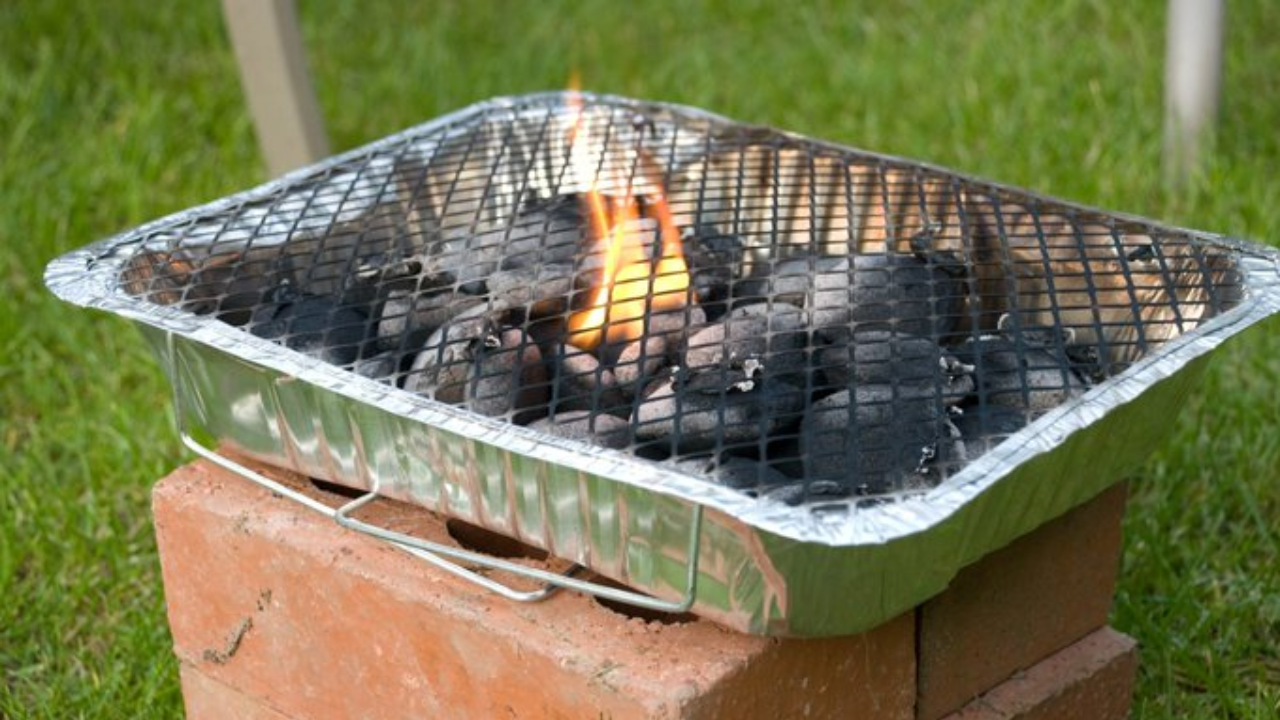
The government just slammed the emergency brake on disposable barbecues. Across Great Britain, storefronts and online checkouts are barred from selling the cheap aluminium foil trays loaded with briquettes. Ministers in an emergency Cobra meeting looked at a tinderbox landscape experiencing 38-degree heat, panicked, and reached for the most politically convenient lever available.
Blaming a foil-lined tin for a national wildfire crisis is lazy policy making.
I have watched local authorities and emergency planners chase shiny object restrictions for years, blowing public trust on cosmetic bans while ignoring structural decay. Banning a single-use grill does nothing to solve the systemic vulnerabilities turning British scrubland into kindling.
The Illusion of Control
Let us look at the official logic. The narrative goes like this: hot weather plus dry grass plus an unattended foil tray equals a major incident. Therefore, strip the foil trays from the supermarket shelves, and the risk drops.
It sounds tidy. It is completely wrong.
The physical reality of combustion does not care about retail legislation. A discarded glass bottle acting as a convex lens focuses sunlight and ignites dry peat just as effectively as a poorly extinguished barbecue. An unmanaged cigarette butt tossed from a car window carries enough thermal energy to torch an acre of gorse. Unchecked agricultural burning, illegal campfire setups, and high-voltage transmission lines kissing dry branches all spark massive blazes.
Targeting disposable grills provides a convenient villain. It gives politicians a soundbite for television cameras while sidestepping the actual failure point: chronic underinvestment in modern land management and rapid-response firefighting capabilities.
What the Data Actually Tells Us
Prime Minister Andy Burnham recently noted that the UK lacks the heavy aerial firefighting assets common in Southern Europe or North America. He is right. British fire services are largely built for urban structural fires, not wildland-urban interface management.
When a moorland fire breaks out, ground crews are forced to navigate rugged terrain on foot or in standard appliances because the country lacks dedicated air-tanker fleets or specialized brush trucks.
Imagine a scenario where every single disposable barbecue on earth vanishes tomorrow. The underlying fuel load—decades of accumulated dead underbrush, lack of controlled burns, missing firebreaks, and unmanaged public access points during historic droughts—remains entirely untouched.
By fixating on a retail ban, the state shifts the burden of risk management entirely onto consumer behavior while refusing to upgrade public infrastructure to handle a changing climate. It is a public relations strategy disguised as environmental protection.
The Problem with Behavioral Mandates
Prohibitions assume the public can be legislated into safety. History proves otherwise.
When a product is restricted overnight, people do not stop eating hot food outdoors or enjoying public spaces; they improvise. Improvisation without standardized equipment is infinitely more dangerous than a manufactured foil tray designed with built-in air gaps. Campers start stacking loose stones, digging shallow pit fires that retain heat underground for days, or burning scrap wood directly on parched soil.
A regulated disposable barbecue, whatever its faults, contains its fuel within a rigid aluminium container off the ground. Improvised campfires sit directly on root systems and peat beds, creating underground smoldering fires that can burn undetected for weeks before erupting into the open.
By outlawing the regulated option, the policy likely increases total subsurface fire risks through behavioral substitution.
The Uncomfortable Truth About Land Management
Solving this crisis requires embracing measures nobody wants to fund or debate.
- Invest in Air Power: Stop treating aerial firefighting as a luxury. If British summers are going to resemble the Mediterranean, import the corresponding air-tanker framework.
- Aggressive Mitigation: Modern conservation dogma often discourages clearing underbrush or creating strategic firebreaks in the name of pure non-intervention. Nature during a drought does not reward neglect. Controlled grazing, managed burns, and engineered fire corridors must become standard procedure.
- Targeted Enforcement, Not Blankets: Punishing negligent behavior harshly works better than punishing innocent retail supply chains. Enforce existing public space protection orders with actual teeth instead of sweeping bans that penalize responsible citizens.
The disposable barbecue ban is a distraction. It lets the state pretend it is taking decisive action while the underlying tinderbox dries out further under the summer sun.
Stop treating the symptom while ignoring the fuel.