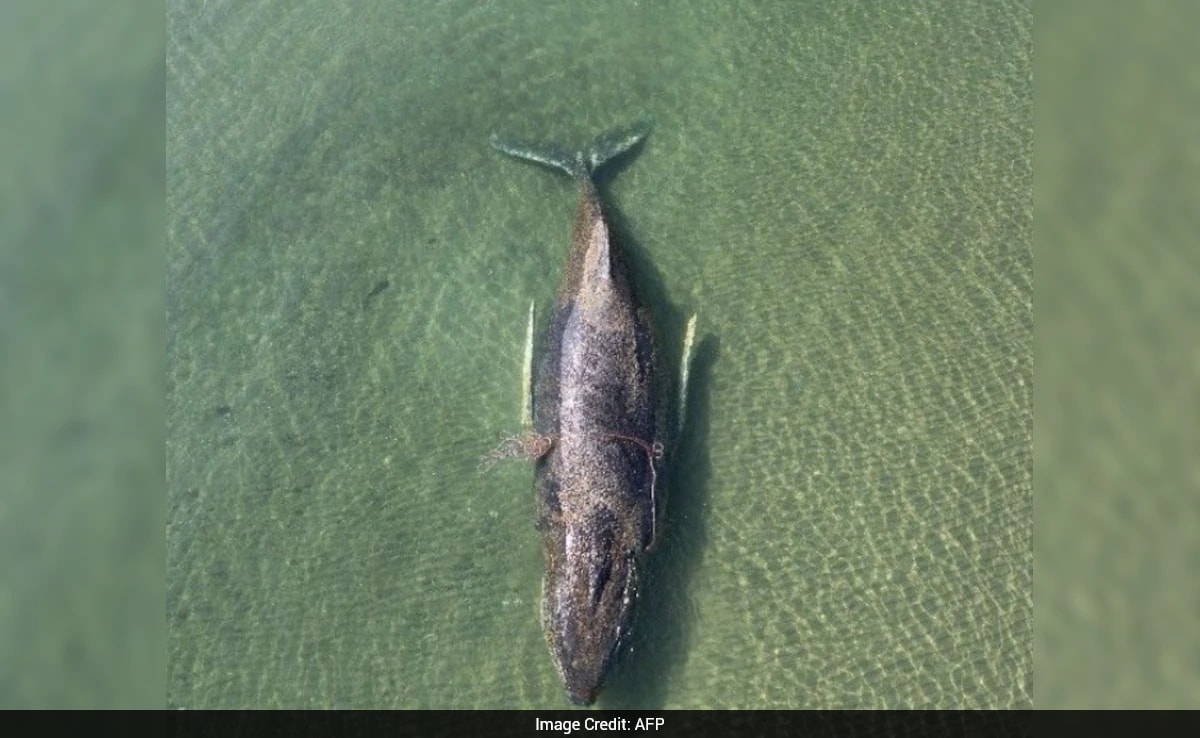
The headlines are always the same. A giant humpback whale takes a wrong turn, ends up in shallow water, and the internet goes into a collective meltdown. Media outlets rush to publish heartbreaking stories about how "the animal will die here" while rescuers throw up their hands in defeat.
It is predictable, high-drama clickbait. It also reveals a massive misunderstanding of marine biology and the brutal reality of natural selection.
I have spent years studying marine ecosystems and working alongside wildlife biologists. I have watched well-meaning organizations burn through hundreds of thousands of dollars trying to "save" a single animal that was already genetically or physically compromised. We are letting pure emotion dictate our environmental policies, and it is actively harming the oceans we claim to protect.
Let's dismantle the lazy consensus surrounding marine strandings and look at what the data actually tells us.
The Flawed Premise of the "Rescue" Industry
When a large whale strays into a place like the Baltic Sea or a shallow inlet, the public immediate demands an intervention. They want boats, slings, helicopters, and a small army of volunteers.
Here is the uncomfortable truth: Most large whales strand themselves because they are already dying.
Healthy whales do not just forget how to navigate. They do not get lost because they took a wrong turn at a sandbar. Marine mammals possess incredibly sophisticated biological sonar. When a humpback or a sperm whale ends up hard aground, it is usually the result of severe trauma, heavy parasite loads, advanced age, or acute illness.
By pushing, pulling, and harassing these massive animals back into deeper water, we are not saving them. We are prolonging their suffering.
Consider the sheer physics of a whale stranding. These animals are designed to live in a zero-gravity aqueous environment. Their massive skeletal structures cannot support their own body weight on land or even in extremely shallow water. The moment a whale settles on the seabed, its internal organs begin to crush under its own mass. Blood flow is restricted, muscles begin to break down, and toxins flood the bloodstream.
Even if you manage to tow a 30-ton humpback back out to sea, the damage to its internal organs is frequently irreversible. You are sending a terminal patient back out to drown in the deep ocean, away from the cameras.
The Massive Resource Drain
Let's talk about the money.
A single high-profile whale rescue operation can easily cost upwards of $50,000 to $100,000. That includes specialized equipment, boat fuel, veterinarian fees, and hundreds of man-hours.
Where does that money come from? It comes from tight conservation budgets that could be used for systemic, high-impact environmental work.
For the cost of trying to save one sick humpback whale that has a 5% chance of survival, a conservation group could:
- Fund the removal of thousands of pounds of ghost fishing nets that kill hundreds of marine animals every year.
- Finance litigation to enforce ship-strike speed limits in critical feeding grounds.
- Purchase acoustic pingers for commercial fishing fleets to prevent harbor porpoises from getting entangled in the first place.
But ghost nets and shipping lanes are not telegenic. A sad whale on a beach is. We are prioritizing the photogenic individual over the health of the entire species. It is a classic case of missing the forest for a single, dying tree.
The Flawed Premise of Human Intervention
People frequently ask queries like, "Why can't we just use a crane to lift the whale?" or "Why can't we feed it until it gets better?"
These questions assume that human technology can easily override biological reality. Lifting a 40-foot whale with a crane usually results in severe spinal injury or skin tearing. Feeding a wild, stressed cetacean in the wild is practically impossible.
The most brutal, honest answer to the question "How do we save a stranded whale?" is often: We don't.
We need to accept that death is a vital component of a healthy ecosystem. When a whale dies and sinks to the bottom of the ocean, it creates what biologists call a "whale fall." A single whale carcass provides a massive influx of nutrients to the deep sea, sustaining entire communities of scavengers, crabs, sharks, and specialized bone-eating worms for decades.
By fighting tooth and nail to prevent these deaths, or by euthanizing the animal and burying it in a landfill, we are actively robbing the marine ecosystem of a critical pulse of life.
The Nuance We Are Missing
Am I suggesting we should never intervene? No.
There are specific, data-backed scenarios where rescue operations make sense. These are the nuances that the mainstream media completely ignores because they do not fit into a neat, emotional narrative.
We should intervene when:
- The stranding is directly caused by a sudden, acute human action. If a healthy whale is driven ashore by active naval sonar testing or becomes entangled in active fishing gear in shallow water, we have a moral obligation to act. In these cases, the animal is not systematically ill; it is a victim of a specific event and has a much higher chance of post-release survival.
- The species is critically endangered. If we are dealing with a North Atlantic right whale, where every single breeding female is vital to the survival of the species, the cost-benefit analysis shifts. We must take massive risks because the species is on the brink of extinction. Humpback whales, while charismatic, are generally not in that same desperate category globally.
If the animal does not meet those criteria, the most humane, scientifically sound action is to monitor it, keep the public away to reduce its stress, and let nature take its course. If the suffering is extreme, rapid veterinary euthanasia is the only responsible human choice.
Stop Asking the Wrong Questions
The public is asking, "How do we get this whale back in the water?"
That is the wrong question. It assumes that going back into the water equals survival.
We should be asking, "Why are these animals ending up here in the first place?"
Instead of pouring money into futile rescue attempts that make us feel good but do nothing for the species, we need to address the root causes of marine mammal distress. We need to focus on reducing ocean noise pollution, which scrambles their navigation. We need to crack down on industrial runoff that weakens their immune systems.
I admit the downside to this contrarian approach. It is brutal. It requires us to stand on a beach, look a giant, beautiful, intelligent creature in the eye, and acknowledge that we cannot, and should not, save it. It forces us to put our savior complex aside and respect the harsh reality of the natural world.
It is much easier to play the hero for the local news cameras. But true conservation is not about feeling good. It is about doing what actually works for the ecosystem as a whole.
The next time you see a headline about a doomed whale and a group of frantic rescuers, stop crying and start questioning where those resources are going. Demand that your hard-earned conservation dollars go toward fixing the systemic issues killing thousands of whales out in the deep blue, rather than the one dying on the sand.
Put down the buckets of water. Stop pushing. Let the ocean do its job.