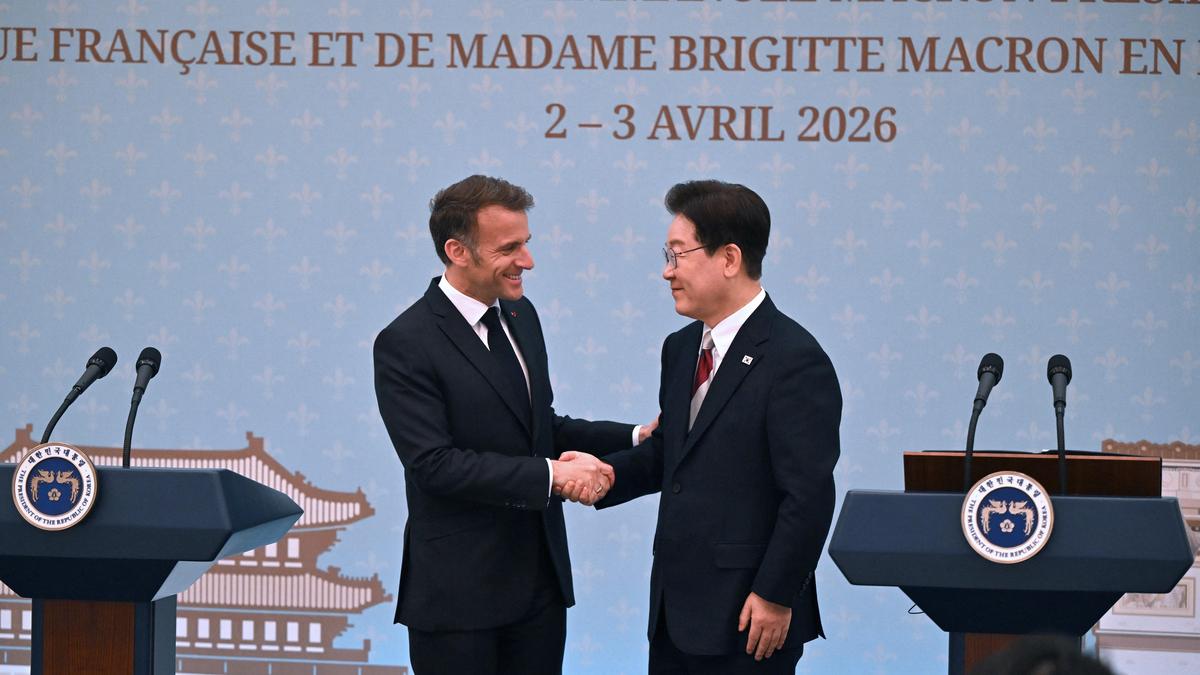
French President Emmanuel Macron and Singapore’s Lee Hsien Loong standing shoulder-to-shoulder to "reopen" the Strait of Hormuz is a masterclass in political theater. It’s a performance staged for a global audience that still believes the 1970s energy map governs the 2020s. The headlines suggest a bold diplomatic maneuver. The reality is a desperate attempt to maintain relevance in a geography that is rapidly becoming a strategic liability rather than a vital artery.
Stop looking at the Strait as a "choke point" that needs clearing. Start looking at it as a legacy system facing inevitable decommissioning.
The Myth of Global Energy Security
The standard narrative is simple: 20% of the world’s petroleum passes through this twenty-one-mile-wide strip of water. If it shuts down, the global economy collapses. Therefore, we need "coalitions of the willing" and joint naval patrols to keep the tankers moving.
This is fundamentally flawed.
First, the "global" nature of this crisis is a convenient fiction. The oil flowing through Hormuz isn't headed for Marseilles or New Jersey. It’s headed for Ningbo, Gwangyang, and Chiba. Over 70% of the crude exiting the Persian Gulf is destined for Asian markets. When Macron pledges French resources to "secure" this waterway, he isn't protecting French gas prices; he’s subsidizing the energy security of China and India with European taxpayer money and military risk.
I’ve spent years analyzing the supply chains of the world's largest refiners. The smart money isn't betting on the Strait staying open; it’s betting on making the Strait irrelevant.
Diplomacy as a Distraction
Macron and Lee’s joint statement is an exercise in "stability-washing." They talk about international law and freedom of navigation as if these are physical barriers that can stop a $50,000 drone from disabling a $200 million Suezmax tanker.
The Strait of Hormuz isn't "closed" because of a lack of diplomatic will. It’s unstable because the cost of asymmetric warfare has plummeted. Iran—and any other regional actor with a grudge—doesn't need a navy to shut the door. They need a handful of naval mines and a swarm of cheap loitering munitions. No amount of "pledging to work together" changes the physics of a narrow channel flanked by hostile batteries.
The "lazy consensus" assumes that if we just get enough world leaders to sign a communique, the insurance premiums for Lloyd’s of London will magically drop. They won't. The market knows what the politicians won't admit: The Persian Gulf is a geographic trap.
The Brutal Math of the Bypass
If you want to understand the future of energy, stop reading diplomatic transcripts and start looking at pipeline capacity.
The real story isn't about reopening a waterway; it’s about the massive, silent migration toward the Red Sea and the Gulf of Oman. Saudi Arabia’s East-West Pipeline (Petroline) can already move 5 million barrels per day (bpd) to Yanbu, completely bypassing Hormuz. The Abu Dhabi Crude Oil Pipeline (ADCOP) shunts 1.5 million bpd directly to Fujairah.
- Current Bypass Capacity: Roughly 6.5 million bpd.
- Expansion Potential: Upwards of 10 million bpd with current tech.
- The Reality: Hormuz is being engineered out of the system.
Every time a Western leader makes a "pledge" to secure the Strait, they are essentially trying to save a rotary phone in the age of fiber optics. The infrastructure is already shifting. The center of gravity is moving.
The Sovereignty Trap
Singapore's involvement is particularly telling. As a premier bunkering hub and transshipment point, Singapore is terrified of a world where the Persian Gulf isn't the primary source of the world's liquid energy. If the oil stops flowing East from the Gulf, Singapore’s relevance as a strategic "toll booth" diminishes.
Lee Hsien Loong isn't acting out of a sense of global duty. He’s acting out of existential dread. He needs the old world order to persist because Singapore is a primary beneficiary of that specific geometry.
Macron, meanwhile, is playing the "European Strategic Autonomy" card. By involving himself in a Middle Eastern maritime dispute, he attempts to project French power where the US has traditionally held the baton. But it’s a bluff. France does not have the carrier groups or the logistics to provide a credible security guarantee in the Gulf without the US Fifth Fleet doing the heavy lifting.
Why We Should Let It Close
This is the take that gets me kicked out of boardrooms: Maybe the world needs the Strait of Hormuz to become unusable for a period.
Why? Because as long as we treat it as "fixable," we delay the inevitable transition to a more resilient, decentralized energy architecture.
- Accelerated Diversification: Nothing clears the mind like a 300% spike in insurance premiums. A permanent shift away from Hormuz-dependent energy would force China and India to accelerate their domestic renewables and nuclear programs, reducing global carbon footprints faster than any climate accord.
- Strategic De-escalation: If the Strait is no longer vital, it loses its value as a hostage. Iran's primary leverage against the West is the threat of closing the tap. If the tap is already bypassed or irrelevant, the "Hormuz Card" becomes a joker.
- Market Realism: We are currently subsidizing the true cost of Gulf oil by using state militaries to protect the lanes. If oil companies had to pay for their own private armadas to transit the Strait, the price of oil would reflect its actual risk profile.
The Illusion of Control
"People Also Ask" if a conflict in the Strait will lead to World War III. The answer is a brutal "No." It would lead to a massive, painful, but necessary reorganization of global trade.
The assumption that we must "work together" to keep this specific waterway open is a relic of the Cold War. We are moving toward a world of regional energy blocks. The US is a net exporter. Russia has its own captive pipelines to the East. The Mediterranean is looking at its own offshore gas.
The only people who truly need Hormuz are the ones who haven't built a bypass yet.
Macron and Lee are essentially two captains of a sinking ship agreeing to keep bailing water. They are ignoring the fact that there are lifeboats available and a shore in sight. They want to maintain the status quo because the status quo gave them their power.
The Actionable Pivot
If you are an investor or a policy wonk, stop listening to the "reopening" rhetoric.
- Bet on Infrastructure: Invest in the ports of Fujairah (UAE) and Yanbu (Saudi Arabia). These are the new gateways.
- Ignore the Communiques: A joint statement from two leaders who don't control the geography of the Gulf is worth exactly the paper it's printed on.
- Watch the Insurance: The real indicator of "freedom of navigation" isn't a naval patrol; it's the War Risk Surcharge. When that drops, the danger is gone. It hasn't dropped.
The Strait of Hormuz is a 20th-century solution to a 21st-century problem. We are witnessing the death rattles of a strategic era. The more we try to "save" the Strait, the more we tie ourselves to a volatile, outdated, and ultimately indefensible piece of water.
Stop pledging. Start pivoting.
The era of the "global choke point" is over, not because the gates are closed, but because the world has finally learned how to build a fence around the entire neighborhood. If Macron and Lee want to be truly visionary, they should stop trying to reopen the past and start figuring out how to manage a world where the Persian Gulf is just another body of water, rather than the heartbeat of civilization.
Burn the old maps. They aren't showing you the way out; they're just showing you where the trap is.