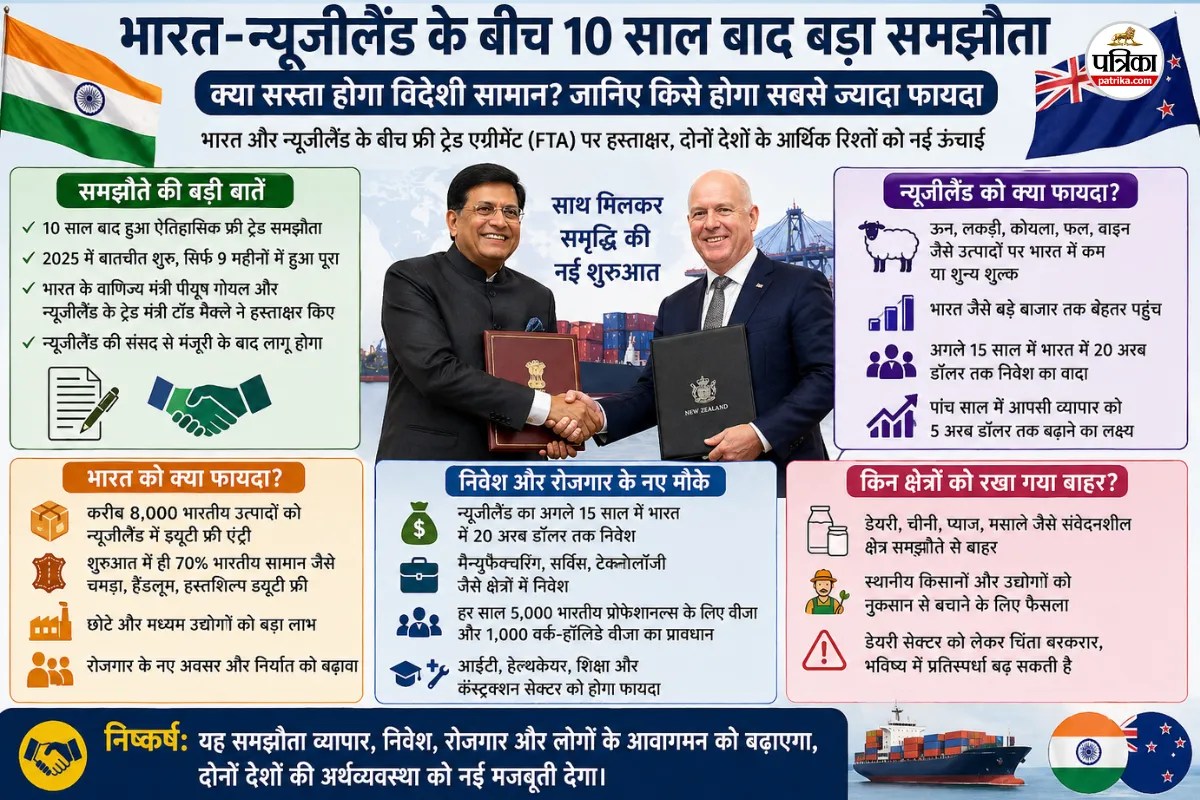
The recent 10-year milestone agreement between India and New Zealand signals a transition from passive diplomatic observation to an active structural alignment in the Indo-Pacific economic corridor. While surface-level analysis often focuses on immediate retail price fluctuations, the true value of this agreement lies in the systemic reduction of transaction costs and the integration of supply chain protocols. This isn't a simple tariff reduction exercise; it is a recalibration of comparative advantage in high-value services, agriculture technology, and educational exports.
The Triad of Economic Integration
The logic of this agreement rests on three distinct pillars that define the flow of capital and goods between New Delhi and Wellington. Understanding these pillars is essential to predicting which sectors will capture the resulting alpha. You might also find this related story useful: The Desert and the Deep Well.
1. The Technology-Agriculture Nexus
New Zealand’s primary export strength is not just the physical product—dairy, fruit, or timber—but the underlying biological and digital infrastructure used to produce it at scale. India’s objective is the "Importation of Process." By easing trade barriers, India gains access to cold-chain logistics intellectual property and sustainable farming techniques that are critical for its internal food security. For New Zealand, this opens a market of 1.4 billion people where the middle-class dietary preference is shifting toward high-protein and premium organic imports.
2. Service-Led Capital Flows
Unlike traditional trade deals focused on manufacturing, the India-New Zealand relationship is increasingly defined by the export of human capital and digital services. New Zealand’s education sector acts as a high-margin service export, while India provides the technical talent pool required to sustain New Zealand's growing fintech and agritech industries. The agreement seeks to standardize professional certifications and visa processing, effectively lowering the "entry tax" on professional services. As highlighted in detailed reports by The Wall Street Journal, the results are widespread.
3. Supply Chain De-risking
In a global environment defined by "friend-shoring," this agreement serves as a hedge against over-reliance on a single regional hegemon. By formalizing a decade-long roadmap, both nations are creating a predictable regulatory environment. Predictability is the primary currency of long-term infrastructure investment.
The Cost Function of Bilateral Trade
The common question of whether foreign goods will become cheaper for the Indian consumer requires a breakdown of the landed cost of goods. The retail price is a function of:
$P_{retail} = (C_{production} + T_{logistics} + D_{customs}) \times (1 + M_{distributor})$
Where:
- $D_{customs}$ represents the import duties.
- $T_{logistics}$ represents the friction of moving goods across the 12,000 km maritime distance.
The agreement targets $D_{customs}$ through phased reductions, but more importantly, it addresses $T_{logistics}$ through "Non-Tariff Barrier" (NTB) harmonization. When phytosanitary standards (health and safety regulations for plants/animals) are aligned, the time a shipment spends in customs detention decreases. This reduction in "time-at-port" is often more significant for perishable goods—like New Zealand’s high-end kiwifruit or dairy—than a 5% reduction in the headline tariff rate.
Strategic Winners and Resource Allocation
The benefits of this agreement will not be distributed evenly. A clinical assessment of sector-specific fundamentals reveals a clear hierarchy of beneficiaries.
Primary Beneficiaries: The Premium Consumer Goods Sector
New Zealand’s "Zespri" kiwifruit and "Manuka" honey brands are positioned at the top of the Veblen-good pyramid in urban India. Reduced duties will not necessarily lead to a price war at the bottom of the market. Instead, it will allow these brands to increase their marketing spend and distribution depth within Tier-1 and Tier-2 Indian cities. The benefit here is scale rather than raw affordability.
Secondary Beneficiaries: The Indian MSME Manufacturing Base
A hidden component of the bilateral dialogue involves New Zealand's demand for high-quality engineering goods and textiles. Indian Small and Medium Enterprises (SMEs) that can meet New Zealand's stringent quality standards will find a high-trust, high-margin market. This is a shift away from the high-volume, low-margin competition found in larger trade blocs.
The Education and Aviation Corridor
The agreement facilitates more direct flights and code-sharing arrangements. This reduces the "Distance Penalty" for the 250,000-strong Indian diaspora in New Zealand and the thousands of students traveling annually. For the aviation industry, this creates a high-yield long-haul route that was previously hindered by regulatory uncertainty.
The Bottleneck of Domestic Sensitivity
We must acknowledge the friction points that prevent a full-scale Free Trade Agreement (FTA) in the immediate term. The primary constraint is the Dairy Protectionism Paradox.
- India's Position: India is the world's largest milk producer, with a domestic industry built on millions of small-scale farmers. Opening the market to New Zealand’s Fonterra—a global dairy giant with massive economies of scale—poses an existential threat to the Indian cooperative model (e.g., Amul).
- New Zealand's Position: Dairy represents nearly 25% of New Zealand’s total export earnings. Any trade deal that excludes dairy is seen domestically as a partial failure.
Because of this, the "10-year agreement" acts as a framework for cooperation rather than a total market opening. It focuses on technology transfer in the dairy sector—helping Indian farmers increase yield per cattle—rather than allowing direct competition in liquid milk or basic milk powder. This "cooperation-over-competition" model is the only politically viable path.
Quantifying the Institutional Impact
The signing of such a long-term agreement shifts the risk profile for private equity and venture capital. When two governments commit to a decade of alignment, the "Policy Risk Premium" decreases.
- Investment Certainty: New Zealand pension funds and institutional investors can now view Indian infrastructure and green energy as 10-to-15-year bets with a lower probability of sudden regulatory shifts.
- Standardization of Quality: Indian exporters are being forced to adopt New Zealand’s world-class traceability standards. While this increases short-term compliance costs, it "upgrades" the Indian firm to a global standard, making them more competitive in the EU and North American markets as a side effect.
Structural Evolution of the Trade Balance
The trade balance between the two nations has historically been tilted, but the composition of that trade is evolving. We are seeing a transition from "Commodity-for-Commodity" trade to "Value-Add-for-Service" trade.
- India’s Export Evolution: Transitioning from bulk textiles to pharmaceuticals and IT services tailored for New Zealand’s healthcare and banking sectors.
- New Zealand’s Export Evolution: Transitioning from raw wool and logs to specialized agri-tech software and premium processed foods.
This evolution reduces the sensitivity of the trade balance to fluctuations in global commodity prices, creating a more stable bilateral economic environment.
The Strategic Play for Market Participants
For businesses looking to capitalize on this decade-long roadmap, the strategy is not to wait for tariff zero-out, but to solve for the logistics and compliance gaps now.
Firms should prioritize:
- Joint Ventures in Agri-Logistics: Combining New Zealand’s cold-chain IP with Indian local distribution networks.
- Educational Partnerships: Moving beyond student recruitment into "Transnational Education" (TNE), where New Zealand degrees are partially delivered in India, reducing the cost for the student while maintaining the high-margin export for the provider.
- Digital Integration: Leveraging India's Unified Payments Interface (UPI) and digital public infrastructure to facilitate seamless B2B payments for New Zealand exporters.
The 10-year horizon is the most critical variable. It allows for the amortization of the high setup costs required to enter these markets. The true winners will be those who treat the agreement not as a discount on goods, but as a subsidized invitation to build cross-border infrastructure. The real profit lies in the "middle-ware" of trade—the logistics, the certifications, and the technology that allows goods and people to move between these two disparate economies with minimal friction.