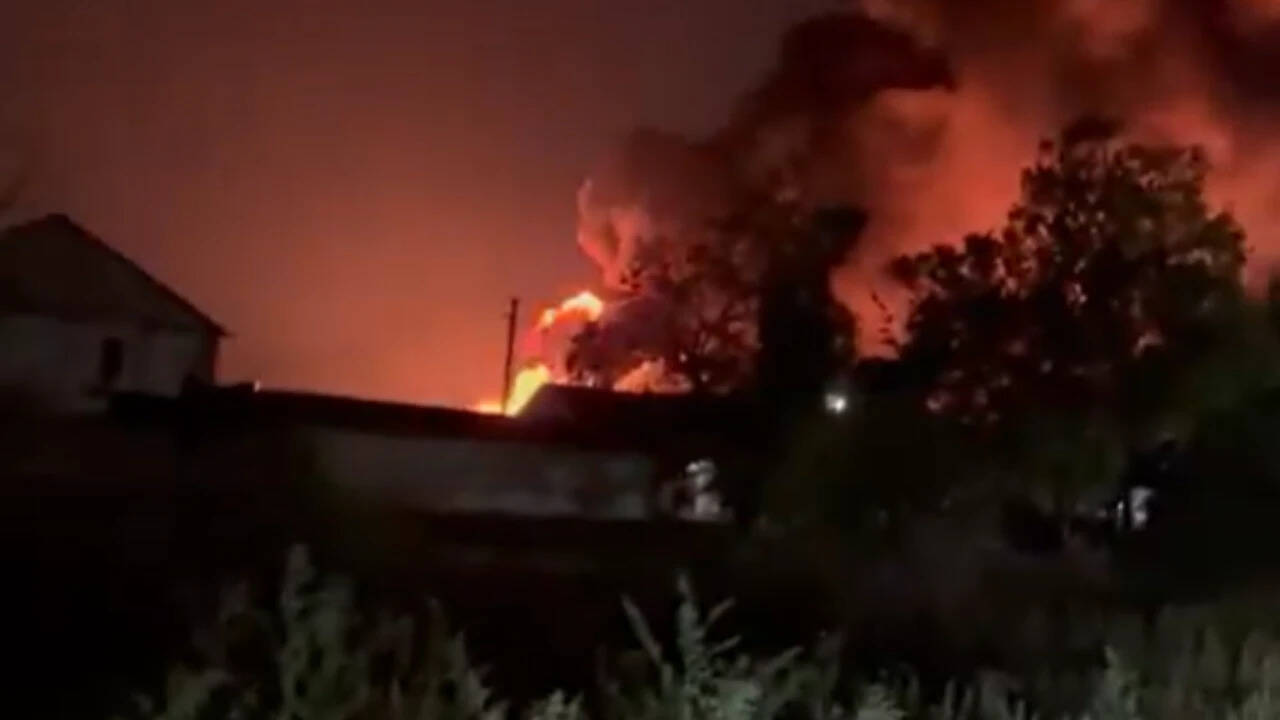
Long-range attritional campaigns operate on a continuous economic and logistical ledger rather than isolated tactical victories. When aerial bombardments target municipal centers simultaneously with deep strikes against petrochemical hubs, the underlying objective transcends simple destruction. It represents a coordinated effort to alter the adversary's cost-benefit calculus, straining national defense distribution, fuel logistics, and industrial output.
Deconstructing these synchronized operations requires analyzing the distinct strategic vectors driving both sides: the architectural strain on municipal air defense versus the systematic disruption of energy export and refining capacity.
The Mechanics of Municipal Attrition and Air Defense Saturation
Targeting urban centers like Kyiv while executing long-range drone blitzes against Russian oil depots, refineries, and military airfields creates a severe allocation dilemma for defensive command structures. Air defense assets—specifically high-tier interceptor batteries such as Patriot and NASAMS—are finite, highly expensive resources with restricted inventory replenishment rates.
When an offensive campaign deploys hundreds of low-cost loitering munitions alongside ballistic and cruise missiles in a compressed timeframe, it forces defenders into a brutal economic imbalance. Intercepting low-cost aerial threats with high-cost interceptors creates an unsustainable financial burn rate. Conversely, prioritizing missile conservation to preserve stockpiles risks direct structural impacts on critical civic infrastructure, resulting in civilian casualties and localized service outages.
This dynamic establishes a forced compromise. The defender cannot simultaneously achieve absolute intercept efficiency across all regional vectors and preserve its long-term strategic reserve of interceptor inventory. The operational rhythm is deliberately designed to degrade the elasticity of the integrated air defense system over time.
The Petrochemical Bottleneck and Refining Disruption
While urban strikes pressure command and control networks, parallel long-range drone incursions targeting Russian petrochemical assets exploit systemic vulnerabilities in centralized energy infrastructure. Facilities such as primary oil-processing units, linear production control stations, and regional fuel depots function as critical nodes in national supply chains.
The structural vulnerability of these facilities stems from specialized manufacturing dependencies. Key components within large-scale refining units—such as catalytic cracking towers and specialized distillation columns—rely heavily on precision engineering and international components that are difficult to replace rapidly under strict trade restrictions. When a drone strike ignites fuel storage tanks or damages primary processing units like an ELOU-AVT installation, the operational friction extends far beyond the immediate fire damage.
The cascading effects include:
- Localized fuel shortages that disrupt regional commercial transit and military supply lines.
- Pipeline blending bottlenecks, particularly at major distribution hubs that process crude grades for export.
- Capital-intensive repair cycles that require prolonged facility downtime, eroding national refining output.
Logistical Adaptation and the Production-Interception Loop
Both belligerents face a persistent optimization problem regarding manufacturing output versus consumption velocity. For the striking force, maintaining a high volume of long-range UAV production is vital to outpace the adversary's localized electronic warfare and point-defense capabilities. For the targeted state, the imperative shifts toward hardening secondary fuel reserves, decentralizing storage infrastructure, and deploying mobile electronic jamming units to disrupt autonomous guidance systems before impact.
However, hardening massive industrial footprints is economically inefficient. A sprawling oil depot or an open-air airfield cannot be easily placed beneath reinforced concrete. Consequently, defense strategies lean heavily on active interception rather than passive hardening, keeping the strategic initiative with the long-range strike operator who can continuously alter attack vectors, payload configurations, and approach corridors.
Strategic Forecast
The trajectory of this attritional campaign hinges entirely on industrial output rates and supply chain resilience. As long as the marginal cost of producing long-range strike vectors remains significantly lower than the replacement cost of the targeted petrochemical and military infrastructure, deep strikes will remain a primary instrument of strategic coercion. The operational focus will continue to prioritize nodes that yield compounding systemic failures, forcing adversaries to divert resources constantly between frontline tactical defense and rear-area critical asset protection.