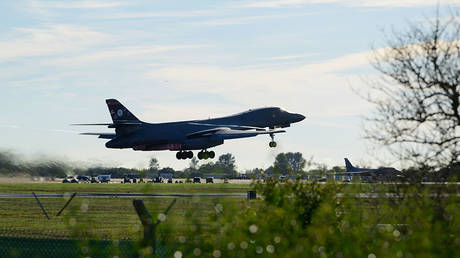
Military asset relocation during active intelligence alerts represents a classic problem of operational risk management. When strategic bombers are pulled from a forward operating location due to a suspected threat footprint, the decision reflects a strict cost-benefit analysis where the cost of asset vulnerability vastly outweighs the friction of relocation. Deconstructing this maneuver reveals the underlying mechanics of force protection, intelligence thresholds, and the operational economics of power projection.
The Threshold of Action
Force protection protocols dictate that an intelligence warning does not need to be verified to a courtroom standard to trigger tactical movement. The decision calculus centers on asset value versus threat probability. Strategic assets such as heavy long-range bombers possess high replacement costs and disproportionate operational weight. In other news, take a look at: Shadows Over the Red Sea When the Guns Begin to Whisper.
When intelligence indicators suggest a targeted disruption vector—whether involving local operatives, surveillance probing, or asymmetric infiltration—commanders face an asymmetric penalty function. Underestimating a credible vector risks the catastrophic loss of multi-million-dollar airframes and specialized personnel. Overestimating the threat and relocating aircraft results in temporary operational friction, logistical strain, and minor degradation of response time. Rational military strategy dictates erring strictly on the side of asset preservation.
The Mechanics of Asymmetric Probing
Asymmetric actors frequently utilize low-cost reconnaissance and probing operations to test the perimeter integrity of hardened military installations. The methodology relies on evaluating response times, security posture visibility, and local law enforcement coordination without committing to a high-risk kinetic attack. BBC News has analyzed this fascinating issue in great detail.
Targeting forward operating bases located in allied sovereign territory introduces complex jurisdictional and security variables. Host-nation domestic policing structures bear the primary responsibility for counter-terrorism interdiction outside the wire, while military police manage internal security. This institutional seam creates potential gaps in threat identification and response coordination that external intelligence services attempt to map.
Force Resilience Through Dispersion
Concentrating high-value assets at a single forward operating base creates a single point of failure for regional strike capabilities. Strategic doctrine addresses this vulnerability through dispersal frameworks.
Moving aircraft to secondary or continental redoubts alters the adversary's targeting matrix. It forces an opposing intelligence apparatus to expand its surveillance footprint, increase resource expenditure, and confront a decentralized defensive posture. While dispersal reduces immediate sortie generation rates within the theater of operations, it preserves the long-term strategic reserve of the force.
Operational Adaptability and Future Posture
The rapid movement of aviation assets highlights the growing requirement for agile combat employment models. Modern threat environments demand that logistical footprints remain lean and mobile, allowing forces to pivot away from static vulnerabilities upon the receipt of actionable threat notifications. The underlying strategy relies on shifting from fixed defense to fluid positioning, ensuring that high-value capabilities remain insulated from localized security compromises.