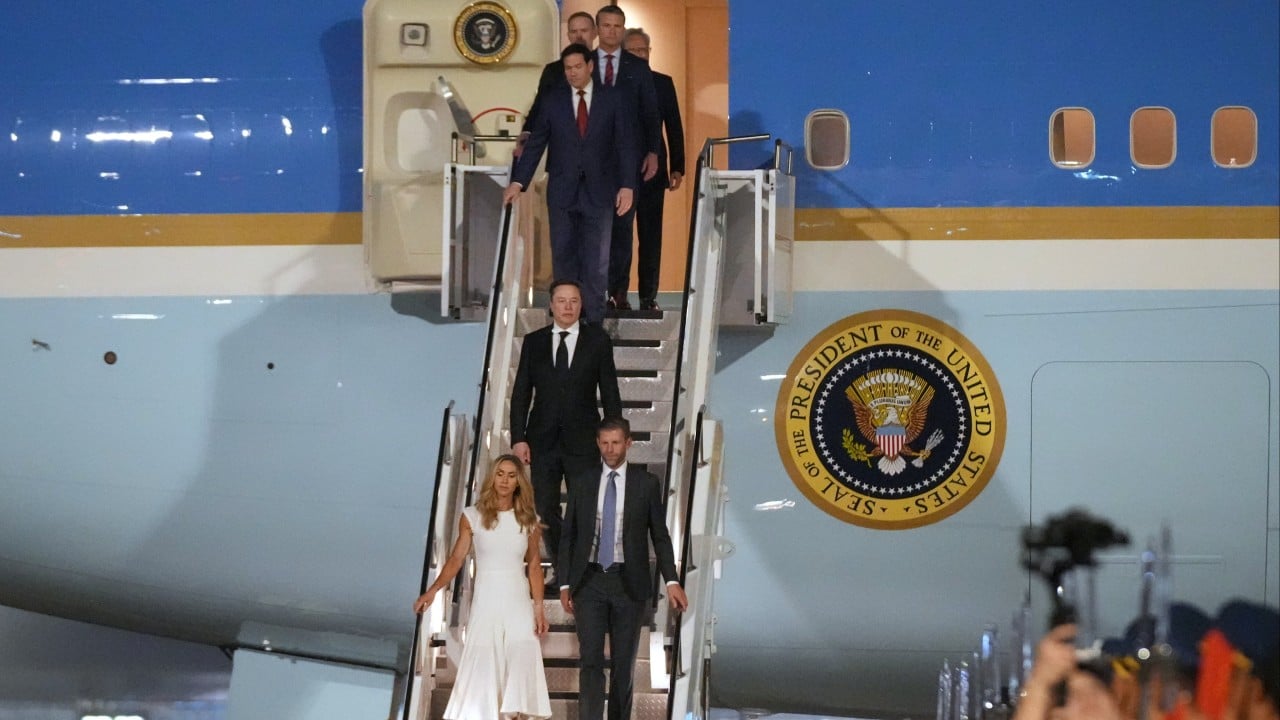
The arrival of a high-capital business delegation in China, ostensibly representing a trillion dollars in cumulative market capitalization and assets under management, signals a shift from purely transactional trade to a complex re-indexing of global supply chains. While surface-level reporting focuses on "deals," the underlying objective is the negotiation of a new equilibrium between aggressive U.S. industrial policy and China’s entrenched manufacturing dominance. This movement is not merely a diplomatic exercise; it is a high-stakes recalibration of the risk-adjusted return on capital for American multinationals operating within the "China Plus One" framework.
The Tripartite Framework of the Delegation's Mandate
To understand the objectives of this delegation, one must categorize their interests into three distinct strategic pillars. Each pillar represents a different facet of the current geopolitical-economic friction.
1. Market Access and Regulatory Reciprocity
The primary bottleneck for U.S. firms remains the asymmetry in market entry. While Chinese firms have historically enjoyed relatively open access to Western consumer markets, U.S. firms in sectors like financial services, healthcare, and high-end manufacturing face a labyrinth of licensing requirements and domestic preference laws. The delegation’s goal is to secure "national treatment" status, ensuring that American entities are not structurally disadvantaged against State-Owned Enterprises (SOEs).
2. Supply Chain Integrity and De-risking
The "trillion-dollar" figure is a proxy for the scale of the supply chains at stake. These companies are not looking to decouple—an economically ruinous prospect—but rather to "de-risk." This involves:
- Redundancy Engineering: Establishing secondary supply nodes outside of China while maintaining core efficiencies within it.
- Technology Transfer Guardrails: Formalizing agreements that prevent coerced intellectual property sharing in exchange for market presence.
- Logistical Resilience: Securing long-term commitments for the export of critical minerals and intermediate goods essential for U.S. high-tech production.
3. Capital Flow Optimization
With interest rate environments fluctuating and the Renminbi facing valuation pressures, the delegation represents a massive pool of liquidity seeking stable, long-term deployment. The negotiation involves the repatriation of profits and the removal of "trap" mechanisms that make it difficult for foreign firms to exit positions or move capital across borders.
The Cost Function of Decoupling vs. Engagement
A brutal analysis of the current economic state reveals that the cost of complete industrial separation is non-linear. The friction does not merely add a flat percentage to the price of goods; it introduces systemic volatility that markets cannot efficiently price.
The delegation operates under a specific cost function where the "Cost of Departure" includes the loss of the world’s most sophisticated manufacturing ecosystem and a consumer market of 1.4 billion people. Conversely, the "Cost of Compliance" involves navigating increasingly restrictive U.S. export controls and Chinese domestic security laws. The "sweet spot" for these business leaders is a narrow band of engagement where the marginal utility of a Chinese partnership outweighs the marginal risk of political blowback in Washington.
Identifying the Power Dynamics of Negotiating Levers
The delegation does not arrive empty-handed. Their leverage is built upon three specific economic realities that the Chinese administration must acknowledge to maintain its own growth targets.
The Technology Gap in Precision Engineering
Despite significant Chinese advances in AI and EV battery technology, a gap remains in high-end lithography, aerospace components, and advanced biotech. The U.S. delegation uses the promise of continued collaboration in these "allowable" tech spheres as a carrot to ensure favorable treatment for more commoditized industries.
The Necessity of Foreign Direct Investment (FDI)
China’s post-pandemic recovery has been uneven. Domestic consumption has not yet fully replaced the engine of export-led growth. To hit GDP targets, China requires a steady infusion of FDI. The trillion-dollar delegation represents the largest potential source of this capital. If these firms signal a lack of confidence, it triggers a "herd effect" among smaller institutional investors, leading to a broader capital flight.
Global Standards Competition
The side that defines the standards for the next generation of 6G, green energy grids, and autonomous systems wins the decade. By engaging directly, the delegation attempts to ensure that Chinese standards do not diverge so far from international norms that they create a bifurcated global economy, which would double the R&D costs for every firm involved.
Structural Bottlenecks in the Deal Making Process
The success of this delegation is hindered by several structural realities that no amount of "handshaking" can fully resolve.
- The Dual-Use Dilemma: Almost any advanced industrial deal can be scrutinized under the lens of national security. A deal for civilian aircraft components can be viewed as a boost to dual-use aerospace capabilities. This creates a permanent ceiling on the depth of cooperation.
- Legislative Lag: While the executive branch and business leaders may reach an understanding, the U.S. Congress remains a volatile variable. Agreements made in Beijing are subject to immediate scrutiny and potential reversal via sanctions or executive orders upon the delegation's return.
- The Transparency Gap: For U.S. firms to commit the levels of capital being discussed, they require a level of data transparency regarding Chinese corporate debt and local government financing vehicles (LGFVs) that the Chinese state has historically been reluctant to provide.
Quantifying the Value of Soft Commitments
Much of what will be announced following this visit will fall into the category of "Memorandums of Understanding" (MOUs). In the world of high-level strategy, an MOU is a placeholder for future intent rather than a binding contract. However, the quantity and sector-distribution of these MOUs serve as a heat map for where the U.S. private sector sees the least political resistance.
If the MOUs are concentrated in "hard tech," the delegation is pushing the boundaries of U.S. export policy. If they are concentrated in agriculture and consumer retail, it signals a retreat to "safe" sectors, indicating that the high-tech trade war is entering a period of prolonged stasis.
Strategic Realignment of the Manufacturing Base
The delegation’s presence suggests a move toward "Vertical Localization." This strategy involves U.S. firms building entirely self-contained supply chains within China for the Chinese market, while simultaneously building separate, decoupled chains for the Western market.
This "In China, For China" model minimizes the impact of cross-border tariffs but increases the risk of asset seizure in the event of a total diplomatic breakdown. The decision to proceed with this model indicates that the delegation's members have calculated the probability of such a breakdown to be lower than the cost of missing out on Chinese domestic growth.
The Geopolitical Arbitrage of the "Business First" Approach
There is a deliberate attempt to use commerce as a stabilizing force—a concept known as "commercial peace theory." The theory suggests that the more integrated the trillion dollars of assets are within the Chinese economy, the higher the cost of conflict for both nations.
However, this ignores the shift in both capitals toward prioritizing national security over pure GDP growth. The delegation is essentially performing an arbitrage of time: they are securing as much profit and market positioning as possible before the "iron curtain" of technology regulation fully descends.
Tactical Recommendations for Market Participants
The influx of high-level deal-making creates a specific set of requirements for observers and competitors not present in the room.
- Monitor the "Secondary Tier" Suppliers: The large firms in the delegation will dictate the terms, but the real movement will happen in the mid-market. Watch for the relocation of Tier 2 and Tier 3 suppliers. If they do not follow the lead of the "Trillion Dollar" firms, the primary deals will eventually fail due to a lack of local ecosystem support.
- Evaluate IP Protection Clauses: Any announced deals should be scrutinized for specific language regarding data residency and "source code escrow." Firms that concede on these points are trading long-term sovereignty for short-term revenue.
- Hedge Against Policy Reversal: The "political risk premium" must be factored into every deal. Investors should look for "break-up fee" equivalents or insurance mechanisms that protect the capital in the event of new trade barriers.
The visit of this delegation marks the end of the "Globalism 1.0" era and the beginning of a fragmented, managed trade regime. The success of these deals will not be measured in the immediate dollar value of contracts signed, but in the durability of the legal and structural frameworks established to protect that capital in an increasingly bifurcated world.
The final strategic move for these firms is the transition from being "multinational" to "multi-local." This requires a complete overhaul of corporate governance, where regional branches operate with a degree of autonomy that allows them to survive local political pressures without compromising the global entity's integrity. The firms that master this dual-mode operation will dominate the next cycle of the Sino-American economic relationship.