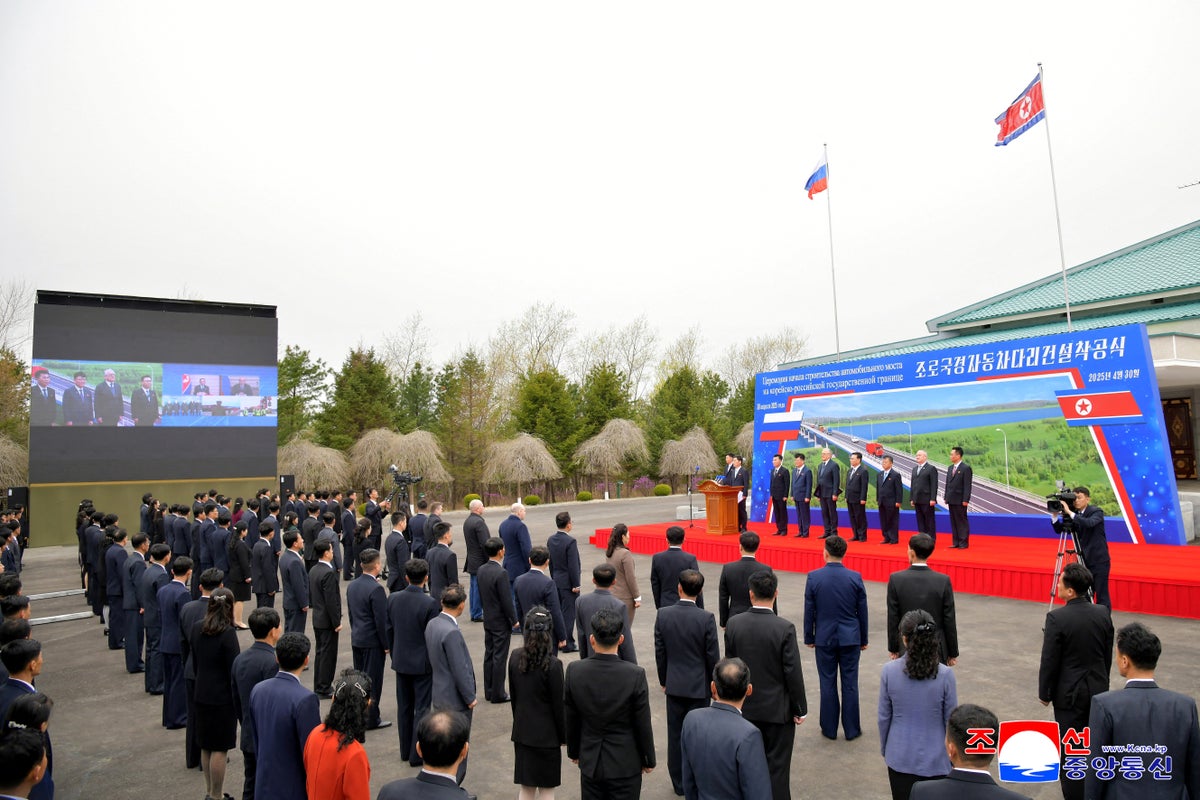
The completion of the first road bridge spanning the Tumen River between the Democratic Republic of Korea (DPRK) and the Russian Federation represents a fundamental shift in Northeast Asian logistics. This is not merely a symbolic connection but a structural recalibration of the "bridge-and-ferry" bottleneck that has historically constrained bilateral trade. By transitioning from a single-track rail-exclusive corridor to a dual-modality transport system, the two nations are addressing a specific economic friction point: the inability to execute high-frequency, small-batch logistics that rail systems cannot efficiently manage.
The Tri-Border Logistic Constraint
The geographical reality of the Tumen River estuary has long served as a natural choke point. Previously, the Khasan-Tumangang rail bridge, known as the Friendship Bridge, stood as the sole fixed link. While rail is optimized for bulk commodities—coal, timber, and heavy machinery—it lacks the flexibility required for the rapid movement of consumer goods, perishable items, and specialized technical equipment.
The new road bridge functions as a redundancy mechanism and a volume multiplier. It bypasses the inherent delays of rail scheduling and the high fixed costs of locomotive operation. In engineering terms, this adds a parallel circuit to a system that previously suffered from a single point of failure. If the rail link is compromised or overcapacity, the road bridge maintains the flow of materials, ensuring that geopolitical friction does not translate into immediate supply chain collapse.
The Three Pillars of Sino-Russo-Korean Connectivity
The emergence of this road link must be analyzed through three distinct strategic frameworks:
1. The Transshipment Efficiency Vector
The primary value of a road bridge lies in the reduction of "dead time." Rail transport requires extensive shunting, gauge changes (or bogie exchanges between the Russian 1,520 mm and the Korean 1,435 mm tracks), and massive marshalling yards. Road transport eliminates these steps.
- Direct-to-Warehouse Logistics: Trucks can deliver goods from Vladivostok directly to Rason without the intermediate handling required by rail.
- Lower Barrier to Entry: Small and medium enterprises (SMEs) that cannot fill a 50-car freight train can now utilize individual trucks, diversifying the types of goods entering the DPRK market.
2. The Sanction Resiliency Loop
This infrastructure provides a physical hedge against international pressure. Fixed road assets are notoriously difficult to monitor compared to maritime shipping, which is subject to satellite tracking and interdiction in international waters. A land-based road link allows for "gray zone" logistics where cargo can be decentralized across hundreds of smaller vehicles, making comprehensive tracking and enforcement nearly impossible for external observers.
3. The Rason Economic Zone Integration
The bridge serves as the final technical requirement for the Rason Special Economic Zone (SEZ) to function as a genuine tri-border hub. Without a road link to Russia, Rason remained overly dependent on Chinese infrastructure. This bridge creates a competitive environment for DPRK transit services, allowing Pyongyang to play Russian and Chinese logistical interests against one another to secure better transit fees and infrastructure investment.
Engineering and Geopolitical Dependencies
The construction of the bridge involves more than just pouring concrete; it requires the synchronization of two disparate bureaucratic and technical systems. The success of this infrastructure depends on the Interoperability Factor.
The bridge must handle the weight of heavy-duty freight vehicles, typically rated for 40-ton loads. However, the bottleneck is often not the bridge's structural integrity but the customs and quarantine facilities on either side. If the "Clearance Coefficient"—the speed at which a vehicle passes through a checkpoint—is lower than the transit speed of the bridge, the bridge becomes an expensive parking lot.
Russia’s Ministry of Transport has signaled that the project includes the modernization of the Khasan checkpoint. This suggests an understanding that hardware (the bridge) is useless without software (digital customs tracking and streamlined inspection protocols).
The Strategic Pivot: Why Now?
The timing of this completion is dictated by the Shift in Russian Pivot Logic. Post-2022, Russia has aggressively reoriented its trade focus from the West to the "Global East." In this context, North Korea is no longer a peripheral neighbor but a strategic manufacturing and labor reserve.
- Labor Arbitrage: The road bridge facilitates the easier movement of North Korean labor into the Russian Far East, particularly for construction and agricultural sectors where Russia faces a chronic deficit.
- Resource Exchange: It provides a direct conduit for Russian energy products (refined petroleum) and food (flour and corn) to reach the DPRK in exchange for the hardware and munitions that have characterized recent bilateral agreements.
The Cost Function of Isolation
Every kilometer of new infrastructure built between Russia and North Korea increases the cost of maintaining the status quo for the United States and its allies. Historically, the policy of "Strategic Patience" relied on the assumption that North Korea would eventually buckle under economic isolation. This bridge effectively breaks that isolation.
The Economic Isolation Decay can be calculated by the increase in non-seaborne trade volume. As land-based trade capacity increases, the leverage of maritime blockades decreases. This road link represents a permanent loss of Western influence over the North Korean economy's "minimum viable survival" threshold.
Structural Challenges and Bottlenecks
Despite the strategic advantages, the bridge faces significant operational risks.
- Maintenance Deficit: The Tumen River is prone to significant seasonal flooding and ice floes. Maintaining the structural integrity of a road bridge in sub-arctic conditions requires a level of consistent investment that North Korea has historically struggled to provide.
- Currency Incompatibility: While the physical bridge exists, the financial bridge is broken. The lack of a unified clearing system between the Ruble and the Won forces a reliance on the Chinese Yuan or barter systems, creating an "Exchange Rate Friction" that adds 5-10% to the cost of every transaction.
- The China Variable: Beijing views the Russo-Korean warming with caution. A road bridge that bypasses Chinese territory reduces Beijing's "Gatekeeper Status" in the region. If Russia becomes the primary provider of high-value goods via the new bridge, China may respond by tightening or loosening its own border controls at Dandong to regain market dominance.
Projecting the Cargo Composition
Based on current industrial needs in both nations, we can categorize the likely cargo flow into three distinct tiers:
- Tier 1: Strategic Sustenance (Russia to DPRK): Refined fuel, grain, fertilizers, and heavy vehicle parts. These items are the prerequisite for North Korean domestic stability.
- Tier 2: Industrial Input (DPRK to Russia): Construction materials, textiles, and potentially dual-use chemical components.
- Tier 3: Specialized Technical Flow: Information technology hardware, telecommunications equipment, and precision tools—items that are small enough to be transported by truck but too valuable to risk in the slow-moving rail system.
The Logistics of Power
The bridge is a physical manifestation of a Realpolitik Realignment. In the previous decade, infrastructure projects in this region were often discussed but rarely finished due to the fear of triggering secondary sanctions. The completion of this bridge signals that Russia has calculated that the benefits of a direct, high-capacity road link to North Korea now outweigh the costs of international condemnation.
This is a move toward a "Closed Circuit" economy. By building fixed land assets, Russia and North Korea are creating a micro-theater of trade that is immune to the primary tools of 21st-century economic warfare. The bridge is not just a path for trucks; it is a bypass for the global financial system.
The immediate tactical move for regional stakeholders is to monitor the build-out of the "Secondary Logistics Layer." This includes the construction of cold-storage warehouses, fuel depots, and repair bays within a 50-kilometer radius of the Khasan-Tumangang crossing. The density and scale of these facilities will provide the true metric of the bridge’s intended throughput. If we see the deployment of large-scale container handling equipment on the DPRK side, it indicates a move toward multimodal shipping that could eventually link Rason to the broader Trans-Siberian Railway network via road-to-rail transfer points.
The era of North Korean isolation as a function of geography is ending. The bridge over the Tumen River is the technical proof of that conclusion. Strategic planners must now account for a North Korea that is logistically integrated with the Russian Far East, creating a combined economic space that is physically contiguous and increasingly difficult to penetrate or disrupt.