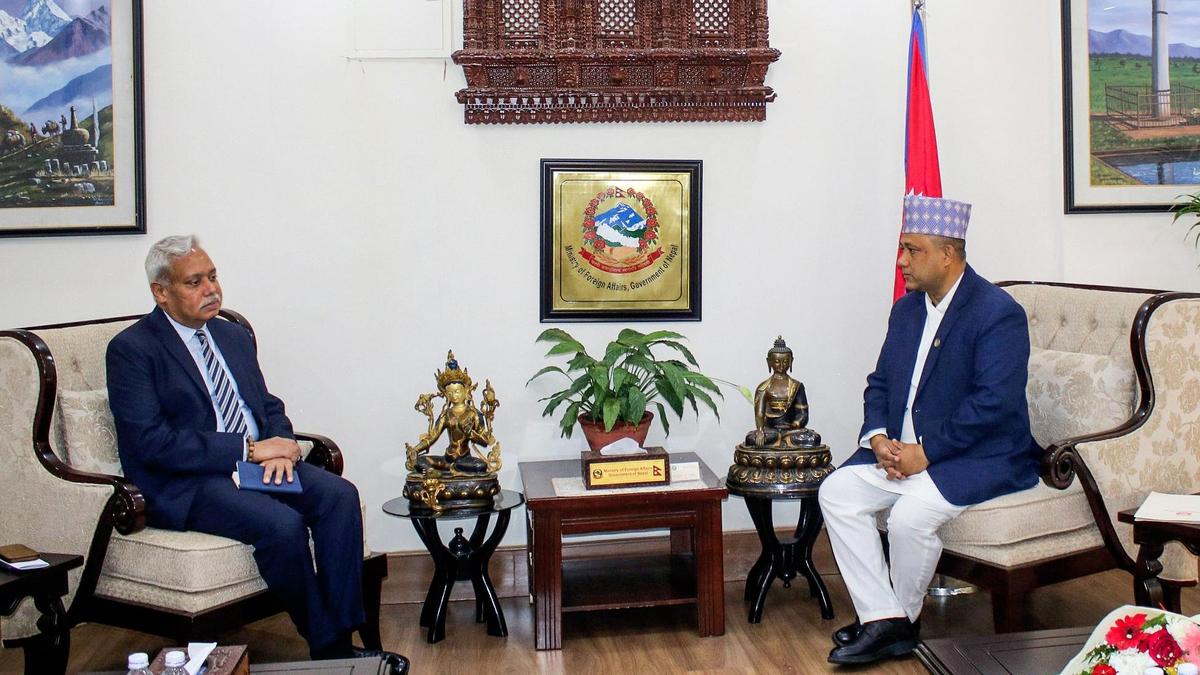
The diplomatic engagement between the Indian Ambassador and Nepal's newly appointed Foreign Minister signals more than a routine courtesy visit; it represents a high-stakes recalibration of the Indo-Nepal strategic axis. In the context of shifting Himalayan geopolitics, this interaction serves as a diagnostic tool for identifying friction points in cross-border infrastructure, energy sovereignty, and the transition from a "dependency-based" to a "connectivity-based" partnership. The success of this bilateral period depends on moving past symbolic gestures toward quantifiable milestones in trade logistics and hydropower export protocols.
The Tripartite Architecture of Modern Indo-Nepal Relations
The current engagement operates within a tripartite framework that governs the stability of the relationship. While media reports focus on the "warmth" of the meeting, the underlying mechanics are driven by three distinct pillars of institutional cooperation.
1. The Infrastructure Connectivity Loop
Bilateral ties are no longer defined by high-level summits but by the throughput capacity of Integrated Check Posts (ICPs) and cross-border rail links. The current strategic priority focuses on the operationalization of the Raxaul-Kathmandu railway and the expansion of the Jogbani-Biratnagar link. These projects aim to reduce the "transit-time cost" for Nepalese importers, which currently suffers from a bottleneck of bureaucratic documentation and physical inspection delays at the border.
2. The Energy Export Mechanism
Nepal’s transition from a power-deficit nation to a seasonal power exporter has fundamentally altered the bargaining power within this relationship. The 10,000 MW export agreement over the next decade serves as a long-term capital commitment from the Indian side. However, the execution of this agreement faces a technical constraint: the synchronization of the two national grids and the development of high-voltage transmission lines like the 400kV Dhalkebar-Muzaffarpur link.
3. The Security-Border Equilibrium
The open border policy (codified in the 1950 Treaty of Peace and Friendship) remains both a strategic asset and a logistical liability. Security cooperation now targets "non-traditional threats," including digital financial crimes and the illicit movement of third-country nationals, requiring a level of intelligence sharing that transcends traditional military-to-military ties.
Analyzing the Friction in Hydro-Diplomacy
The dialogue between the Indian envoy and the Foreign Minister must reconcile Nepal’s desire for energy autonomy with India’s "Cross Border Trade of Electricity" (CBTE) guidelines. Under current Indian regulations, electricity generated by projects involving investment from "countries of concern" (a clear reference to Chinese-funded projects in Nepal) faces significant barriers to entering the Indian grid.
This creates a structural dilemma for Nepal. The "Cost of Capital" for hydropower projects is significantly lower when sourcing Chinese construction expertise or financing. Yet, the "Market Access" is almost entirely dependent on India. The Foreign Minister’s challenge is to navigate this bottleneck by either diversifying the investment profile of upcoming projects or negotiating a more flexible interpretation of the CBTE guidelines to ensure Nepal does not end up with stranded assets in the form of unexportable energy.
The Logistics of Trade and the Transit Deficit
Nepal’s trade deficit with India is not merely a product of consumption patterns but a result of logistical inefficiency. The "Landed Cost" of Indian goods in Kathmandu is disproportionately high due to a reliance on road transport.
- Multimodal Integration: The transition from road to rail-based freight is the primary mechanism to reduce this deficit.
- Electronic Cargo Tracking Systems (ECTS): Implementing ECTS across all major transit points would eliminate the need for physical inspections, reducing the turnaround time for containers from 14 days to under 5 days.
- Letters of Credit (LC) and Currency Volatility: While the Nepali Rupee is pegged to the Indian Rupee, the administrative hurdles in settling cross-border payments through the formal banking sector often drive small-scale traders toward informal channels, obscuring the true volume of trade.
The Envoy’s mission is to ensure that the "Mutual Recognition Agreements" (MRAs) regarding food standards and phytosanitary certificates are fully operational. This would allow Nepali agricultural exports—ginger, tea, and cardamom—to enter the Indian market without the current 72-hour delay at testing laboratories in Kolkata or Delhi.
Geopolitical Competition as a Strategic Variable
The meeting occurs against the backdrop of Nepal’s "Equidistance Policy," an attempt to balance the influence of India and China. While China offers massive infrastructure loans under the Belt and Road Initiative (BRI), India provides a "Geographic Monopoly" on transit and a deep-rooted cultural and social integration.
India's strategy has shifted from "interference" to "delivery." By focusing on "High Impact Community Development Projects" (HICDPs), India aims to secure grassroots legitimacy that large-scale, debt-heavy Chinese projects often lack. The Foreign Minister’s role in this new cabinet will be to determine if Nepal can sustain this balance without triggering a "security dilemma" where India perceives Nepalese infrastructure projects as potential dual-use assets for northern competitors.
The Boundary Management Stasis
The Kalapani, Lipulekh, and Limpiyadhura disputes remain the "dormant variables" in the relationship. While both parties agree to resolve these through established diplomatic channels, the technical work of the Boundary Working Group (BWG) is often sidelined by domestic political cycles in Kathmandu.
The analytical reality is that neither side can afford a full escalation. For Nepal, the boundary issue is a matter of constitutional sovereignty; for India, it is a matter of strategic depth against Himalayan passes. The current diplomatic "quietude" suggests a tactical agreement to prioritize economic connectivity (the "Functionalist Approach") over territorial disputes that offer zero immediate economic utility.
Financial Interconnectivity and Digital Diplomacy
A critical but under-reported aspect of the Envoy-Minister meeting is the integration of digital payment systems. The launch of Unified Payments Interface (UPI) services in Nepal allows for the seamless transfer of remittances and simplifies tourism transactions.
- Remittance Formalization: Over 3 million Nepalese work in India. Moving these flows from "Hundi" (informal networks) to digital UPI rails provides the Nepali central bank with much-needed Indian currency reserves.
- Monetary Stability: Digital integration acts as a hedge against the liquidity crunches that have periodically affected the Nepali banking system.
Strategic Constraints and Execution Risks
The primary risk to the bilateral roadmap is the "Stability Gap" in Nepalese domestic politics. Frequent changes in the governing coalition lead to a "revolving door" of ministers, which disrupts the continuity of long-term infrastructure projects. When a Foreign Minister is replaced every 12 to 18 months, the institutional memory of negotiations is lost, leading to a cycle of "re-briefings" rather than project execution.
Furthermore, the "Anti-India Sentiment" often used as a domestic mobilization tool in Nepal creates a political cost for any minister who appears too conciliatory. This necessitates a "Two-Track Diplomacy" where public optics are managed through sovereignty-heavy rhetoric, while technical committees continue the pragmatic work of grid synchronization and customs harmonization.
Strategic Recommendation for the Current Term
The Foreign Ministry must prioritize the "Economic Integration First" model. This involves decoupling the energy and transit negotiations from the emotive boundary and treaty revision discussions. Specifically, the ministry should push for:
- The immediate finalization of the "Service Level Agreement" for the operation of the Kurtha-Bijalpura railway extension.
- A formal "Guarantee of Purchase" mechanism for the 10,000 MW power deal to de-risk private investment in the Arun and Karnali river basins.
- The expansion of the "Air Entry Routes" through Mahendranagar and Nepalgunj to make the new international airports in Bhairahawa and Pokhara commercially viable.
Without these specific technical clearances, the meeting between the Envoy and the Minister remains a purely symbolic exercise in diplomatic maintenance. The real measure of success will be the volume of cargo cleared and the megawatts of power transmitted by the next fiscal quarter.



