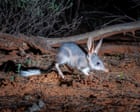
The survival of the Greater Bilby (Macrotis lagotis) in the Mallee Cliffs National Park represents a fundamental shift from passive conservation to high-intervention ecosystem engineering. The success of the current breeding trial is not a matter of biological luck but the result of a rigorous mitigation of two primary variables: predation pressure and habitat fragmentation. To evaluate the efficacy of this reintroduction, we must analyze the project through the lens of population dynamics, predator-exclusion economics, and the specific ecological niche the bilby occupies as a "soil engineer."
The Predator Exclusion Calculus
The primary bottleneck for bilby survival in New South Wales is not a lack of resources, but a catastrophic imbalance in the predator-prey equation. The introduction of the European red fox and the feral cat has created a mortality rate that exceeds the maximum intrinsic growth rate of the species.
In Mallee Cliffs, the strategy centers on a Hard Barrier Metric. By establishing a 9,500-hectare feral-free area, the project effectively resets the local ecosystem to a pre-colonial baseline. This exclusion zone functions as a closed system where the reproductive output ($R_0$) of the bilby population can finally exceed 1.0 without the interference of stochastic predation events.
The Mechanics of the Feral-Free Zone
- Perimeter Integrity: The fencing is designed to neutralize specific feline and vulpine locomotion—incorporating floppy tops to prevent climbing and aprons to prevent burrowing.
- Eradication Phasing: Before reintroduction, every individual predator within the 9,500 hectares was removed. This creates a "vacuum" effect where the only limiting factors are intraspecific competition and seasonal resource availability.
- Biosafety Protocols: Continuous monitoring via thermal imaging and motion-sensor arrays ensures that any breach is detected and neutralized before a breeding cycle is compromised.
The Biological Multiplier: Why Breeding Trials Succeed
The "boom" observed in the Mallee Cliffs trial is a predictable response to the removal of environmental stressors. When a high-fecundity species like the bilby is placed in a high-resource, zero-predator environment, the population enters an exponential growth phase.
Bilbies have a remarkably short gestation period of approximately 12 to 14 days—one of the shortest among mammals. This allows for a rapid "doubling time" within the population. The success of the trial is quantified by the presence of "pouch young" and independent juveniles, indicating that the relocated adults have successfully transitioned from the stress of translocation to the stability of the local environment.
Nutritional Density and Soil Turnover
The Mallee Cliffs environment provides a specific caloric profile necessary for this growth. Bilbies are omnivorous, consuming insects, seeds, bulbs, and fungi. Their foraging behavior creates "foraging pits" which serve two critical ecological functions:
- Seed Catchment: The pits collect organic matter and moisture, creating micro-habitats for seed germination.
- Nutrient Cycling: By overturning soil, bilbies increase the rate of decomposition and nitrogen availability in the Mallee ecosystem.
This creates a positive feedback loop. As the bilby population grows, the health of the soil improves, which in turn supports a higher density of the flora and fauna that bilbies consume.
Assessing the Translocation Risk Profile
Translocation is inherently high-risk. The Mallee Cliffs project manages this through a Tiered Release Strategy. Instead of a mass release, which risks overwhelming the local carrying capacity or suffering from a "scatter effect" where individuals cannot find mates, the project uses acclimation pens.
Variables of Translocation Success
- Genetic Diversity Management: The founding individuals are sourced from diverse populations (such as Thistle Island or captive breeding programs) to prevent the "founder effect" and maintain long-term adaptive potential.
- Weight and Health Benchmarking: Monthly monitoring of "body condition scores" allows ecologists to determine if the local forage is sufficient or if the population is reaching a density-dependent plateau.
- Site Fidelity: The tendency of an animal to remain near the release point. The Mallee Cliffs fence ensures site fidelity by force, preventing "lethal wandering" into predator-heavy zones.
The Economic and Strategic Constraints of Fenced Reserves
While the breeding trial is an undeniable success in biological terms, it exposes a strategic vulnerability in Australian conservation: the "Island Mentality."
The 9,500-hectare zone is effectively an inland island. It requires perpetual maintenance and high capital expenditure. The cost function of protecting a single bilby in a fenced reserve is orders of magnitude higher than protecting an equivalent animal in an open system. However, until the "cat problem" is solved via large-scale genetic biocontrol or more effective landscape-scale baiting, these high-cost enclaves are the only viable mechanism to prevent extinction.
The bottleneck for expanding this success is not the bilby’s ability to breed—they have proven they can thrive if given a chance—but the geographic and financial limits of predator-proof fencing.
Quantitative Milestones for Long-Term Viability
To transition from a "trial" to a "stable population," the Mallee Cliffs project must hit specific data targets. We are looking for three specific indicators of systemic stability:
- Generation Turnover: The point at which the original "founders" are outnumbered by "locally-born" individuals. This indicates the habitat is suitable for the full life cycle, not just survival.
- Carrying Capacity Equilibrium: The population will eventually hit a ceiling where the resources of the 9,500 hectares can no longer support more individuals. Observations of a slight decline or stabilization in growth rates will paradoxically signal a "mature" ecosystem.
- Expansion Readiness: Using the Mallee Cliffs population as a "source" for other reintroductions. A successful project should eventually export individuals to other reserves, turning a single point of success into a network of resilience.
Ecological Engineering as a Management Standard
The bilby is more than a flagship species; it is a tool for landscape restoration. The success at Mallee Cliffs suggests that reintroducing "lost" species can accelerate the recovery of degraded national parks. By restoring the digging functions of the bilby, we see a measurable increase in the heterogeneity of the ground cover.
This "top-down" restoration strategy—where the introduction of a key species drives the recovery of the flora—is more efficient than "bottom-up" approaches that focus solely on planting or weeding.
The strategic imperative moving forward is the integration of these fenced havens with broader landscape management. We cannot fence the entire continent. Therefore, the data gathered at Mallee Cliffs regarding bilby movement, diet, and interaction with other reintroduced species (like the Greater Stick-nest Rat or the Numbat) is vital for developing the next generation of "open-landscape" protection technologies.
The focus must now shift toward quantifying the exact volume of soil moved per bilby per year and the subsequent carbon sequestration or nitrogen-fixing benefits provided by their presence. This data will allow conservationists to frame the bilby not just as a species to be saved, but as a critical infrastructure component of a healthy Australian ecosystem.