Standard protest coverage reduces complex civic breakdowns to two flat variables: crowd headcount and street confrontation. Treating a nationwide wave of demonstrations, school walkouts, public-sector strikes, and violent fringe clashes as a single uniform event obscures why calm marches curdle into property destruction, why official crowd estimates diverge so sharply from union tallies, and how street disorder alters electoral coalitions.
To move past surface-level reporting on France's autumn mobilization, the phenomenon needs to be analyzed through four structural mechanisms:
- The Multi-Coalition Convergence Engine, which explains how localized grievances merge into national scale.
- The Crowd-to-Riots Bifurcation, which separates peaceful mass assemblies from destructive fringe action.
- The Measurement and Coercion Feedback Loop, which shows how crowd counting disputes and policing tactics amplify grievance.
- The Electoral Polarization Multiplier, which tracks how street volatility reshapes political incentives ahead of national elections.
A rigorous reading of the unrest requires separating verified operational records from competing political interpretations. Confirmed facts include multi-sector strikes, secondary school blockades, tear gas and water cannon deployments, arrests, injuries, property damage, and administrative bans. Unverified or contested claims include partisan attributions of blame, exact nationwide crowd sizes when police and unions report wide gaps, and causal assertions about which faction initiated specific clashes.
The Multi-Coalition Convergence Engine
Surface headlines often treat mass protests as one monolithic movement marching toward one demand. In practice, sustained French street waves gain durability when distinct grievances lock onto a shared calendar rather than merging into a single ideology.
Across the mobilization that began taking national shape in September 2026, three separate pressure tracks converged:
- Public-sector wage and cost-of-living friction, driven by public employees, unions, and workers confronting real-income strain and stalled pay negotiations with Prime Minister Sébastien Lecornu's government.
- Secondary school and campus bottlenecks, sparked by student walkouts over staffing gaps, overcrowded rooms, infrastructure strain, and admissions pressures around Parcoursup.
- Sectoral and regional blockades, involving targeted disruptions by specific occupational groups and local assemblies that raise the economic cost of routine transit and commerce.
When these tracks overlap on the same dates, each group supplies a different operational asset. Labor unions provide organizational discipline, marshals, and strike leverage across millions of public-sector roles. High school and university students provide rapid horizontal spread, social-media contagion, and high-visibility physical blockades. Sectoral actors create localized choke points on roads, ports, or depots that force rapid executive attention.
Convergence creates volume, but divergence creates fragility: the same coalition breadth that brings tens or hundreds of thousands into the streets also makes unified negotiation harder once demands span wages, school resources, and broader political grievances.
Consider a stylized demonstration in a regional city. A union-backed march moves along a declared route with stewards at the flanks, while a separate group of students and unaffiliated youths gathers near a transit junction or municipal building. Even if both groups dislike the same government policies, their tactical horizons differ. Union leaders manage multi-day bargaining credibility; younger or unaligned participants often push for immediate symbolic disruption. When authorities respond to the second group, the political fallout spills across the entire day's tally.
The Crowd-to-Riots Bifurcation
A major analytical flaw in routine street reporting is conflating demonstration scale with insurrectionary intent. A march of tens of thousands can be overwhelmingly peaceful in composition while still generating severe localized violence at its edges or after dispersal.
In crowd dynamics and public-order policing, escalation rarely happens by uniform crowd conversion. Instead, it follows a structural bifurcation between three functional groups operating in overlapping space:
- Core demonstrators, who assemble to signal grievance, show collective strength, or press specific policy demands.
- Confrontational actors and hard-left or extremist fringes, who treat marches as cover or staging grounds for projectiles, fireworks, barricades, looting, or direct clashes with security forces.
- Bystanders, cultural participants, and peripheral youths, whose proximity to containment zones exposes them to crowd crush, chemical irritants, or arrest sweeps even without participating in property damage.
The causal chain from peaceful assembly to street disorder typically runs through spatial overlap and containment friction. Large urban marches funnel tens of thousands of people through narrow avenues and designated squares. Once a subset throws objects, lights fires, or attempts to breach perimeters, riot units deploy tear gas, water cannons, or kinetic dispersal tactics.
That deployment alters the crowd's geometry. Peaceful marchers trying to exit or stay together may be pushed into side streets where commercial storefronts sit unguarded or where small confrontational clusters operate. Conversely, heavy containment at bottlenecks can trap peaceful participants alongside agitating elements, turning a local flashpoint into a wider clash.
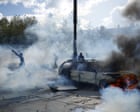
A clear illustration of this mechanism appears on days when marches begin peacefully or include cultural elements in public squares, only for tear gas and street clashes to erupt along adjacent thoroughfares or later in the day. To an observer watching a single camera feed, the entire event looks like a riot. To an analyst tracking spatial movement, the riot occupies a fraction of the footprint while imposing disproportionate physical and political costs on everyone else.
The Measurement and Coercion Feedback Loop
Why do crowd numbers routinely clash between police prefectures and union organizers, and why do bans and curfews sometimes calm one street while inflaming another? The answer lies in a measurement and coercion feedback loop.
Crowd estimation is inherently contested because actors measure different phenomena under different constraints. Police authorities generally count people passing specific checkpoints or marching along approved segments at given intervals, excluding dispersed groups or unapproved side gatherings. Organizers frequently aggregate estimates across multiple cities, count marchers who join or peel off along the route, or project total turnout rather than static peak density. When a protest spans dozens of municipalities simultaneously, methodological differences alone can produce wide numerical gaps.
Yet those numbers are not passive statistics; they feed directly into tactical decisions by both state officials and protest organizers:
- Pre-event risk pricing: Authorities weigh prior clash intensity, intelligence on confrontational groups, and administrative bans or curfews to decide deployment size, perimeter rules, and use-of-force posture.
- Tactical friction on the ground: Strict bans on routes or school-adjacent gatherings can deter casual attendees while concentrating determined protesters and confrontational actors into tighter flashpoints.
- Post-event blame attribution: High arrest counts, officer injuries, protester injuries, and damaged buildings become ammunition in public debates over whether policing was "proportionate" or "excessive," or whether political rhetoric stoked confrontation.
- Next-cycle mobilization: Perceived heavy-handedness or unresolved grievances can bring fresh participants out for the next mobilization day, even if overall turnout fluctuates from week to week.
This loop has sharp operational limits for both sides. Heavy force can clear streets and protect key buildings in the short term, but frequent chemical dispersal and broad bans risk alienating moderate demonstrators and eroding institutional legitimacy. At the same time, permissive policing invites commercial looting, arson, and severe injuries to officers and citizens alike, which rapidly turns public opinion against the demonstrators. Neither pure containment nor pure restraint solves the underlying structural tension on its own.
The Electoral Polarization Multiplier
Street unrest in France rarely stays confined to administrative policy; it acts as a polarization multiplier in national politics. When governments appear squeezed between fiscal or institutional constraints and broad street opposition, political poles gain leverage at the expense of the center.
The mechanism works across rival camps simultaneously:
- Nationalist and hard-right forces can frame disorder, commercial damage, and public-service strain as proof of state weakness and lawlessness, consolidating voters who prioritize order and border or identity restrictions.
- Hard-left movements can channel youth frustration, anti-austerity sentiment, and opposition to the government or the far right into organized street presence and anti-establishment alignment.
- Incumbents and centrist executives face a narrow corridor: concessions meant to calm students or workers risk being labeled as capitulation under pressure, while firm law-and-order measures risk drawing accusations of authoritarian overreach.
A second limitation of street-driven politics is agenda distortion. When violent clashes dominate evening broadcasts, policy disputes over teacher staffing, classroom conditions, or public-sector pay compression get crowded out by images of burning barricades, shattered glass, and riot gear. Movement organizers who rely on mass street pressure face a persistent strategic dilemma: large crowds confer bargaining power, but repeated fringe violence damages the public sympathy required to win durable policy concessions.
Operational Playbook for Analysts, Executives, and Policymakers
Evaluating ongoing French street mobilization requires moving from headline tracking to structured monitoring and risk management.
Step 1: Audit Every Claim by Scope and Source
Separate localized incidents from national trends. Check whether a figure refers to a single city or nationwide totals, whether it comes from police prefectures, union tallies, independent event trackers, or local officials, and whether injuries or arrests occurred during a permitted march, a banned gathering, or post-march clashes.
Step 2: Map Grievances Against Concession Thresholds
Track which coalition demands can be met through administrative or budgetary adjustments versus which ones are purely political. Targeted reforms—such as school staffing, timetable or admissions adjustments, or narrow pay measures—can peel away single-issue participants even when broader political hostility persists.
Step 3: Stress-Test Operations Around Transit and Commercial Nodes
For businesses, logistics operators, and institutions, primary risk usually clusters around transit hubs, major squares, university and high-school corridors, and high-visibility retail districts rather than uniform citywide shutdowns. Build contingency routing, flexible hours, and physical security checks around mobilization dates and ban announcements.
Step 4: Account for Counter-Measures and Unintended Side Effects
Every security or communication move carries trade-offs. Tighter perimeter bans and curfews can reduce looting in protected zones while shifting friction elsewhere; harsh rhetoric can rally base supporters while hardening opposition among students and unions. Factor second-order reactions into any forecast or operational plan.
The sharpest strategic move for decision-makers tracking or operating amid this unrest is to decouple crowd-size headlines from risk and policy forecasts, and instead monitor three leading indicators ahead of each mobilization cycle: whether union bargaining talks produce concrete concessions, where spatial bans or curfews compress crowd movement, and whether fringe clashes eclipse core economic and educational grievances.