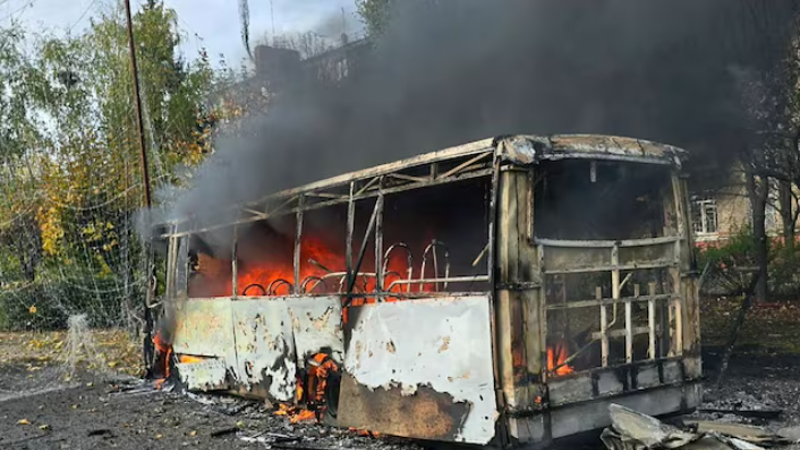
The kinetic mechanics of modern urban conflict dictate that population density operates as a primary multiplier of collateral impact. When high-explosive ordnance is deployed against infrastructure hubs within contested population centers, the resulting casualty metrics reflect predictable geometric and structural variables rather than random variance. Evaluating events such as the missile strike in Kostiantynivka requires a systematic breakdown of urban vulnerability factors, ordnance physics, and strategic targeting trade-offs.
The Structural Vulnerability of Commercial Nodes
Urban strongholds in protracted conflicts frequently maintain localized economic and social nodes—such as central markets or transit hubs—that concentrate civilian foot traffic during daylight hours. From a tactical standpoint, these locations represent high-density spatial zones where fixed infrastructure intersects with high human occupancy rates.
When analyzing the physics of high-explosive munitions detonating in confined or semi-open public spaces, three primary variables determine the severity of personnel loss:
- Overpressure Wave Propagation: In open-air markets flanked by low-rise buildings, shockwaves reflect off masonry and asphalt, compounding the peak overpressure experienced by human targets. This secondary reflection dramatically increases primary blast injuries, including pulmonary barotrauma and internal hemorrhaging.
- Fragmentation Lethality: Traditional high-explosive warheads release hundreds of high-velocity metal fragments designed to defeat unarmored personnel. In densely populated commercial settings, the lack of immediate subterranean or reinforced concrete cover eliminates shielding options, maximizing the effective lethal radius of shrapnel.
- Secondary Structural Collapse: Impacts near commercial structures often induce partial collapses of roofs, awnings, and load-bearing walls, converting building materials into secondary projectiles and trapping survivors in restricted egress zones.
The Attrition Calculus in Contested Zones
In protracted territorial disputes, the application of standoff firepower against urban centers serves distinct strategic functions that extend beyond immediate tactical engagement. Understanding the underlying operational logic requires examining the resource allocation and risk management models employed by belligerents.
Resource Allocation and Precision Constraints
The deployment of long-range precision-guided munitions represents a significant capital expenditure for any military force. When strikes occur in civilian-dense areas adjacent to active frontlines, analysts must assess whether the target represents an operational node (such as logistics staging, command nodes, or troop concentrations) or if the outcome stems from systemic targeting error, equipment drift, or deliberate coercion through population attrition.
The Feedback Loop of Urban Displacement
High-casualty incidents in regional hubs accelerate demographic shifts, straining municipal infrastructure in destination zones while degrading the host nation's economic output. The destruction of local commercial distribution networks disrupts food security and medical access, creating cascading secondary effects that compound the initial kinetic impact.
Strategic Forecasting and Urban Resilience Metrics
Mitigating civilian vulnerability in high-density conflict zones requires decentralizing critical civic infrastructure and enforcing early-warning dissemination protocols that account for modern missile flight times. As long-range strike capabilities continue to evolve, urban defense strategies must shift toward hardening public gathering spaces and establishing modular distribution networks to minimize the concentration index of non-combatant populations.