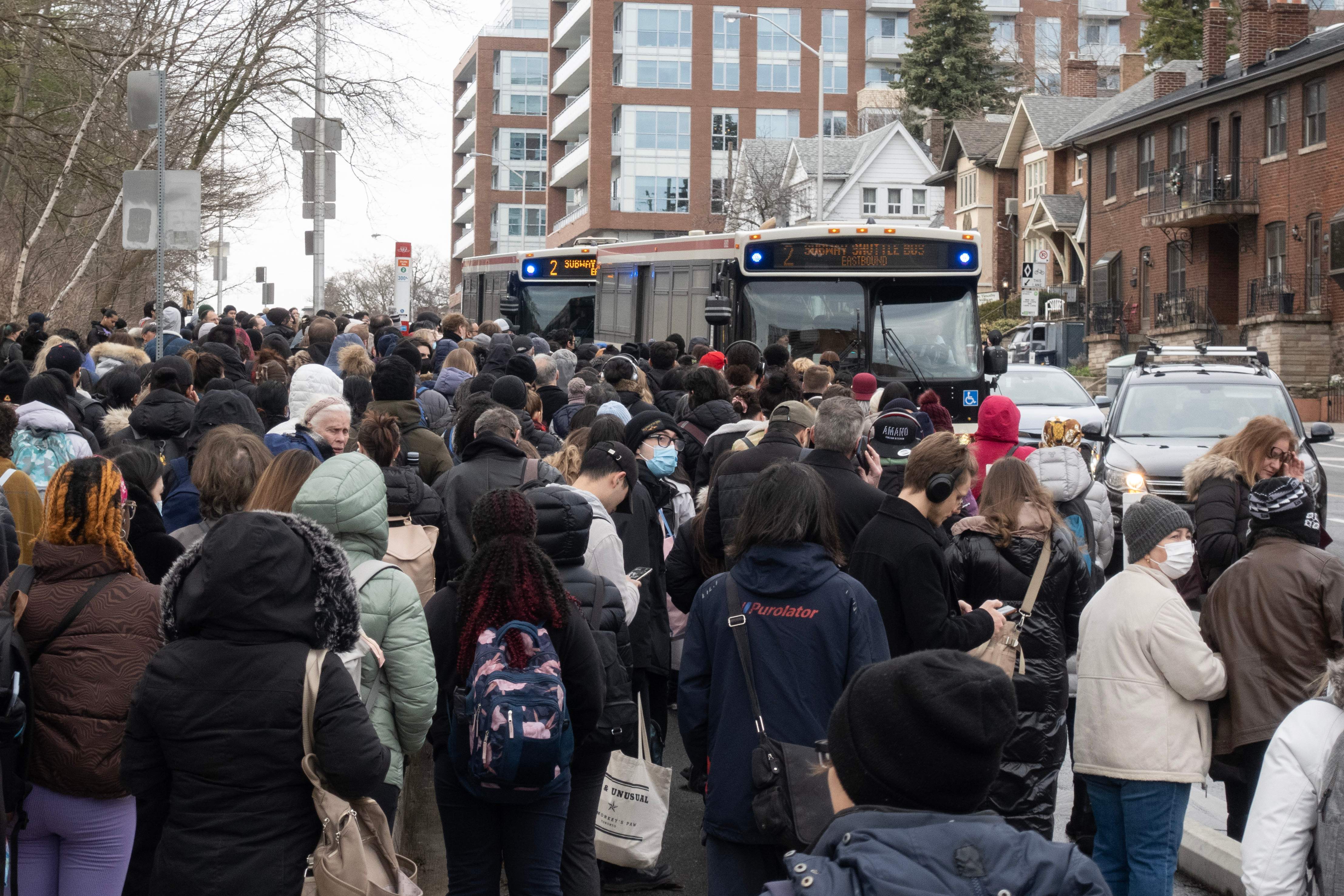
The operational integrity of a Tier-1 mass transit system rests on the predictable execution of the Triple-A Framework: Availability, Accessibility, and Accountability. When the Toronto Transit Commission (TTC) experienced a cascading failure following a localized "subway spill," the subsequent service paralysis was not a random occurrence of bad luck. It was the mathematical inevitability of a system operating at the edge of its safety margins with insufficient redundancy protocols. While a public apology addresses the political fallout, it fails to address the underlying engineering and logistical bottlenecks that turned a minor janitorial or mechanical incident into a city-wide economic drain.
The Cascade Mechanism of High-Density Transit
A transit system functions as a series of interconnected nodes and links. In a radial network like Toronto's, the loss of a single central link (a "spill" or track obstruction) does not merely stop one train; it triggers a back-pressure wave across the entire line. This phenomenon, known as Network Shunting, occurs because the system lacks the physical bypass tracks necessary to divert high-frequency traffic around a stationary hazard.
- The Point of Ignition: A localized incident (the spill) necessitates an immediate power cut to the third rail for safety protocols.
- The Buffer Exhaustion: Once power is cut, trains behind the incident site consume their "headway buffer." Within six minutes of a peak-hour stoppage, three to five trains—carrying upwards of 5,000 passengers—become immobile between stations.
- The Surge Load: As stations are evacuated, the demand shifts instantaneously to the surface bus network. Toronto’s bus infrastructure is not dimensioned to absorb a 1,000% instantaneous increase in passenger volume from a crippled subway line.
The Economic Cost Function of Commuter Chaos
The apology issued by transit leadership often misses the quantifiable reality of lost productivity. If we model the "chaos" using a standard Value of Time (VoT) metric, the true cost of the spill exceeds the internal repair costs by several orders of magnitude.
Assuming a conservative average hourly wage of $35 CAD and a delay affecting 100,000 commuters for an average of 45 minutes, the direct productivity loss to the Toronto economy sits at roughly **$2.6 million per hour of disruption**. This figure excludes the "Second-Order Externalities":
- Increased fuel consumption and emissions from idling ride-share vehicles.
- The opportunity cost of missed medical appointments and delayed logistics deliveries.
- Long-term brand erosion, where discretionary riders switch to private vehicles, increasing permanent road congestion.
The apology operates in the realm of sentiment; the data operates in the realm of capital. A system that cannot guarantee a 99.5% uptime during peak hours acts as a tax on the city’s GDP.
Infrastructure Fragility and the Maintenance Gap
The incident highlights a critical divergence between Corrective Maintenance (fixing things when they break) and Reliability-Centered Maintenance (RCM). A spill that causes "chaos" suggests a failure in the containment and rapid-response protocols.
In a high-reliability organization (HRO), a spill is categorized by its chemical or physical properties immediately. If the TTC's response required a protracted shutdown, it indicates a lack of on-site specialized response units at strategic "hot-nodes."
The Physical Constraints of the Yonge-University Line
The Yonge-University line serves as the central nervous system of Toronto. Its design—largely a legacy of mid-century engineering—suffers from Throughput Inelasticity.
- Signal Bottlenecks: Even with the transition to Automatic Train Control (ATC), the physical distance between crossover tracks limits the ability of the control center to "short-turn" trains.
- Station Morphology: Older stations lack the platform width to handle the "crowd turbulence" that occurs when service is suspended. This creates a secondary safety risk: platform overcrowding that prevents emergency personnel from reaching the original incident site.
The Cognitive Dissonance of Transit Accountability
The act of apologizing is a strategic move to de-escalate public frustration, but in a technical context, it is a substitute for Root Cause Analysis (RCA). True accountability in transit management requires a public disclosure of the Mean Time to Recovery (MTTR) metrics.
Why did the "spill" take as long as it did to clear?
- Factor 1: Communication Latency. The delay between the sensor trigger (or operator report) and the deployment of specialized crews.
- Factor 2: Equipment Availability. The proximity of vacuum or chemical neutralization units to the central business district.
- Factor 3: Regulatory Friction. The time required for safety inspectors to sign off on track integrity before the third rail is re-energized.
Without quantifying these three factors, an apology is merely a PR shield against structural criticism.
The Surface Transit Failure Loop
When the subway fails, the "Shuttle Bus" strategy is the default recovery mode. However, this strategy is mathematically flawed in a dense urban core. To replace a single six-car Rocket subway train, you require approximately 15 to 18 articulated buses. During a major disruption, replacing the capacity of the subway would require 200+ buses—a fleet size that the TTC cannot mobilize without stripping service from every other neighborhood in the city.
This creates the Commuter Hunger Games:
- Subway passengers dump onto the street.
- Bus capacity is reached within seconds.
- Ride-share pricing surges (Dynamic Pricing Elasticity), further penalizing low-income commuters.
- The sheer volume of people on the street creates "Pedestrian Gridlock," preventing the very shuttle buses meant to save them from reaching the station entrance.
Operational Redundancy as a Strategic Priority
To prevent a repeat of the subway spill fallout, the strategy must shift from "Apology and Absolution" to "Redundancy and Resilience." This requires three specific technical investments:
- Hardened Infrastructure: Installing physical barriers or improved drainage/containment systems in high-risk zones (curves, stations with high debris accumulation).
- Decentralized Response Units: Positioning "Rapid Recovery Teams" at Bloor-Yonge, St. George, and Union stations during peak hours, equipped with industrial-grade clearing equipment.
- Dynamic Information Systems: Moving beyond vague "major delay" announcements toward real-time, data-driven routing that integrates with third-party navigation apps to divert commuters before they enter the station.
The TTC's current model relies on the patience of the passenger. In a data-driven economy, patience is a depreciating asset. The transition from a reactive "apology" culture to a proactive "resilience" culture is the only path to maintaining Toronto's status as a functional global hub.
The next operational step is not a policy review but a Stress-Test Simulation: the TTC must model a "Total Node Loss" at Union Station during a Tuesday morning peak and publicly release the recovery timeline. Only when the "Time to Resumption" is treated as a hard SLA (Service Level Agreement) will the system move beyond its current state of fragile equilibrium.



