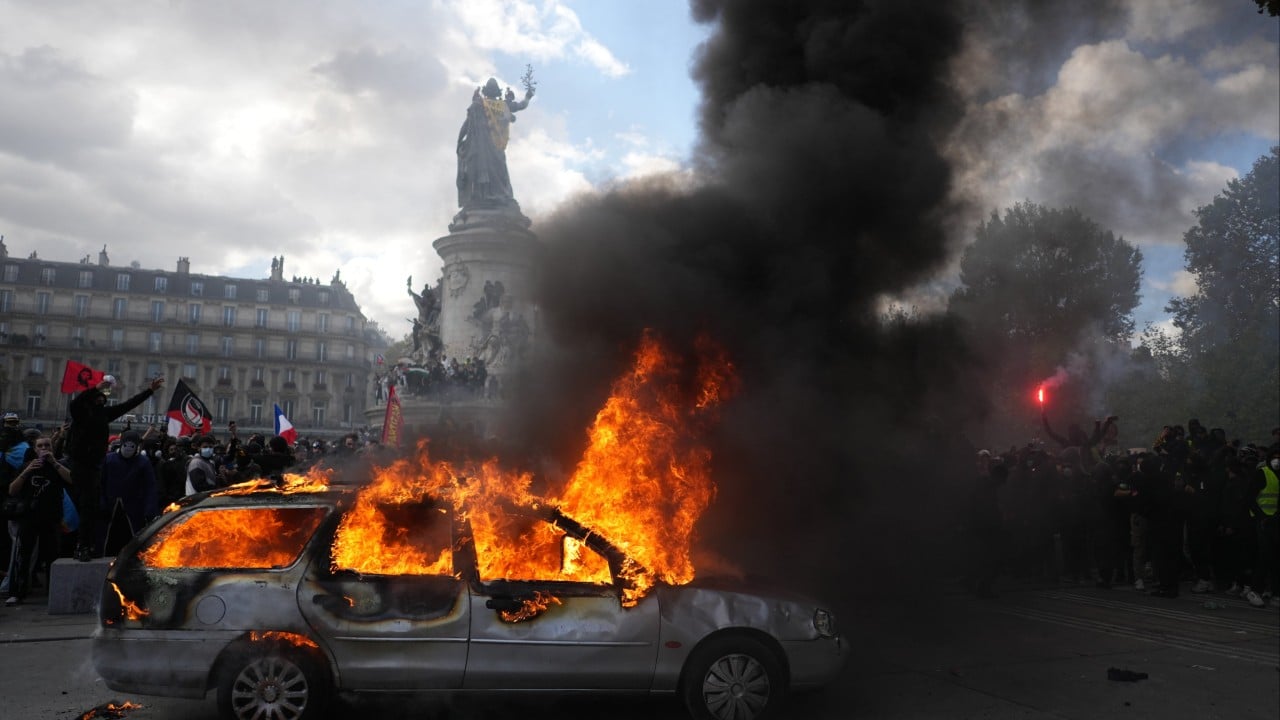
Civil unrest is rarely an isolated combustion of sudden anger; it is the physical output of structural stress within a state's economic and political architecture. When widespread riots overwhelm municipal boundaries and force a government to augment conventional law enforcement with military assets, the response signals a critical failure in public-order administration. Deconstructing the French civil unrest requires looking past the surface volatility of street-level clashes and examining the systemic variables driving the friction between the state, the civilian population, and security apparatuses.
The operational breakdown during high-intensity protests stems from three distinct system failures. First, tactical rigidity within police deployment models creates vulnerability. Traditional crowd control strategies rely on static defense lines and containment perimeters. When insurgent groups or decentralized rioters adopt fluid, highly mobile swarm tactics across multiple urban centers simultaneously, static units lose operational effectiveness. The inability to project force dynamically across decentralized zones allows localized looting and property destruction to outpace police response times. Learn more on a similar issue: this related article.
Second, intelligence asymmetry distorts risk assessment. State authorities frequently misjudge the convergence of distinct interest groups—such as student collectives protesting educational infrastructure deficits and economic coalitions mobilizing against cost-of-living pressures—treating them as isolated vectors rather than a unified compounding force. When intelligence agencies fail to map the velocity of social media mobilization, operational planners schedule routine leave and baseline deployments that are fundamentally misaligned with actual threat levels.
Third, the economic multiplier effect places immediate pressure on public infrastructure and private capital. Widespread asset destruction, targeted arson of municipal buildings, and extensive retail looting generate shockwaves through commercial supply chains and investor confidence. The resulting capital flight and risk premium adjustments, reflected in sovereign bond yield movements, demonstrate that physical urban disorder immediately translates into macroeconomic instability. Further analysis by Associated Press highlights related perspectives on the subject.
To counteract these systemic vulnerabilities, the French state adjusted its operational doctrine by integrating military personnel into a supporting framework. Soldiers are deployed not to engage or confront protestors directly, but to assume static protective duties around critical infrastructure and government installations. This redistribution of personnel frees specialized mobile gendarmerie and elite tactical units to focus exclusively on high-mobility intervention and counter-disorder operations.
However, this military augmentation introduces its own operational constraints. Utilizing military forces within domestic borders risks heightening civilian friction and altering the political signaling of the state. The reliance on armor-backed vehicles, surveillance assets, and heavy-duty crowd dispersal equipment reflects a shift from administrative policing to a higher threshold of state containment.
The trajectory of state stability under these conditions depends on the government's ability to transition from reactive force projection to structural mitigation. Resolving the crisis requires addressing the core economic grievances—ranging from fuel taxation and purchasing power erosion to public service funding—that sustain popular mobilization. Without structural adjustments to these underlying economic pressures, enhanced security deployments serve merely as a temporary containment mechanism, deferring rather than resolving the systemic volatility embedded within the state's political economy.