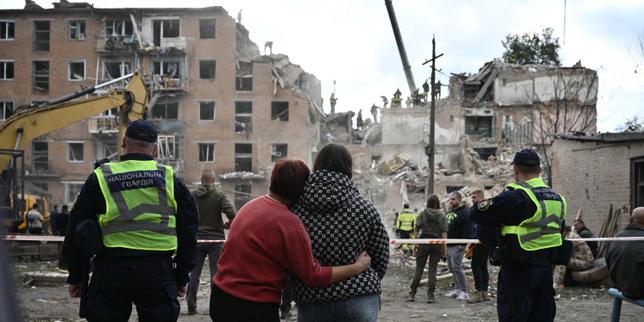
Mass aerial bombardment operations function through predictable economic and logistical equations rather than arbitrary acts of destruction. When a state executes coordinated missile and drone saturation strikes against national infrastructure, the operational objective extends beyond immediate kinetic damage. The strategic mechanism relies on forcing the defender to allocate scarce interceptor assets, destabilize industrial supply chains, and absorb systemic psychological friction. Evaluating these campaigns requires dismantling the operation into three core variables: resource expenditure asymmetry, infrastructure node vulnerability, and cumulative societal friction cost.
The Asymmetry of Interception Economics
The foundational metric governing modern strategic strikes is the cost differential between the offensive delivery system and the defensive interception mechanism. Advanced air defense systems utilize precision-guided interceptor missiles that require microelectronics, high-tolerance rocket motors, and complex tracking radar. Conversely, mass-produced long-range loitering munitions and cruise missiles often substitute exquisite engineering for volume, utilizing commercial-grade navigation components and standardized airframes.
When a defender deploys a high-value surface-to-air missile to neutralize an inexpensive incoming vector, an immediate economic drain occurs. The defender faces a forced choice governed by the conservation of interceptor inventory. If the defender fires, they deplete strategic reserves that take years to manufacture. If the defender withholds fire to conserve inventory, the kinetic impact hits critical infrastructure. This economic friction creates a structural depletion rate that operational planners monitor as closely as battlefield territorial shifts.
Infrastructure Node Interdependence
Target selection during intensive air campaigns does not target random urban centers; it focuses on systemic nodal choke points. Electrical grids, fuel distribution networks, and railway switching yards operate as interdependent networks. When a precision strike disables a high-voltage transformer substation or a regional fuel storage facility, the disruption cascades across multiple sectors.
The vulnerability of an infrastructure network is a function of its redundancy and repair latency. Modern electrical grids rely on centralized step-down transformers that require specialized manufacturing processes. When these specific nodes sustain structural damage, the replacement timeline is measured in months, not days. The defender's mitigation strategy relies on decentralization, mobile backup generators, and rapid reconfiguration of transmission paths. However, when the frequency of strikes outpaces the repair capacity of engineering teams, a permanent state of functional degradation sets in, shifting the target from temporary disruption to sustained operational paralysis.
The Logistics of Civil Resilience
Beyond the industrial and military calculus lies the human element of strategic campaigns: civil resilience and societal friction. Sustained campaigns against municipal utilities aim to overwhelm the municipal coping capacity. Water treatment facilities, heating networks, and communication grids maintain the baseline operational tempo of a civilian workforce.
When these services fail simultaneously during cold weather or high-stress periods, the secondary effects compound exponentially. Medical facilities shift to emergency power generation, administrative functions slow down due to communications loss, and domestic displacement strains regional housing markets. The defender must continuously divert labor and heavy machinery from frontline logistics to rear-area reconstruction and emergency response. This resource diversion acts as a hidden tax on the defender's gross domestic product and mobilization capacity.
The Operational Horizon
The trajectory of widespread kinetic strikes points toward an automated future where electronic warfare, swarm logic, and decentralized launch platforms dictate campaign outcomes. Defenders can no longer rely on static fortifications or passive concealment alone. Survival in a high-attrition aerospace environment requires active electronic deception, hardened micro-grids, and deeply buried or mobile redundancy for all critical national assets. The campaign ceases to be a contest of raw explosive power and becomes an uncompromising test of industrial capacity and systemic adaptability.