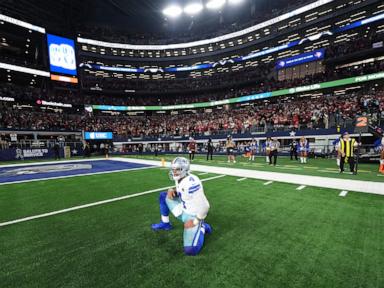
Quarterback efficiency operates on a diminishing marginal return curve when paired with a structurally compromised defensive unit. In Dallas, Dak Prescott’s high-volume touchdown production masks an underlying mathematical reality: an offense forced into permanent pass-heavy game scripts cannot sustain a positive expected points added (EPA) differential against competent opposition. When a defense surrenders explosive plays and fails to generate third-down stops, the offensive coordinator loses access to the entire playbook, compressing the margin for error on every snap until variance inevitably forces a turnover or a stalled drive.
The Asymmetry of Scoring Efficiency and Possession Volume
Standard sports commentary treats football games as simple additive equations where three touchdown passes from a franchise quarterback should equal a victory. This view ignores the mechanics of possession efficiency and time of possession. In modern NFL architecture, winning requires maximizing points per drive while minimizing the opponent’s opportunities to possess the ball. Recently making news in related news: Why the Jacksonville Jaguars 30-Point Scoring Streak Actually Matters.
When the Dallas defense fails to contain the run or collapse the pocket, opposing offenses dictate the tempo. They execute sustained, multi-play drives that drain clock and physically exhaust the defensive front seven. By the time Prescott and the offensive unit return to the field, the game state has shifted. A seven-point deficit in the second quarter forces a subtle departure from balanced play-calling; a fourteen-point deficit in the third quarter eliminates the rushing attack entirely.
This creates a feedback loop of offensive predictability. Opposing defensive coordinators recognize the game script immediately. They drop seven defenders into zone coverage, pin their defensive ends' ears back to rush the passer without concern for play-action fakes, and force Prescott to throw into tightening windows. Even when Prescott executes at an elite level—delivering accurate, high-difficulty throws for touchdowns—the structural strain remains unsustainable. Every scoring drive requires ten to twelve plays of precise execution, whereas the opposing offense scores in four to six plays due to blown assignments and missed tackles in the secondary. More details into this topic are explored by FOX Sports.
Deconstructing the Defensive Failure Mechanisms
A porous defense rarely stems from a single point of failure. Instead, it represents a cascading breakdown across three distinct operational layers: gap integrity at the line of scrimmage, pass-rush containment, and secondary communication.
First-Down Run Defense and Early Down Leverage
The primary catalyst for Dallas’s defensive collapse occurs on first down. When an opposing offense consistently gains five or more yards on first down, they enter second-and-manageable situations. This invalidates the pass rush. Defensive tackles cannot shoot gaps aggressively if they must read blocking schemes to prevent interior gashes. Linebackers are forced to step forward to fill running lanes, which vacates the intermediate zones over the middle of the field.
Once a defense loses early-down leverage, the offensive play-caller gains complete optionality. Play-action passes become lethal because the linebackers must honor the run threat. Prescott is then forced to watch from the sideline as opposing quarterbacks hit wide-open receivers on crossers and seams without facing meaningful pressure.
Pass-Rush Integrity Versus Over-Pursuit
Pass rushing is an exercise in disciplined geometry, not merely raw speed. A common operational flaw in struggling defenses is edge over-pursuit. When defensive ends rush upfield past the depth of the quarterback without maintaining outside containment, they create massive B-gap and C-gap escape lanes.
Modern quarterbacks exploit these lanes effortlessly. If an interior defensive tackle fails to push the pocket vertically, the quarterback steps up into the vacated space, extends the play, and allows secondary routes to break open downfield. No defensive backfield in professional football can cover elite wide receivers for five or six seconds. The touchdown passes Prescott throws on offense are negated because the defense grants opposing quarterbacks infinite time to operate within broken pockets.
Communication Breakdowns in Pattern-Match Coverage
Modern NFL defenses rely heavily on pattern-match zone concepts, where defenders adjust their coverage responsibilities based on the release and stem of the receivers. This system requires instantaneous verbal and non-verbal communication between safeties, cornerbacks, and nickel defenders.
When a defense is porous, it usually exhibits hesitation at the point of route distribution. Two defenders pass off a receiver into empty space, or both jump the underneath route while leaving the deep third unprotected. These mental errors result in explosive plays—gains of twenty yards or more—which directly correlate with scoring drives. Giving up three explosive plays in a single half almost guarantees a loss, regardless of how efficiently the offense operates in the red zone.
The Salary Cap Allocation Bottleneck
Understanding why Prescott’s production cannot rescue the defense requires examining the economic constraints of the NFL’s hard salary cap. Roster construction is a zero-sum capital allocation problem. Every dollar committed to a market-setting quarterback contract and elite wide receiver compensation is a dollar unavailable for defensive line depth, premier cornerbacks, or veteran linebackers.
- Top-Heavy Capital Distribution: Allocating over forty percent of the total salary cap to three or four offensive players creates an immediate talent deficit on the other side of the ball. The front office must fill defensive roster spots with rookie contracts, mid-tier free agents, and aging veterans on minimum deals.
- The Depth Attrition Problem: An NFL season is a war of attrition. A starting defensive lineup built on thin margins might look adequate in September, but by November, injuries force rotational backups into high-leverage snaps. Because the capital was spent on offensive star power, the drop-off between the first-string defensive tackle and the backup is catastrophic.
- The Expectation of Perfection: When a franchise pays a quarterback at the top of the market, the implicit organizational strategy is that the quarterback will elevate replacement-level talent and outscore defensive deficiencies. However, football is too high-variance a sport for this model to hold across a seventeen-game schedule and a four-game postseason tournament.
Why Quarterback Touchdowns Are a Flawed Metric for Team Health
Evaluating a team’s competitiveness based on quarterback touchdown totals introduces severe selection bias. Touchdowns thrown while trailing by multiple scores often occur against soft preventative coverages designed to concede underneath yardage in exchange for running time off the clock.
- Garbage-Time Distortion: Defenses leading by two touchdowns in the fourth quarter willingly surrender eight-yard completions in the middle of the field. This inflates a quarterback’s completion percentage, yardage, and touchdown totals while actually lowering the trailing team’s win probability by consuming precious seconds.
- Red-Zone Compression: When an offense must constantly throw to keep pace, red-zone efficiency eventually regresses. Inside the twenty-yard line, the field shrinks vertically, eliminating deep threats and allowing defenders to sit on short routes. Without a dominant rushing attack to threaten the goal line, Prescott is forced to thread needles into dense traffic, increasing the probability of deflected passes and interceptions.
- The Turnover Margin Imperative: Teams with bad defenses must win the turnover battle by at least plus-two to overcome their yardage deficits. Yet, forcing the quarterback to throw forty-five times a game mathematically increases exposure to strip-sacks and tipped balls. The very strategy required to keep pace—high-volume passing—directly undermines the turnover margin needed to survive.
Operational Mechanics of a Game Script Collapse
To see how these variables interact in real time, trace the trajectory of a typical loss where Prescott throws three touchdown passes yet leaves the stadium defeated.
The game begins with Dallas receiving the kickoff. Prescott engineers a crisp, ten-play drive, mixing short passes with occasional runs, culminating in a touchdown. The offense looks unstoppable.
On the ensuing possession, the opponent runs the ball twice for twelve yards, establishing early leverage. On third-and-two, the Dallas linebackers bite on a play-action fake, surrendering a thirty-five-yard completion down the seam. Three plays later, the opponent scores a touchdown, matching Dallas’s effort in half the time.
By the second quarter, the pattern solidifies. Dallas’s second drive stalls at midfield after a holding penalty puts them behind the chains—a common symptom when offensive linemen must pass-block indefinitely. The opponent responds with another methodical, eight-minute touchdown drive, exploiting missed tackles on screen passes and poor edge containment on quarterback scrambles.
At halftime, the score is tied or Dallas trails by a touchdown. Prescott’s box score looks pristine: high completion rate, two touchdown passes, zero interceptions. However, the defensive front seven has already logged forty snaps. Their pass-rush get-off slows by fractions of a second in the third quarter.
Now trailing by ten points, the Cowboys abandon the run entirely. Prescott drops back on twelve consecutive plays. He delivers a brilliant third touchdown pass to cut the deficit to three, demonstrating elite arm talent and pocket presence. Yet, the defense returns to the field exhausted and structurally outmatched. They immediately surrender a sixty-yard touchdown drive that burns six minutes off the fourth-quarter clock. Prescott gets the ball back with ninety seconds remaining, no timeouts, and eighty yards of field ahead of him, forced to attempt low-probability deep shots against a defense playing pure prevent. The final interception seals a loss that the box score will inaccurately attribute to a late quarterback mistake rather than sixty minutes of defensive insolvency.
Limitations of Mid-Season Tactical Adjustments
Once a team enters the regular season with this structural imbalance, the coaching staff possesses limited levers to pull. You cannot manufacture elite interior defensive line anchor strength through scheme alone, nor can you teach veteran safeties recovery speed they no longer possess.
- The Blitzing Trap: Defensive coordinators often respond to poor base-rush pressure by dialing up heavy blitz packages. While this occasionally generates a sack, it leaves vulnerable cornerbacks in zero-coverage situations. Against elite quarterbacks, blitzing a bad secondary simply accelerates the rate at which explosive touchdowns are surrendered.
- Ball-Control Offense: The offensive staff might attempt to protect the defense by slowing the tempo and running the ball into stacked boxes. This strategy fails because it willingly takes the ball out of the hands of the team's highest-paid, most efficient asset—Prescott—and relies on low-efficiency rushing plays, leading to three-and-outs that put the exhausted defense right back on the field.
- Personnel Shuffling: Benchings and practice-squad elevations rarely yield immediate dividends. Defensive cohesion relies on rep-based familiarity. Swapping out linebackers or safeties mid-season often exacerbates communication errors in pattern-match coverages, trading physical limitations for mental busts.
Strategic Realignment for the Front Office and Coaching Staff
If the Dallas Cowboys intend to convert Dak Prescott’s prime passing years into championship contention rather than hollow statistical milestones, the organization must execute a deliberate structural pivot. Relying on the quarterback to throw four touchdowns every Sunday is not a viable operational model; it is an admission of roster failure.
First, the offensive play-calling must decouple from traditional balance metrics and embrace early-down passing efficiency to build leads, rather than waiting until the defense falls behind. If the defense cannot hold leads, the offense must treat every first-quarter possession with fourth-quarter urgency, using tempo and spread formations to force opponents out of their run-heavy game scripts early.
Second, the defensive coordinator must abandon complex pattern-match coverages that the current personnel cannot execute cleanly, shifting instead to static, shell-based two-high safety structures. This concedes underneath rushing and short passing yards intentionally, forcing opposing offenses to execute twelve-to-fifteen-play drives without making a mistake. By eliminating explosive plays, the defense compresses the game, reduces total possessions, and forces opponents to win in the tight red zone rather than scoring from fifty yards out.
Finally, in the upcoming offseason cycle, capital allocation must swing aggressively toward the defensive interior. Regardless of draft board value or offensive allure, every premium draft pick and available cap dollar must be directed at acquiring space-eating nose tackles and disciplined edge setters. Until the front four can stop the run with a light box and generate pressure without blitzing, Dak Prescott’s touchdown passes will remain expensive decorations on a fundamentally broken competitive model.