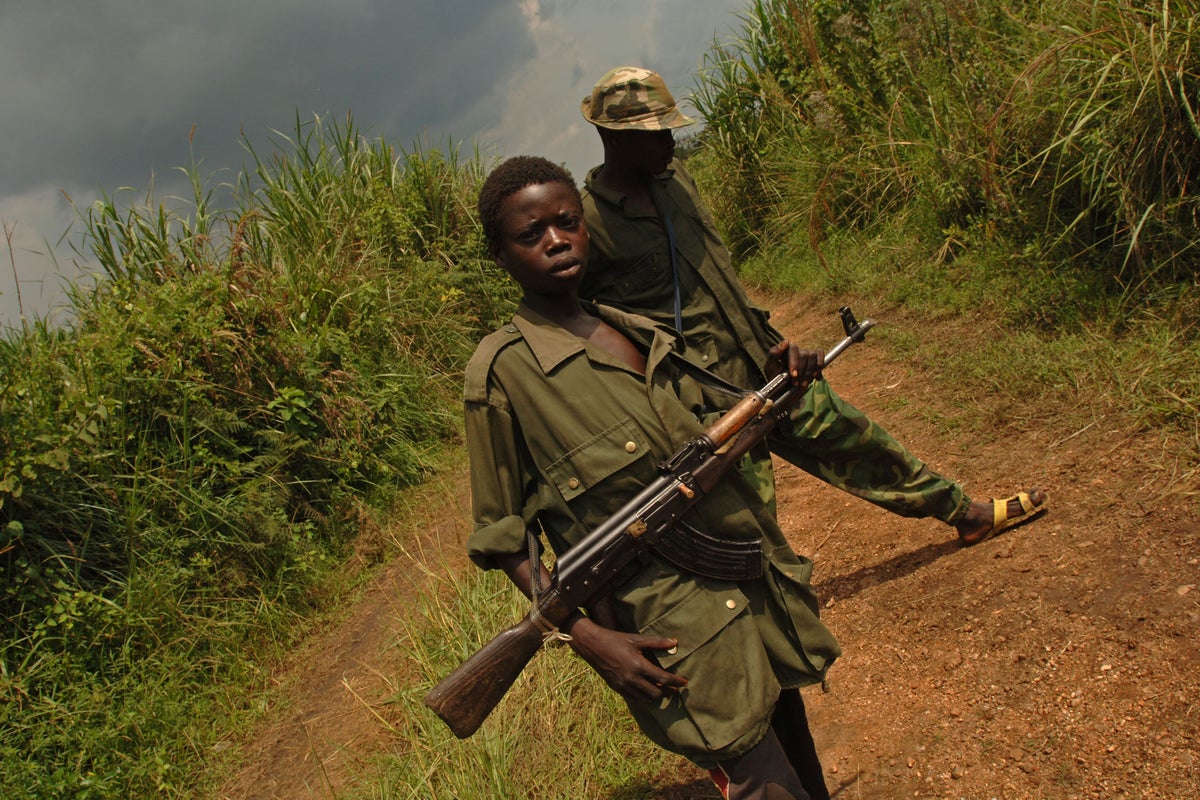
The persistent utilization of child soldiers in the Democratic Republic of the Congo (DRC) is not a chaotic byproduct of war but a calculated operational choice driven by the intersection of demographic surplus, failed state architecture, and the low-cost acquisition of coercive power. While humanitarian narratives focus on the moral degradation of the practice, an analytical deconstruction reveals that armed groups—specifically the M23, CODECO, and various Mai-Mai factions—treat children as high-utility, low-maintenance human capital. This exploitation functions through a predictable lifecycle: predatory recruitment, psychological conditioning via trauma-induced compliance, and deployment as expendable front-line assets.
The Recruitment Calculus: Supply and Demand Dynamics
The recruitment of children in the eastern DRC operates on a structural incentive model. The "supply" side is populated by a youth-heavy demographic where 45% of the population is under the age of 15, living in an environment where the state has effectively abdicated its monopoly on violence and social services. If you liked this piece, you should check out: this related article.
The Vulnerability Index
Recruitment success relies on three primary variables:
- Economic Insolvency: In regions where subsistence farming is disrupted by mineral extraction or conflict, the armed group becomes the sole provider of caloric intake.
- Security Vacuum: When the FARDC (Forces Armées de la République Démocratique du Congo) fails to provide localized protection, joining a militia becomes a defensive survival strategy rather than an ideological choice.
- Educational Displacement: The destruction of school infrastructure removes the primary institutional competitor for a child's time and loyalty.
From an operational standpoint, children are "cheap" assets. They require fewer calories than adult soldiers, are more susceptible to ideological molding, and possess a lower threshold for risk-assessment, making them ideal for high-casualty maneuvers. For another angle on this story, see the latest update from NPR.
The Mechanism of Atrocity: Engineering the Child Combatant
The transformation of a civilian child into a combatant requires the systematic breaking of social and moral constraints. This is not achieved through training alone but through a "trauma-bond" framework designed to make the child’s return to civilian life impossible.
The Logic of Forced Complicity
Commanders frequently force new recruits to commit acts of violence against their own communities or families. This serves a dual strategic purpose. First, it creates an immediate legal and social barrier between the child and their home, effectively "burning the bridge" to their former life. Second, it shifts the child’s identity from victim to perpetrator, a psychological pivot that ensures total dependence on the militia for protection and belonging.
Functional Roles and Utility
Children are not only utilized as frontline infantry. Their utility is diversified across the militia’s "value chain":
- Tactical Intelligence: Small physical profiles allow children to move through government-controlled areas unnoticed as scouts or couriers.
- Logistical Support: Children function as the primary labor force for transporting equipment and looted resources through difficult terrain where mechanized transport is impossible.
- Psychological Warfare: The use of children on the front lines creates a "hesitation gap" for professional soldiers or UN peacekeepers (MONUSCO), who may hesitate to fire upon minors, providing a tactical window for adult commanders.
The Cost Function of Infinite War
The conflict in the DRC is often termed "endless" because the cost of maintaining a child-based militia is lower than the cost of peace for the leadership. This is a classic "principal-agent" problem where the commanders (principals) reap the rewards of mineral control while the children (agents) bear 100% of the kinetic risk.
The Mineral-Violence Feedback Loop
The extraction of coltan, gold, and tin provides the liquidity necessary to sustain these groups. The logic follows a circular path:
- Control of a mining site provides revenue.
- Revenue is used to procure small arms and basic rations.
- Rations and arms are used to "recruit" and retain child labor to secure more territory.
This creates a self-sustaining ecosystem where the "labor" (the children) is self-replenishing through the ongoing displacement caused by the conflict itself. Every village burned by child soldiers creates a new pool of displaced, starving orphans who are then susceptible to recruitment by the same or a rival group.
The Failure of Current Disarmament Frameworks
The DDR (Disarmament, Demobilization, and Reintegration) programs currently deployed in the DRC often fail because they treat the issue as a temporary humanitarian crisis rather than a permanent economic structure.
The Re-recruitment Trap
Many children who undergo formal "demobilization" find themselves in the same economic vacuum that led to their initial recruitment. Without a viable alternative for income or security, the "opportunity cost" of returning to a militia is near zero. Furthermore, the social stigma of being a "child killer" leads to community ostracization, driving the individual back toward the only group that accepts them: the militia.
Institutional Inertia
International intervention frequently targets the "symptoms"—the presence of children in the ranks—without addressing the "disease"—the profitability of the mineral trade and the absence of state-led security. Sanctions on specific commanders rarely trickle down to the localized recruitment cells that operate with high levels of autonomy.
Tactical Realignment and Systemic Requirements
Ending the cycle of child soldiering in the DRC requires moving beyond advocacy toward a disruption of the operational model. This involves shifting the cost-benefit analysis for militia leaders.
Intelligence-Led Attrition
Efforts must prioritize the identification and neutralization of the logistical officers responsible for recruitment. By increasing the "cost of acquisition" for new child soldiers—through targeted legal action and the disruption of the small arms trade—the utility of children as a low-cost asset begins to diminish.
Economic Hardening of Schools
Education must be reframed as a security asset. Schools that provide guaranteed caloric intake and physical security function as "hard targets" against recruitment. This requires a shift in funding from generalized aid to the creation of secure, fortified educational zones that compete directly with militias for the "allegiance" of the youth demographic.
Traceability and Market Pressure
The primary driver of the conflict—the illicit mineral trade—must be addressed through aggressive, technology-backed traceability. If the "output" of the child-soldier-run mines cannot be sold on the global market, the "input" (the children) loses its economic justification. This requires a transition from voluntary corporate responsibility to mandatory, audited supply chain transparency that tracks minerals from the pit to the processor.
The persistence of child soldiers is a signal of a functioning, albeit predatory, market for violence. Until the state or international community can provide a superior "product" in terms of security and economic stability, the militia will remain the primary employer in the eastern DRC. The solution is not found in the emotional appeal of the child’s plight, but in the clinical dismantling of the structures that make their exploitation profitable.
Strategic intervention must focus on the professionalization of the FARDC to provide a credible security alternative, coupled with the aggressive criminalization of the entire supply chain that converts Congolese soil into global electronics. Failure to address the underlying economic engine ensures that the "endless war" will continue to consume the DRC's demographic future as its primary fuel source.