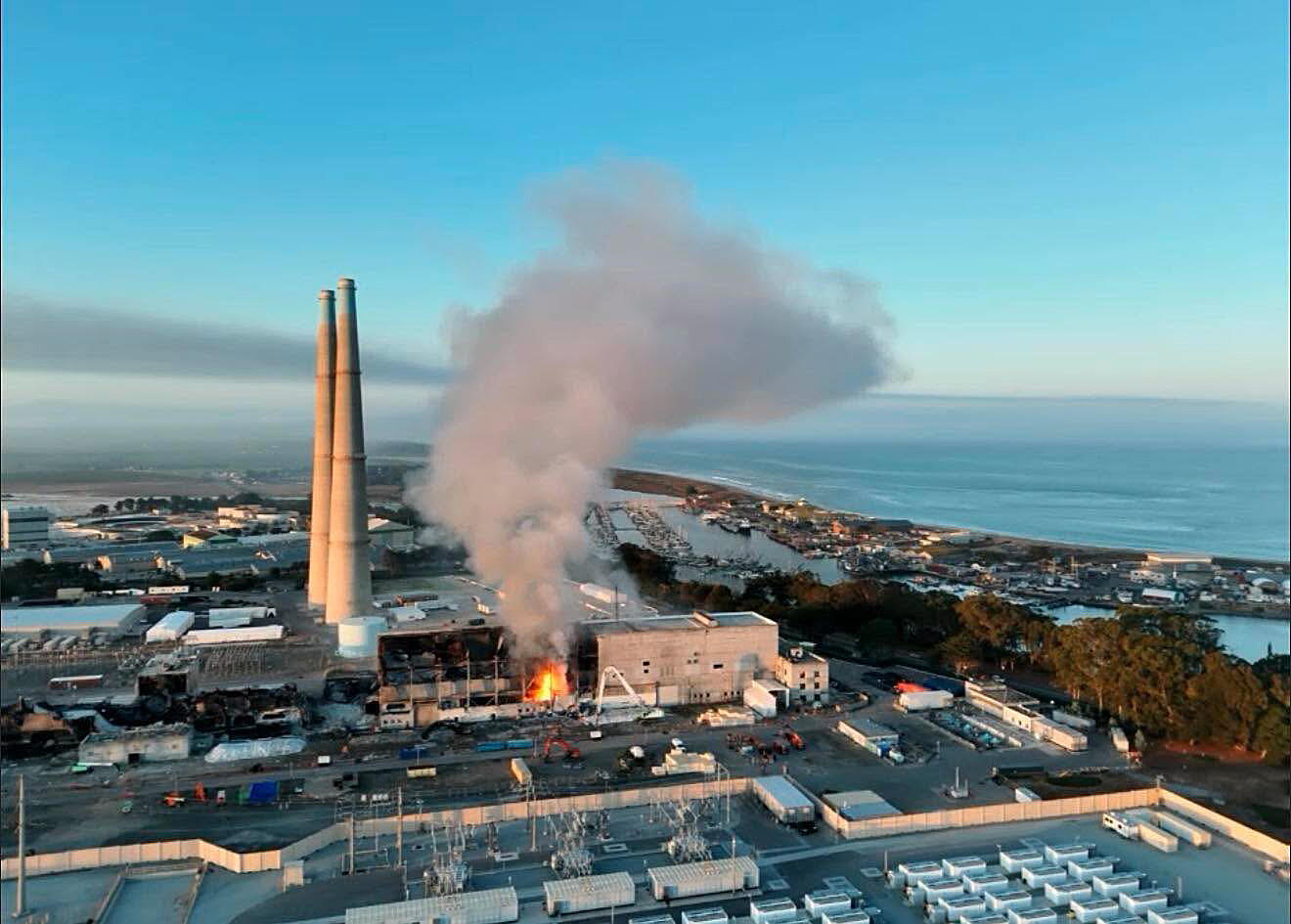
The rapid transition toward grid-scale renewable integration relies heavily on electrochemical buffering. As utility networks abandon inertial generation in favor of intermittent solar and wind resources, massive lithium-ion battery energy storage systems have become the backbone of grid stability. Yet, the physical reality of densely packed lithium-ion arrays introduces severe engineering vulnerabilities. When containment fails at facilities like the Moss Landing Power Plant, the subsequent thermal events expose fundamental flaws in current system architecture, hazard mitigation, and residual energy management. Deconstructing these failures requires moving past superficial incident reporting to analyze the operational mechanics, thermodynamic thresholds, and systemic risk factors that govern multi-gigawatt-hour storage installations.
The Thermodynamics of Thermal Runaway Escalation
At the core of every large-scale electrochemical storage failure lies an unmitigated exothermic chain reaction. Lithium-ion cells operate in a state of high thermodynamic instability. When a single cell experiences an internal short circuit, mechanical puncture, or manufacturing defect, its internal temperature spikes. This triggers a sequence of degradation steps starting with the breakdown of the solid electrolyte interphase layer, followed by separator melting, anode-cathode reactions, and electrolyte decomposition.
The primary danger is propagation. As one cell undergoes thermal runaway, it releases combustible gases—including hydrogen, carbon monoxide, and various hydrocarbons—and transfers heat to adjacent cells. In mega-scale architectures housing hundreds of thousands of individual cells, the physical proximity creates a high conduction-and-radiation environment.
- Initiation Phase: Localized electrical or mechanical stress causes internal shorting, driving temperatures past 150 degrees Celsius.
- Off-Gas Generation: Internal pressure breaches the cell vent, discharging flammable volatile organic compounds into the enclosure.
- Ignition and Propagation: Contact with an ignition source or auto-ignition triggers rapid deflagration, transferring thermal energy to neighboring modules faster than passive cooling systems can dissipate it.
Standard fire suppression systems deployed in these facilities, such as clean agents or water mist, are primarily designed to suppress open flames or cool external boundaries. They are fundamentally incapable of halting an internal chemical runaway once exothermic reactions are underway within a sealed battery module. Consequently, the fire continues to consume available fuel internally until localized reactants are exhausted or active intervention physically isolates the affected string.
The Architectural Hazard of Residual State-of-Charge
A critical vulnerability highlighted during prolonged facility outages is the presence of electrically charged units within compromised or partially destroyed structures. When a system suffers physical damage, standard grid disconnection protocols may fail due to severed telemetry lines, fused switchgear, or internal short circuits that bypass normal control pathways.
When damaged units remain in a charged state, they represent a latent energy hazard. A lithium-ion battery does not need an external grid connection to release its stored capacity; the energy is held chemically within the electrodes. If structural integrity is compromised by fire or suppression water, physical shifting can create new internal shorts. This explains why thermal events at large installations frequently reignite hours or days after the initial suppression.
Managing these compromised assets introduces an operational bottleneck for emergency responders and utility operators. Standard electrical lockout-tagout procedures assume accessible, functional isolation points. In a high-density energy storage enclosure filled with toxic soot, structural debris, and compromised high-voltage DC buses, manual intervention is impossible. Operators are forced to let residual energy dissipate through controlled burning or protracted, water-intensive cooling operations that risk environmental runoff and structural collapse.
Systemic Risks in High-Density Modular Design
The economics of grid-scale storage dictate high volumetric density. To maximize land utilization and reduce balance-of-plant costs, operators pack racks of battery modules tightly into modular enclosures or specialized buildings. While this maximizes megawatt-hour footprint efficiency, it concentrates catastrophic risk.
- Ventilation Limitations: Dense packaging restricts airflow, complicating the rapid evacuation of off-gases during early-stage venting. Accumulating gases easily reach lower explosive limits before detection systems can trigger mechanical ventilation or emergency shutdown protocols.
- Cascading Structural Failures: Enclosures are often constructed with lightweight steel or composite panels designed for thermal insulation rather than blast containment. When an internal gas accumulation ignites, the resulting overpressure pulse routinely compromises structural walls, tearing down cable trays and damaging neighboring fire suppression infrastructure.
- Monitoring Blind Spots: While Battery Management Systems monitor voltage, current, and temperature at the rack or module level, early-stage micro-shorts within individual wound jellyrolls or stacked pouches often generate negligible macro-level temperature changes until the runaway is irreversible.
These systemic factors indicate that current facility layouts prioritize capital expenditure reduction over defensive engineering redundancy.
Economic and Grid Reliability Externalities
The operational disruption of losing a major regional buffer cascades across the wider transmission grid. Facilities positioned at strategic transmission nodes provide critical frequency regulation, spinning reserve replacement, and congestion relief. When a multi-hundred-megawatt asset is taken offline due to catastrophic failure or extended forensic investigation, the regional grid operator faces an immediate capacity deficit.
This deficit forces the dispatch of higher-cost, carbon-emitting peaker plants to maintain grid stability, undercutting the environmental mandates driving the storage deployment in the first place. Furthermore, insurance markets respond to repeated catastrophic losses by repricing risk across the entire utility-scale storage sector. Premiums escalate, deductible requirements shift, and project financing becomes contingent upon rigorous, third-party safety validations that surpass current baseline building codes.
Strategic Redundancy and Engineering Overhaul
Mitigating the recurrence of catastrophic utility-scale storage fires requires a fundamental shift in design philosophy. Reliance on reactive suppression must be replaced by proactive containment and rapid electrical neutralization architectures.
Industry standards must evolve to mandate physical thermal barriers capable of withstanding localized cell explosions without transferring critical heat to adjacent units. Furthermore, automated DC-side disconnection switches must be integrated at the module level, ensuring that physically damaged or thermally stressed sections can be electronically severed and short-circuited internally into ballast resistors to drain residual state-of-charge safely before emergency personnel arrive.
Site placement and spatial separation must also be re-evaluated. Consolidating gigawatt-hour scale storage into single, contiguous footprints maximizes economic efficiency while guaranteeing catastrophic loss profiles upon containment failure. Distributing smaller, modular capacity blocks across wider geographical areas increases capital expenditure but eliminates single points of systemic grid vulnerability. The long-term viability of electrochemical grid storage depends entirely on decoupling storage scale from catastrophic failure radius.