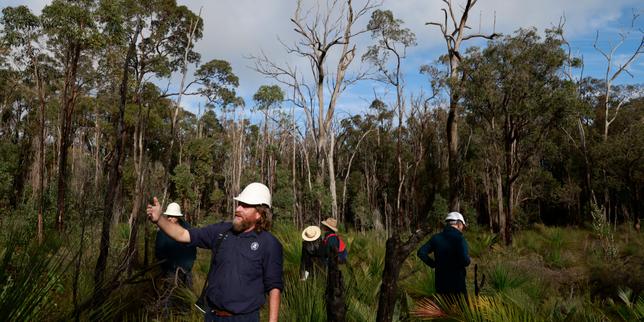
Australia faces a critical ecological misallocation regarding the management and preservation of its ancient eucalyptus forests. The core tension involves reconciling industrial land use, historical forestry policies, and the systemic degradation of biomes that perform irreplaceable carbon sequestration and hydrological regulation. Public discourse frequently reduces this conflict to a binary choice between economic output and environmental sentimentality. That framing obscures the underlying systemic drivers: perverse regulatory incentives, mispriced ecological services, and an outdated resource extraction model that externalizes long-term environmental liability onto the public balance sheet.
Deconstructing the preservation challenge requires analyzing the structural dependencies that keep industrial forestry tied to old-growth timber. The operational framework governing native forest logging relies on yield regulation models designed decades ago, which assumed a stationary climate and infinite ecological resilience. These models fail to account for cumulative stress factors, including prolonged megadroughts, intensified wildfire frequencies, and pathogen proliferation. When an ecosystem operates under non-stationary environmental conditions, historical extraction quotas cease to represent sustainable yield and instead function as a systematic depletion of natural capital.
The economic reality of native forest harvesting reveals a striking market failure. Direct financial returns from native eucalyptus logging often fail to cover the true operational and regulatory costs incurred by state agencies, creating an implicit subsidy for timber corporations. Publicly funded road infrastructure, post-logging fire management, and biodiversity mitigation are absorbed by taxpayers, while private entities capture the short-term rents of timber extraction. A rigorous cost-benefit analysis demonstrates that the net present value of leaving these forests intact—measured through watershed protection, tourism revenue, carbon storage credits, and disaster mitigation—dwarfs the economic contribution of the native timber sector.
Addressing this structural deficit requires moving beyond qualitative preservation appeals and implementing hard legislative constraints paired with economic transition mechanisms.
The first mechanism involves the immediate cessation of commercial logging in high-conservation-value old-growth and secondary growth stands. Halting extraction eliminates the compounding structural damage inflicted on forest floors and canopy structures, which drastically reduces regeneration timelines and enhances resilience against extreme weather events.
The second mechanism requires restructuring the regional labor economy through targeted transition packages for forestry dependent communities. Past conservation efforts have frequently stalled due to legitimate socio-economic anxieties among regional workforces. By decoupling regional economic survival from native forest depletion and reallocating capital toward plantation forestry, ecological restoration, and regional infrastructure, policy makers can align economic incentives with conservation outcomes. Plantations already supply the vast majority of domestic timber demand, rendering native forest logging an economically marginal enterprise with disproportionately high ecological costs.
The ultimate determinant of success will not be rhetorical commitment, but the rigorous enforcement of accountability frameworks that penalize environmental degradation and reward long-term ecological stewardship. As climate pressures mount, the preservation of ancient eucalyptus biomes transitions from an elective environmental policy to an absolute prerequisite for regional climate stabilization.