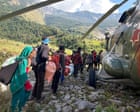
Standard disaster coverage relies on visceral descriptions of mud, displaced populations, and aggregate casualty counts. This narrative framework obscures the underlying physical, economic, and systemic vectors that transform a geological event into a catastrophic regional failure. Deconstructing the mechanics of the flash floods that struck central Nepal and the Tibet Autonomous Region reveals a predictable interaction between high-altitude cryospheric instability, rapid infrastructure density along restricted river corridors, and cascading supply chain vulnerabilities.
The Cryospheric Trigger and Geomorphic Velocity
The event was initiated not by standard monsoon precipitation, but by a high-altitude mass movement originating from the Langtang Lirung massif. A massive volume of rock and glacier ice, estimated in the hundreds of millions of cubic meters, detached from an elevation exceeding 5,000 meters.
The physics of this initial collapse dictate the severity of the downstream impact. When a high-altitude rock-ice avalanche drops vertically over a short horizontal distance, the gravitational potential energy converts into kinetic energy and intense frictional heating. This friction melts a significant fraction of the entrained ice instantly, transforming a solid debris mass into a hyper-mobile, fluid slurry.
This debris flow entered the narrow tributaries of the Bhote Koshi and Trishuli river basins. Confined within steep Himalayan gorges, the surge could not dissipate laterally. Instead, it accumulated mass by scouring riverbeds and banks, generating a high-density hyper-concentrated flow capable of carrying boulders weighing hundreds of tons. Water levels and debris surges reached elevations dozens of meters above normal river baselines in narrow valleys, neutralizing traditional floodplain assumptions and defenses.
Infrastructure Vulnerability and the Hydropower Bottleneck
The localization of the damage exposed a critical flaw in regional development strategy: the heavy concentration of linear infrastructure within active river corridors. Trans-Himalayan economic corridors rely on narrow valley bottoms for roads, trade ports, and renewable energy generation.
Himalayan watersheds represent prime territory for hydropower development due to steep elevation drops over short distances. At the time of the disaster, multiple hydropower projects and under-construction tunneling systems were active along the affected river networks. Subsurface tunnels, coffer dams, and powerhouses act as traps during a high-magnitude debris flow.
When millions of tons of sediment, silt, and rock enter a river system instantaneously, the sediment transport capacity of the river is overwhelmed. Siltation levels exceeding a meter of dense mud settled across valleys instantly, burying structures, access roads, and subterranean work sites. The economic loss extended far beyond physical plant destruction; it compromised regional energy grids and international trade links, trapping transport fleets at customs hubs like Rasuwagadhi.
Cascading Macroeconomic and Supply Chain Shockwaves
The destruction of physical capital in the border zone triggered secondary and tertiary economic contractions that rippled far beyond the immediate disaster footprint.
The primary transmission channel of the shock was logistics. The arterial roadways connecting Nepal and the Tibet Autonomous Region sustained structural severing across dozens of kilometers, alongside the destruction of vital bridges. This created an immediate trade friction penalty, halting cross-border commerce and stranding inventory.
The secondary transmission channel targeted labor markets. The informal economy, tourism operators, hospitality workers, and construction laborers lost their income-generating assets overnight. In regions where household financial buffers are thin, an asset shock of this magnitude forces negative coping strategies, including the depletion of productive capital, emergency borrowing at unsustainable interest rates, and risks of labor exploitation.
Furthermore, the destruction of educational facilities and localized primary health outposts interrupted human capital accumulation. When foundational services are simultaneously disabled across multiple districts, recovery transitions from a discrete engineering problem into a multi-year fiscal drain on national development budgets, shifting public expenditure away from growth-generating investments toward baseline rehabilitation.
Risk Mitigation Architecture for High-Altitude Corridors
Conventional flood management relies on historical hydrological data, which assumes stationary climate and geological baselines. In high-altitude Asian mountain systems, this assumption is invalid. Glacial retreat, permafrost thaw, and increased seismic activity driven by warming temperatures elevate the frequency of slope failures and outburst floods.
Effective spatial planning in these environments requires shifting from reactive disaster response to predictive risk modeling. This entails three operational shifts:
- Mandatory Setback Zones Based on Dynamic Energy Modeling: Zoning laws must prohibit permanent structural density and underground tunneling within energy-line corridors prone to high-velocity debris flows, accounting for runout distances rather than standard water-level flood plains.
- Upstream Cryospheric Monitoring Systems: Deployment of real-time seismic sensors and satellite-based InSAR (Interferometric Synthetic Aperture Radar) tracking on high-risk massifs to detect slope acceleration and glacial movement weeks before structural failure occurs.
- Redundant Trade and Energy Networks: Decentralizing energy generation and transportation routes to prevent single points of failure from isolating entire national economies during localized geographic crises.
Integrating these controls into regional development frameworks dictates whether future infrastructure investments serve as durable economic foundations or temporary assets exposed to systemic cryospheric risks.