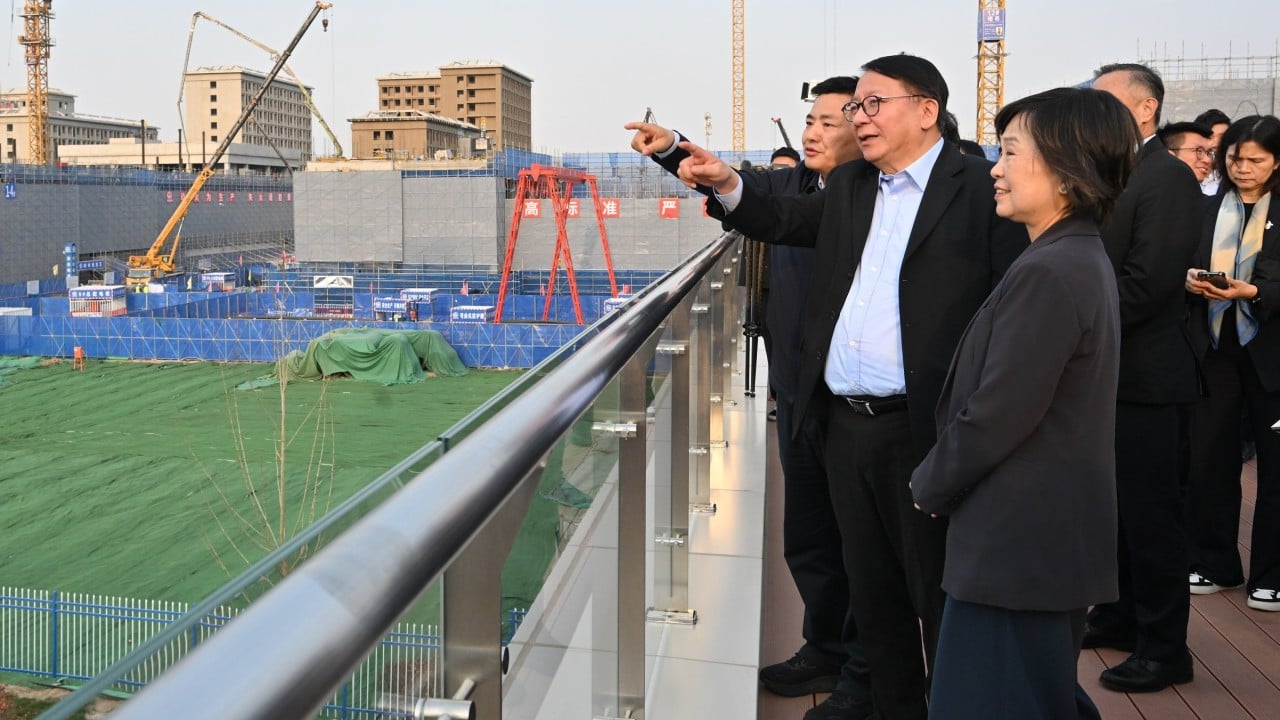
The proposed acceleration of the Northern Metropolis university town in Hong Kong represents a fundamental shift from organic urban growth toward a state-led, high-density innovation cluster. This initiative, championed by Secretary for Innovation, Technology and Industry Eric Chan following strategic consultations in mainland China, seeks to solve the structural decoupling between Hong Kong’s academic output and its industrial application. By fast-tracking this development, the government is attempting to compress the standard twenty-year urban maturation cycle into a decade, utilizing a "top-down" integration model mirrored after the success of the Greater Bay Area’s (GBA) specialized economic zones.
The Tri-Partite Value Chain of the Northern Metropolis
The success of a university town is not measured by the square footage of lecture halls but by the velocity of its "knowledge-to-capital" conversion. The Northern Metropolis strategy operates on three distinct logical planes:
- Spatial Arbitrage and Land Elasticity: Historically, Hong Kong’s university campuses have been land-constrained, limiting their ability to house large-scale laboratory facilities or pilot production lines. Moving northward creates the physical "envelope" required for Deep Tech—biotechnology, microelectronics, and new energy—which demand specific floor-to-loading ratios and specialized ventilation systems.
- Cross-Border Human Capital Flow: Positioning the town near the Shenzhen border reduces the friction of daily labor migration. This proximity allows for a dual-residency model where researchers can utilize Hong Kong’s legal protections for Intellectual Property (IP) while accessing the manufacturing supply chains of the Pearl River Delta within a sixty-minute commute.
- Institutional Clustering (The Network Effect): When multiple research universities occupy the same physical geography, the cost of shared specialized infrastructure—such as clean rooms or genomic sequencing arrays—is amortized across a larger user base.
The Economic Mechanism of "Fast-Tracking"
"Fast-tracking" is often misconstrued as merely cutting red tape. In a data-driven context, it refers to the simultaneous rather than sequential execution of urban planning, land resumption, and institutional tendering. This compressed timeline alters the Net Present Value (NPV) of the project for private investors and participating universities.
The primary mechanism here is the Land-for-Innovation Swap. The government provides land at preferential rates or via direct grants; in exchange, universities must commit to "KPI-driven" outcomes:
- Minimum patent filings per hectare.
- Required ratios of industry-sponsored research.
- Mandatory incubator space for graduate-led startups.
This shift moves the university away from the "Ivory Tower" model toward a "Foundry" model. The bottleneck in this acceleration is not financial capital, as Hong Kong maintains deep reserves, but the Regulatory Throughput. Accelerating the Environmental Impact Assessment (EIA) and zoning changes requires a legislative bypass that balances speed with long-term ecological sustainability, particularly regarding the wetland buffer zones.
Mitigating the "Ghost Town" Risk via Mixed-Use Density
A common failure mode in planned innovation hubs is the creation of a mono-cultural "Science Park" that lacks the social density required for spontaneous collaboration. To avoid this, the Northern Metropolis must solve for The Connectivity Function:
$$C = \frac{D \cdot I}{T}$$
Where $C$ is Collaboration potential, $D$ is Diversity of stakeholders (academia, venture capital, manufacturing), $I$ is the Intensity of social nodes, and $T$ is the Time cost of transit.
The strategy must prioritize the development of "Third Spaces"—cafes, shared gyms, and retail hubs—simultaneously with the academic buildings. If the residential component lags behind the office and lab space, the area becomes a "commuter colony," losing the serendipity that fuels innovation in hubs like Kendall Square or South Lake Union.
The Strategic Alignment with Mainland Industrial Policy
Eric Chan’s visit to mainland China highlights a critical dependency: the Northern Metropolis cannot exist in a vacuum. It is designed as the "Front Shop" for the "Back Factory" of the GBA.
The specific advantage for Hong Kong lies in Common Law and Capital Convertibility. Mainland firms seeking to globalize their R&D can establish a presence in the Northern Metropolis to benefit from Hong Kong’s status as a separate customs territory. This creates a de-risking layer for international talent who may be hesitant to move directly into mainland regulatory environments but are eager to access the Chinese market.
However, this creates a Symmetry Requirement. If Shenzhen’s Hetao zone offers more aggressive tax incentives or lower operational costs, the Northern Metropolis risks becoming a secondary site. The policy must ensure "Regulatory Interoperability"—where researchers can move biological samples, high-end equipment, and data across the border with minimal friction, treating the two zones as a single, integrated laboratory.
Addressing the Talent Retention Bottleneck
Building the infrastructure is secondary to the Talent Acquisition Cost. Top-tier researchers are mobile and sensitive to quality-of-life metrics. The fast-track plan must include:
- Integrated Education Ecosystems: Providing international schooling for the children of global faculty is a prerequisite, not an amenity.
- Direct-to-Residence Pathways: Streamlining the "Top Talent Pass Scheme" specifically for those located within the Northern Metropolis.
- Venture Capital Proximity: Talent stays where the "Exit" potential is highest. Attracting tier-one VC firms to set up satellite offices within the university town is essential to prevent "brain drain" back to North America or Europe.
The Cost of Strategic Misalignment
There are two primary risks to this fast-tracked development. The first is Institutional Redundancy. If the universities involved simply replicate their existing Kowloon or Hong Kong Island campuses, the Northern Metropolis becomes a glorified real estate play rather than an innovation engine. Each participating institution must be forced to specialize—one focused on AI, another on Regenerative Medicine—to prevent internal competition for the same pool of government grants.
The second risk is Macro-Economic Sensitivity. The "Fast-Track" relies on high-interest-rate environments and fluctuating global trade tensions. If the IPO market for biotech remains stagnant, the private sector's appetite for taking up space in the new town will diminish, leaving the government to subsidize a massive, underutilized asset.
The strategic play is to decouple the town’s progress from the general real estate market by anchoring it in Non-Cyclical Research Grants. By securing long-term, ten-year research commitments from multinational corporations before the first brick is laid, the government can de-risk the development. The Northern Metropolis must be marketed not as a property development, but as a sovereign-backed infrastructure play in the global race for technological supremacy.
The immediate tactical requirement is the establishment of a Unified Development Authority (UDA). This body would have the power to override departmental silos (Transport, Housing, Innovation) to ensure that the "Fast-Track" remains a cohesive logistical operation rather than a series of disconnected projects. Success will be determined by whether the first batch of graduate entrepreneurs can move from a lab bench in the Northern Metropolis to a prototype facility in Shenzhen without ever leaving a unified regulatory framework.