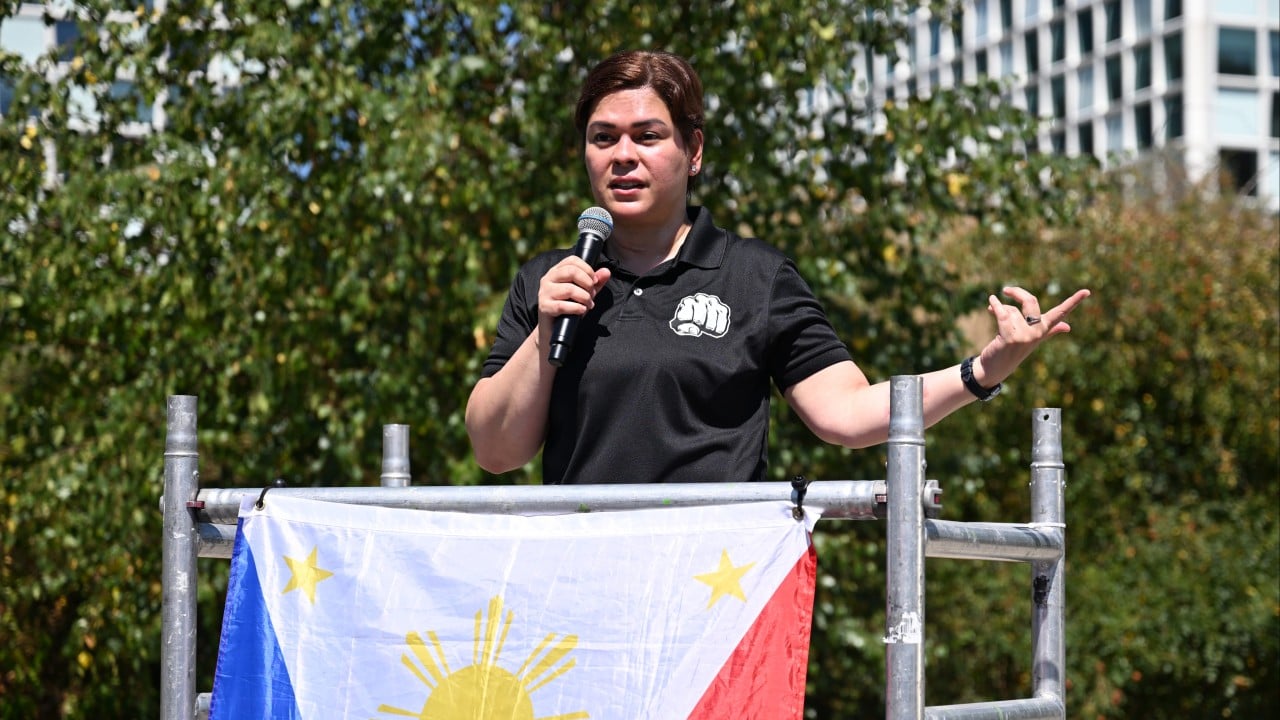
The convergence of a criminal information filing for grave threats against Philippine Vice President Sara Duterte and her ongoing Senate impeachment trial represents a stress test of institutional boundaries. When the Department of Justice formally lodged three counts of grave threats before a Quezon City Regional Trial Court, the action transitioned a political dispute into a technical jurisdictional collision. This dual-track confrontation between the executive branch's prosecutorial apparatus and an impeachable constitutional officer exposes structural vulnerabilities in how the state handles high-level threats of violence.
The Mechanics of the Escalation
The prosecution's architecture rests on statements made during a late-night media briefing in November 2024, where the Vice President detailed conditional instructions given to an intermediary regarding the physical elimination of President Ferdinand Marcos Jr., First Lady Liza Araneta-Marcos, and former House Speaker Martin Romualdez. The statutory definition of grave threats under the Revised Penal Code requires proof that an offender threatened to inflict a wrong amounting to a crime upon the person, honor, or property of another, coupled with evidence of intent. Recently making news in this space: Why The Aqeel Protests Narrative Is A Complete Distraction From The Real Crisis.
The National Bureau of Investigation initially framed this conduct under two headings: inciting to sedition and grave threats. Following preliminary investigation, the prosecutorial panel dropped the sedition charge due to an insufficient quantum of proof to establish reasonable certainty of conviction under constitutional free expression boundaries. However, the grave threats counts survived, moving from investigative dockets to trial proceedings.
The transition from speech to formal criminal charge depends on three operational criteria: More information regarding the matter are explored by Al Jazeera.
- The unequivocal nature of the conditional directive given to a third party.
- The public dissemination of the threat through broadcast and digital infrastructure.
- The absence of satirical or hyperbolic framing that would negate malicious intent under jurisprudence.
The Jurisdictional Bottleneck
The simultaneous progression of the criminal trial and the Senate impeachment proceeding creates a procedural stalemate. The defense team argues that a sitting impeachable officer cannot face concurrent criminal prosecution for an offense that also constitutes an article of impeachment. This argument relies on the doctrine of structural separation, suggesting that the impeachment court holds exclusive original jurisdiction over fitness for office, and parallel criminal proceedings threaten to preempt legislative judgment.
Conversely, constitutional scholars maintain that ordinary criminal jurisdiction operates independently of legislative impeachment. Impeachment is designed to remove individuals from public office and disqualify them from future service, whereas criminal prosecution addresses individual penal liability resulting in incarceration. The friction point is not constitutional prohibition, but resource allocation and the potential for contradictory findings of fact between a political tribunal and a trial court.
The Cost Function of Institutional Friction
This dual-track process inflicts measurable systemic drag on governance. When the Department of Justice and the judiciary absorb high-stakes political litigation, administrative bandwidth for routine criminal and civil matters diminishes.
[Public Outburst / Broadcast]
       │
       ▼
[NBI Criminal Evaluation] ──(Dismissed: Sedition)
       │
       ▼ (Survived: Grave Threats)
[DOJ Preliminary Investigation]
       │
       ▼
[Quezon City RTC Filing] ◄──► [Senate Impeachment Trial]
       │                            │
       ▼                            ▼
[Penal Sanction: 1-6 Months]  [Political Sanction: Removal & Bar]
The institutional cost manifests across three vectors:
- Evidentiary Duplication: The Senate impeachment court and the trial court evaluate identical evidentiary packages—specifically the authenticated video record of the press briefing—forcing witnesses to duplicate testimony across separate forums.
- Normative Degradation: Public trust erodes as legal arguments shift from substantive statutory interpretation to tactical delay mechanisms, reducing judicial processes to proxies for electoral positioning ahead of the 2028 presidential cycle.
- Security Reallocation: The explicit nature of the threat forced the Presidential Security Command to permanently elevate defensive postures around the chief executive, transforming standard executive protection into a mobilized operational footing.
Strategic Execution and Outlook
The trajectory of this case hinges on whether the Quezon City Regional Trial Court suspends proceedings pending the outcome of the Senate trial. If the judiciary asserts its prerogative to proceed independently, the defense must pivot from contesting the admissibility of the video evidence to establishing that the statements lacked the requisite criminal intent to execute a future wrong.
For institutional stability, the immediate imperative is the decoupling of penal accountability from legislative removal. The Senate must complete its evidentiary evaluation regarding Article IV of the Articles of Impeachment without waiting for judicial resolution, establishing clear administrative boundaries that prevent executive-legislative conflicts from permanently co-opting the lower courts.
VP Sara Duterte's video threatening to match Marcos family presented as evidence
This video documentation captures the exact evidentiary basis presented during the Senate impeachment proceedings regarding the contested public statements.
http://googleusercontent.com/youtube_content/1


