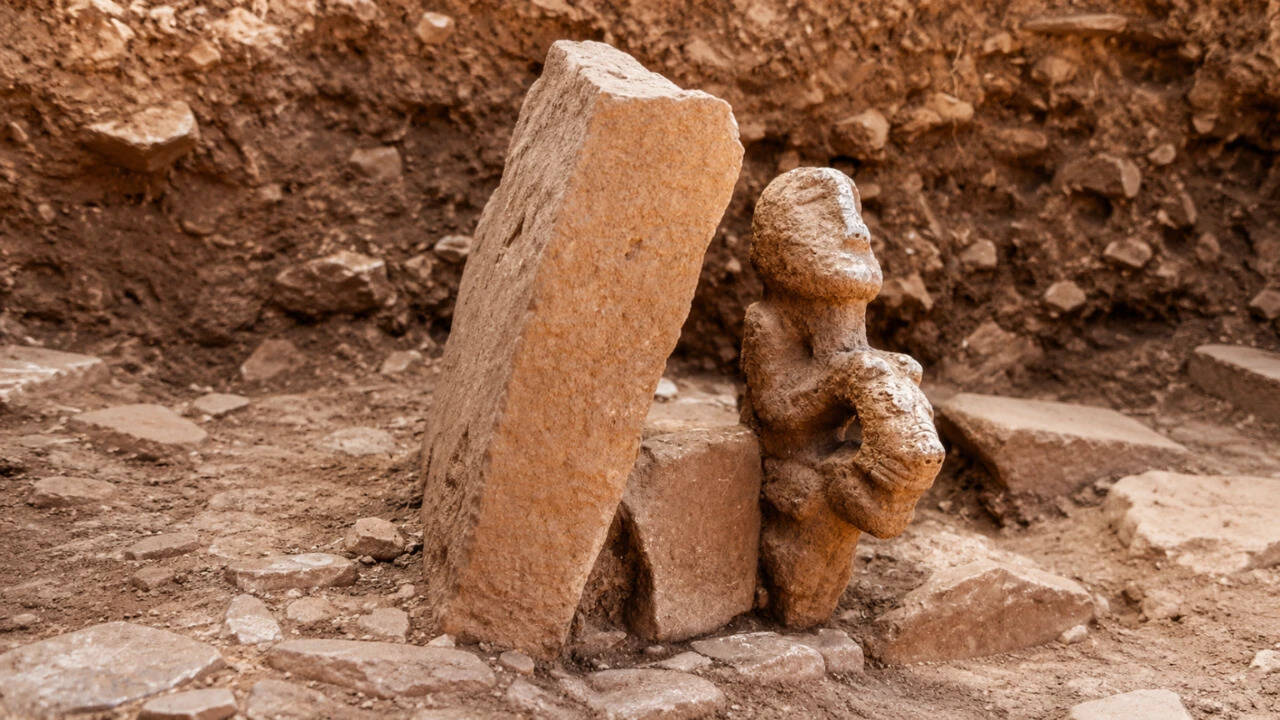
Prehistoric art recovered from the Taş Tepeler network in southeastern Türkiye exposes a fundamental shift in how early sedentary communities modeled ecological dominance. The recent excavation of a 70-centimetre limestone sculpture at Karahantepe, dating back approximately 11,000 years, shifts the visual mechanics of human-animal interactions recorded in the pre-pottery Neolithic. Rather than depicting a human burdened by a predator, the artifact presents a seated figure positioned directly atop a leopard. This architectural and sculptural artifact, discovered in situ on a stone bench within a three-metre circular structure, demands a rigorous deconstruction of the symbolic economy, spatial context, and cognitive frameworks of late epipaleolithic and early Neolithic populations.
The Spatial Matrix and Stratigraphic Context
Contextual archaeology invalidates isolated artifact interpretation. The sculpture was not recovered from a general debris layer or a secondary refuse pit; it rested upon an integrated stone platform lining the interior perimeter of a semisubterranean circular building with a flat-stone paved floor.
This specific architectural integration establishes several operational parameters:
- Fixed Placement: The artifact was designed for stationary deployment within a controlled micro-environment rather than mobile ritual transport.
- Scale-to-Space Ratio: Occupying a circular enclosure measuring approximately three metres in diameter, the 70-centimetre sculpture commands a high visual footprint relative to the available interior volume.
- Controlled Access: Small, circular structures at Karahantepe consistently point toward communal, ritual, or specialized functional use rather than domestic habitation, restricting the audience and amplifying the psychological impact of the imagery.
The spatial confinement forces an immediate engagement between any occupant entering the structure and the stone composition. The bench placement elevates the sculpture from floor level, positioning the human-leopard dyad at an intermediate eye line that commands spatial authority within the chamber.
Inverting the Predator Hierarchy
The primary analytical value of the Karahantepe find lies in its structural opposition to previously cataloged artifacts from the same site. Earlier excavations yielded human-leopard compositions characterized by an inverse physical weight distribution: sculpted human figures bore the mass of animals draped or clinging to their backs.
This stylistic reversal encodes a significant conceptual transition in apex-predator dynamics:
- The Burden Paradigm: An animal positioned on a human back communicates vulnerability, predation, or an asymmetrical tax exacted by the natural world upon the human body. The human acts as the load-bearing substrate.
- The Dominance Paradigm: A human seated on an animal flips the vector of force. The human mass rests upon the biological engine of the predator, establishing structural subordination of wild fauna to human volition.
This shift does not imply biological domestication—leopard domestication is technologically and ecologically implausible for the Pre-Pottery Neolithic A and B periods. Instead, it signals an ideological domestication. The creators of the Karahantepe corpus were systematically rewriting their cognitive relationship with the ecosystem, moving from ecological participants subject to predation to conceptual masters of the local biosphere.
The Taş Tepeler Iconographic Network
Karahantepe operates not as an isolated anomaly but as a nodal point within the broader Taş Tepeler (Stone Hills) initiative, situated roughly 30 kilometres from Göbekli Tepe. Both sites share a repertoire of monumental stone architecture, T-shaped pillars, and high-relief animal iconography. However, Karahantepe distinguishes itself through an intense concentration of figurative sculpture that explicitly binds human anatomy with lethal fauna, including snakes, foxes, and wild cats.
[Epipaleolithic Subsistence]
       │ (Ecosystem Exposure)
       ▼
[The Burden Phase]
       │ (Human bearing animal mass - Karahantepe early phase)
       ▼
[The Dominance Phase]
       *(Human seated on animal mass - The new 11,000-year-old Karahantepe find)*
The progression from abstract pillar symbols to complex, composite statutory figures reflects an escalating need to codify social hierarchy and cosmological control during the transition from mobile foraging to sedentary village life. Sedentism concentrates populations, increases resource competition, and alters human-animal interfaces. Sculptures like the leopard rider functioned as visual nodes that stabilized group identity and reinforced internal hierarchies through shared, potent mythological markers.
Methodological Boundaries and Interpretive Constraints
Rigorous analysis requires distinguishing empirical observation from speculative narrative. Modern observer bias frequently misinterprets prehistoric art through the lens of later historical tropes, such as divine rider deities or proto-shamanic domestication myths.
The physical evidence supports three strict parameters:
- Material Fact: A limestone composite sculpture, measuring 70 centimetres in height, depicting a human form atop a leopard, was carved and installed on a structural stone bench over ten millennia ago.
- Stylistic Innovation: The composition breaks the local artistic convention of human-load-bearing-animal motifs previously identified at the site.
- Functional Ambiguity: The exact semantic payload—whether mythological narrative, ancestral totem, or boundary marker—remains mathematically unprovable due to the absence of contemporaneous written records.
Attempts to assign specific theological pantheons or unrecorded tribal narratives to the object violate evidentiary standards. The analytical utility of the statue lies precisely in its unresolved tension: it captures a moment in human cognitive evolution where the boundary between human agency and predatory nature was actively being renegotiated in stone.
Strategic Allocation of Archaeological Resources
Future excavation vectors at Karahantepe must pivot from broad horizontal clearing to targeted stratigraphic and micro-morphological analysis of circular structure interiors. The preservation state of in-situ installations on stone benches provides an optimal environment for residue analysis, trace organic recovery, and spatial syntax mapping. Cross-referencing the mineral composition of the limestone matrix with regional geological surveys will isolate procurement routes, quantifying the labor cost function required to extract, transport, and carve monumental stone in the early Holocene. Only by treating prehistoric art as a product of energy expenditure, spatial economics, and cognitive adaptation can researchers decode the operational logic of the Taş Tepeler civilization.


