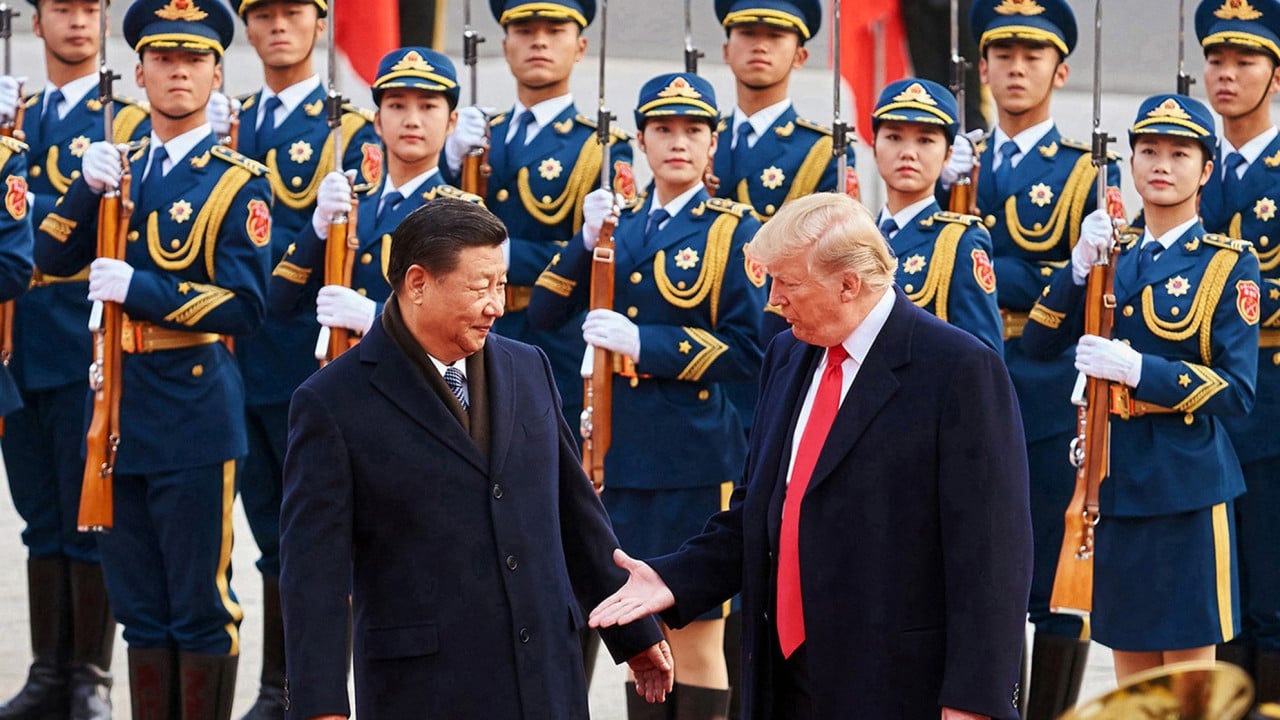
The stability of the Pacific trade corridor is currently undergoing a stress test that exceeds the capacity of traditional diplomatic protocols. When analyzing the projected state visit of Donald Trump to Beijing, the surface-level narrative focuses on "chaos" or "patience." However, a rigorous decomposition of the geopolitical landscape reveals a deeper systemic misalignment. We are witnessing a collision between two incompatible operating systems: the West’s transactional, high-volatility political cycle and China’s centralized, multi-decadal strategic planning. This misalignment creates a "diplomatic debt" where short-term political theater generates long-term structural instability.
The Triad of Diplomatic Friction
To quantify the current tension, one must examine three distinct pillars of friction that govern the interaction between the White House and Zhongnanhai.
- The Predictability Gap: Beijing’s administrative model thrives on "incrementalism." Large-scale policy shifts are signaled years in advance through Five-Year Plans and internal plenums. The current American executive approach operates on "disruptive leverage," where unpredictability is used as a tactical tool to force concessions. In control theory terms, this introduces "noise" into a system designed for "signal," leading to a defensive over-correction by Chinese regulators.
- The Asymmetry of Accountability: While a US President must answer to a fractured legislative body and a four-year electoral clock, the Chinese leadership manages internal stability through economic performance and national sovereignty narratives. Any perceived "loss of face" during a high-profile summit isn't just a PR setback for Beijing; it is a threat to the internal social contract.
- The Weaponization of Interdependence: The decoupling of supply chains—specifically in the semiconductor and EV battery sectors—has transformed trade from a mutual stabilizer into a primary theater of conflict.
The Cost Function of Unpredictable Statecraft
In standard diplomatic engagements, the "cost" of a meeting is measured in administrative man-hours and logistical spend. In the current climate, the cost function is defined by Market Risk Premiums and Regulatory Retaliation Cycles.
When a state visit is characterized by shifting agendas or last-minute demands, it triggers a "preemptive defensive posture" from the Chinese Ministry of Commerce (MOFCOM). For example, the mere threat of increased tariffs during a visit does not just affect future trade; it immediately freezes capital expenditure for multinational corporations (MNCs) operating in mainland China. The uncertainty creates a liquidity trap where firms hold cash rather than investing in R&D or infrastructure, fearing that a single tweet or a failed handshake could render their assets stranded.
The mechanism of retaliation is rarely a direct 1:1 response. Instead, China utilizes "administrative friction"—slowing down licensing, initiating anti-monopoly probes, or tightening export controls on critical minerals like gallium and germanium. This creates a hidden tax on American firms that is difficult to quantify in a single headline but devastating to quarterly earnings.
Tactical Decoupling vs. Strategic Interdependence
A critical oversight in most analyses is the failure to distinguish between rhetoric and reality regarding "decoupling." While political speeches suggest a total severance of ties, the physical infrastructure of global trade suggests a "re-routing" rather than a "removal."
The "China Plus One" strategy—where firms move assembly to Vietnam or Mexico—often conceals a persistent reliance on Chinese upstream components. The logic follows a specific bottleneck:
- Upstream: China maintains a 60% to 90% dominance in the processing of rare earth elements and lithium.
- Midstream: Manufacturing of sub-components remains centered in Chinese industrial clusters due to economies of scale.
- Downstream: Final assembly moves to third-party nations to circumvent US tariffs.
This creates a paradox where the US increases its geopolitical distance from China while maintaining, or even increasing, its supply chain vulnerability. A chaotic state visit intensifies the drive for "autarky"—economic self-sufficiency—on both sides. For China, this means the "Dual Circulation" strategy, prioritizing domestic consumption and internal tech development. For the US, it means the CHIPS Act and similar industrial policies.
The Logic of the "Patience Threshold"
Beijing’s patience is not a psychological state; it is a calculated resource. This threshold is reached when the perceived cost of maintaining a relationship exceeds the cost of a controlled rupture. Several variables determine this limit:
- The Sovereign Redlines: Issues surrounding Taiwan and the South China Sea are non-negotiable within the Chinese political framework. When US diplomatic visits overlap with these sensitivities, the "noise-to-signal ratio" becomes terminal.
- The Economic Cushion: As long as China can find alternative markets in the Global South (BRICS+ expansion), its reliance on the US consumer market diminishes, thereby lowering the cost of "saying no" to Washington.
- Technology Parity: The moment China achieves domestic self-sufficiency in high-end lithography and AI compute, the primary leverage held by the US—technology sanctions—evaporates.
Redefining the Negotiating Table
If the objective is to move beyond "chaos," the framework must shift from "Grand Bargains" to "Functional De-escalation." The standard model of seeking a comprehensive trade deal is fundamentally broken because it ignores the lack of trust.
Instead, a high-authority approach focuses on Micro-Certifications. This involves small, verifiable agreements on non-sensitive issues—such as fentanyl precursor regulation or climate-specific carbon credits—to rebuild the "diplomatic muscle memory" required for larger negotiations.
The failure to establish these micro-agreements creates a vacuum filled by nationalist rhetoric. In the US, being "tough on China" is a bipartisan requirement. In China, "standing up to hegemony" is a core pillar of the current leadership's identity. These domestic pressures act as "anchors" that prevent either side from moving toward the center during a high-stakes visit.
The Mechanism of Policy Spillover
A disorganized trip doesn't just impact trade; it has a direct spillover into global security. The lack of a "hotline" or a consistent communication channel increases the risk of accidental kinetic conflict in the Taiwan Strait. Military commanders require "intent clarity." When political leaders provide contradictory signals, the military's default response is to prepare for the worst-case scenario. This leads to an arms race in the Indo-Pacific that consumes a growing percentage of both nations' GDP, diverting funds from domestic social stability and infrastructure.
Strategic Realignment and the Path Forward
The volatility surrounding a Trump-led engagement with China is not a bug; it is a feature of a changing global order. To navigate this, stakeholders must stop looking for a return to the "Goldilocks Era" of the 1990s and early 2000s. The new reality is a Managed Competitive State.
The strategic play for the next 24 months involves:
- Supply Chain Hardening: Moving beyond "diversification" to "redundancy." This means building capacity that can survive a total freeze in Sino-American trade for 180 days.
- Back-Channel Institutionalization: Relying on sub-national actors—governors, mayors, and CEOs—to maintain functional ties while the federal level remains locked in ideological combat.
- Intellectual Property Bunkering: Transitioning from a defensive posture to an offensive one by innovating faster than the rate of IP leakage.
The upcoming diplomatic engagement will likely yield high-intensity media cycles but low-yield structural changes. The "patience" of Beijing is being reallocated toward building a world where US policy swings no longer dictate Chinese economic outcomes. Organizations and policy-makers must prepare for a bilateral relationship that is no longer defined by cooperation or competition, but by a rigorous, mutual containment. The goal is no longer to "solve" the China problem, but to manage the friction without triggering a systemic collapse.