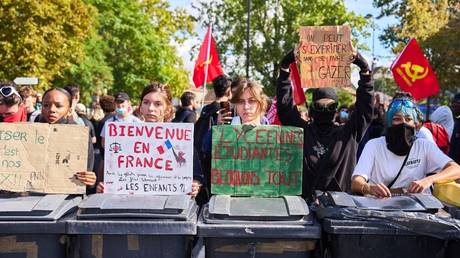
Every time smoke billows over the Latin Quarter and riot police deploy tear gas in Paris, the global media reaches for the exact same tired script. Headlines scream about youthful rebellion, radical agitation, and the fiery romance of French youth taking to the streets. Nearly two thousand arrests flash across screens, prompting hand-wringing pundits to diagnose a generation gone wild.
They are missing the entire point.
These aren't random outbursts of youthful angst. They are the rational, desperate spasms of an economic contract that has already been shredded. When nearly two thousand students get detained in a matter of weeks, blaming teenage temperament is intellectual laziness. You are looking at the smoke while ignoring the systemic arson happening inside the labor market.
For decades, the implicit social pact in France promised a clear trajectory: endure a rigorous educational gauntlet, secure your place in the university system, and step into a stable, protected professional life. That system is dead. In its place sits a bifurcated economy that locks young people out of meaningful upward mobility while insulating entrenched elders from structural reality.
The Illusion of Free Education and Guaranteed Stability
Let us dismantle the first sacred cow: the myth that affordable higher education equals social mobility. France prides itself on accessible universities. Tuition remains low, drawing praise from international observers who contrast it with the debt-load reality of American higher education.
Yet access without outcome is a cruel joke.
Universities have swelled into holding pens. They absorb hundreds of thousands of young adults because the alternative is an unforgiving job market with youth unemployment rates that consistently hover at double-digit percentages. When graduation no longer guarantees a livelihood, the university ceases to be an engine of progress. It becomes a massive waiting room for disillusionment.
Economists love to point to employment protection laws as a triumph of worker rights. They protect the insider at the direct expense of the outsider. If you manage to secure a permanent contract in the protected corporate or civil sectors, you enjoy extraordinary job security. But if you are trying to break in? You face a wall of temporary contracts, low-wage internships, and insurmountable entry barriers.
Youth bear the brunt of this protectionism. Employers hesitate to hire young workers on permanent contracts because dismissing them later proves legally and financially treacherous. So, businesses rely on a revolving door of short-term fixes. Students see this writing on the wall long before they graduate. They know the system is rigged to keep them in a perpetual state of economic precarity.
The Economics of Burning Cars
When peaceful protest yields zero structural movement, disruption becomes the only currency left.
We can lecture young demonstrators about civility all day long from comfortable offices, but let us look at the incentive structures. Peaceful marches get ignored by policymakers safely ensconced in ministries. Traffic blockades, transport strikes, and university occupations, however, force the machinery of the state to grind to a halt.
Economists call this rational behavior under extreme constraint. If the cost of maintaining the status quo means accepting a lifetime of underemployment, inflated housing costs, and diminished purchasing power, the immediate risk of arrest looks remarkably cheap.
The state responds with batons and paddy wagons because it lacks the imagination or political capital to fix the structural rot. Arresting two thousand students does not solve the underlying structural crisis; it merely clears the streets temporarily until the next boiling point arrives. It is a band-aid on a compound fracture.
Dismantling the Generational Wealth Transfer
Look deeper into the grievances driving these movements, and you will find a quiet civil war over wealth and assets.
Housing markets in major French urban centers have decoupled from local entry-level wages. Older generations accumulated property when price-to-income ratios were grounded in reality. Today's graduates face astronomical rents and a mortgage market designed for dual-income households with substantial familial backing.
When your labor fails to buy you security, shelter, or a stake in society, your political alignment shifts dramatically. You stop believing in the rules of the game. Why respect institutions that treat your future as an expendable externality?
Governments respond with temporary subsidies and targeted relief packages. These measures miss the mark entirely. Throwing a small stipend at students does nothing to fix a labor market that rejects long-term investment in human capital. It treats the symptom while the disease metastasizes.
The Real Cost of Stagnation
France is not an isolated anomaly. Across much of Western Europe, a ticking demographic and economic time bomb threatens social cohesion. Aging populations vote to protect their accumulated benefits, shifting the tax and debt burden downward onto smaller generations of workers who receive fewer structural guarantees in return.
Until policymakers summon the courage to tear up rigid labor market protections that safeguard insiders while locking youth out, the smoke in the streets of Paris will not clear. It will become a permanent atmospheric feature.
Stop treating these uprisings as policing problems. They are balance sheet problems.
Fix the economy, or keep counting the arrests.