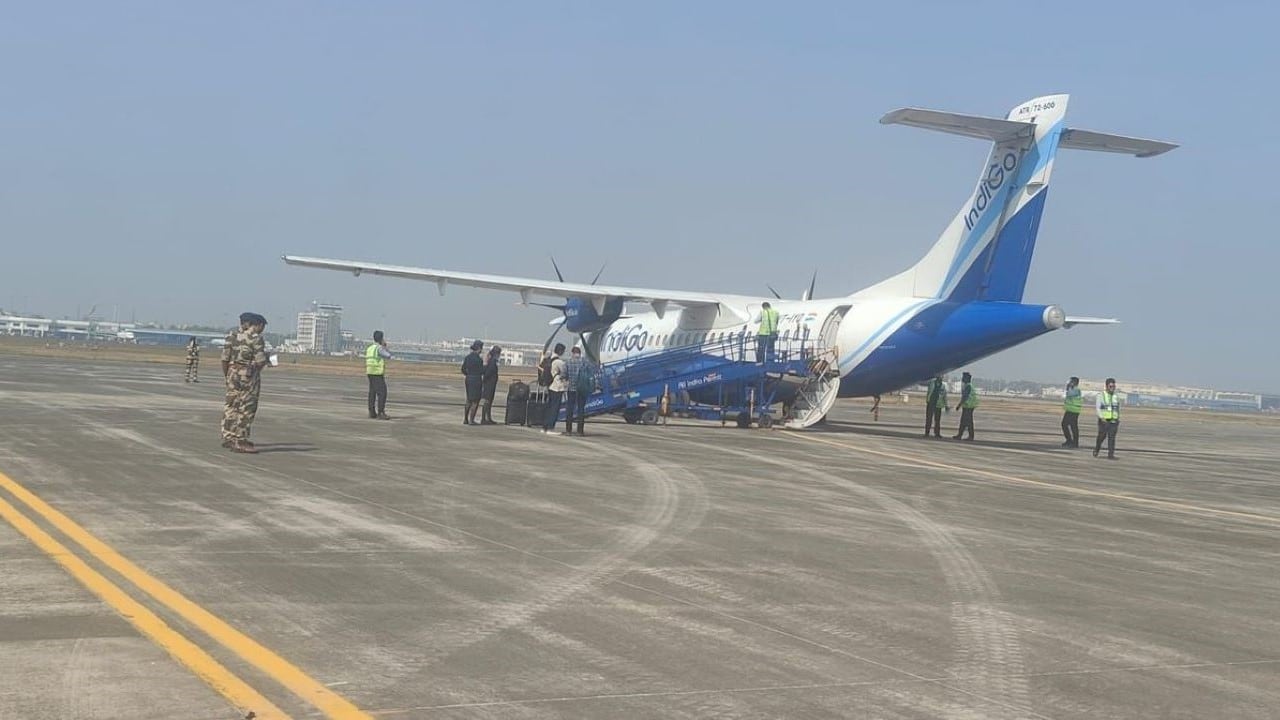
A plastic chair in an airport terminal is not designed for sleep. It is a jagged, unforgiving geometry of molded resin and cold metal. For Rohan, a twenty-four-year-old IT consultant from Hyderabad, that chair has become his entire world. He sits in the transit lounge of a silent airport, his phone battery hovering at 4%, watching the departure board turn into a wall of red text.
CANCELLED. The word repeats like a mechanical stutter. Behind that red text isn't just a logistical hiccup. It is the sound of a closing door.
As tensions between Iran and Israel escalate from rhetorical threats to the physical thunder of ballistic missiles and drone swarms, the geography of the Middle East has effectively folded in on itself. For the hundreds of Indian nationals currently caught in the crosshairs of this geopolitical tremor, the "West Asia crisis" isn't a headline. It is a frantic WhatsApp message to a mother in Kerala. It is the smell of stale coffee and the sight of a runway that has suddenly become a no-man's land.
The Invisible Ceiling
We often think of the sky as an infinite, borderless expanse. It isn't. The sky is a complex grid of invisible highways, and when the missiles start to fly, those highways are barricaded with terrifying speed.
When Iran launched its offensive, the response from civil aviation authorities was instantaneous. Jordan, Lebanon, and Iraq snapped their airspace shut. Israel followed suit. India’s national carrier and major private players like IndiGo and SpiceJet didn't just delay flights; they scrubbed them from the schedule entirely.
Imagine you are at 35,000 feet, somewhere over the Persian Gulf. You are dreaming of home, of the specific heat of a home-cooked meal. Suddenly, the pilot’s voice crackles over the intercom. The tone is calm, but the words are jagged. The plane is turning around. You are heading back to a city you just left, or worse, being diverted to a third-country hub where you have no visa, no currency, and no plan.
This is the reality for hundreds of Indian workers, students, and tourists. They are the "stranded," a word that sounds static but feels like a slow-motion collision.
The Logistics of Fear
There is a cold, mathematical side to this chaos. The Indian Ministry of External Affairs has issued travel advisories, but an advisory cannot move a body from point A to point B once the turbines stop spinning.
Consider the sheer volume of the Indian diaspora in this region. Millions of Indians live and work across the Middle East. They are the backbone of the construction industry in Dubai, the tech sectors in Tel Aviv, and the medical fields in Tehran. When the airspace closes, the nervous system of this global workforce is severed.
- Rerouting costs: A flight that usually takes seven hours might now take twelve as pilots navigate a massive detour around the conflict zone.
- Fuel burnout: Longer routes mean higher fuel consumption, which translates to skyrocketing ticket prices for those desperate to find an alternative way out.
- The Insurance Ripple: Once a region is declared a "war zone," insurance premiums for commercial aircraft go through the roof. Some airlines simply cannot afford the risk of landing, even if the runway is technically clear.
The numbers are staggering, but the numbers don't have faces. They don't have the expression of the elderly couple I saw clutching their Indian passports as if the gold-embossed lion could somehow protect them from a missile defense system.
A Ghost in the Machine
Let’s talk about the "Hypothetical Passenger," let's call her Ananya. She is a nurse in Haifa. She hasn’t seen her daughter in two years. She saved for eighteen months for a ticket to Delhi. She is at the gate. She can see the nose of the Boeing 787 through the glass.
Then, the sirens.
The airport staff disappears into bunkers. The lights flicker. On her phone, she sees the news: Iran has launched a wave of "suicide drones." In that moment, Ananya is no longer a traveler. She is a data point in a diplomatic crisis. Her ticket is now a useless piece of thermal paper.
The real tragedy of being stranded during a conflict is the loss of agency. You are at the mercy of entities that do not know your name. You are waiting for a "de-escalation" that may never come. You are watching the sky, not for your plane, but for the trail of an interceptor missile.
The Ripple Effect at Home
Back in India, the families are not sleeping. In suburban neighborhoods in Mumbai and quiet villages in Punjab, phones are being checked every thirty seconds.
The anxiety is a physical weight. Every time the news flashes a map of the Middle East glowing with strike zones, a thousand hearts in India skip a beat. The government’s helpline numbers are flooded. The Indian embassies in Tel Aviv and Tehran are working on "contingency plans," but "contingency" is a hollow word when you are hiding in a stairwell or sitting on your suitcase in a crowded terminal.
The suspension of flight operations is a victory for gravity. It pulls everyone down, pinning them to a map they desperately want to leave.
History tells us that these closures can last for days, or they can stretch into weeks. During the 2019 Balakot tensions, the closure of Pakistani airspace added hours to every flight from India to Europe, costing airlines millions and passengers their sanity. But this is different. This is a multi-front theater involving global powers. The stakes are not just about fuel or time; they are about the fundamental safety of the corridors we take for granted.
The Weight of the Silence
There is a specific kind of silence that descends on an airport when the flights are grounded. It isn’t peaceful. It is heavy. It’s the sound of wheels not turning, of announcements not being made, of a thousand whispered prayers.
The Indian government faces a monumental task. Evacuation is not as simple as sending a fleet of planes. You cannot fly into a sky filled with projectiles. You cannot land where the ground is shaking. You wait. You negotiate. You coordinate with the "Air Traffic Control" of war.
For the stranded, the biggest enemy isn't the missile. It’s the uncertainty. It’s the question of whether your company will fire you for not returning on time. It’s the dwindling balance in your bank account as you pay for an overpriced "airport hotel" that is really just a room with a cot and a flickering light.
The Human Geometry
We treat geopolitics like a game of chess played by giants. We talk about "strategic depth" and "deterrence." But the board is made of people. The pawns are the laborers in the Gulf who are sending their last few riyals home. The bishops are the students whose degrees are now on hold.
When we look at the map of the Middle East today, we shouldn't just see the borders of Iran, Israel, or Jordan. We should see the thin, vibrating lines of human lives trying to get back to where they belong.
Rohan is still in that chair. His phone has finally died. He looks out the window at the tarmac. The sun is beginning to rise over the desert, casting long, orange shadows across the grounded fleet. The planes look like sleeping birds, wings clipped by the pride of men they will never meet.
He reaches into his bag and pulls out a small, crumpled photograph of his family. He doesn't look at the departure board anymore. He knows it hasn't changed. He simply waits for the sky to open, for the invisible highways to be cleared, and for the world to remember that a suitcase is not just a container for clothes, but a vessel for a person’s entire hope of returning home.
The sky remains empty. The silence is the only thing that travels.


